DSSR-enabled G4 identification/annotation: PDB entry 143d
Summary information and primary citation
- PDB-id
- 143d
- Class
- DNA
- Method
- NMR
- Summary
- Solution structure of the human telomeric repeat d(ag3[t2ag3]3) of the g-quadruplex
- Reference
- Wang Y, Patel DJ (1993): "Solution structure of the human telomeric repeat d[AG3(T2AG3)3] G-tetraplex." Structure, 1, 263-282. doi: 10.1016/0969-2126(93)90015-9.
- Abstract
- Background: Repeats of Gn sequences are detected as
single strand overhangs at the ends of eukaryotic
chromosomes together with associated binding proteins. Such
telomere sequences have been implicated in the replication
and maintenance of chromosomal termini. They may also
mediate chromosomal organization and association during
meiosis and mitosis.
Results: We have determined the three-dimensional solution structure of the human telomere sequence, d[AG3(T2AG3)3] in Na(+)-containing solution using a combined NMR, distance geometry and molecular dynamics approach (including relaxation matrix refinement). The sequence, which contains four AG3 repeats, folds intramolecularly into a G-tetraplex stabilized by three stacked G-tetrads which are connected by two lateral loops and a central diagonal loop. Of the four grooves that are formed, one is wide, two are of medium width and one is narrow. The alignment of adjacent G-G-G segments in parallel generates the two grooves of medium width whilst the antiparallel arrangement results in one wide and one narrow groove. Three of the four adenines stack on top of adjacent G-tetrads while the majority of the thymines sample multiple conformations.
Conclusions: The availability of the d[AG3(T2AG3)3] solution structure containing four AG3 human telomeric repeats should permit the rational design of ligands that recognize and bind with specificity and affinity to the individual grooves of the G-tetraplex, as well as to either end containing the diagonal and lateral loops. Such ligands could modulate the equilibrium between folded G-tetraplex structures and their unfolded extended counterparts. - G4 notes
- 3 G-tetrads, 1 G4 helix, 1 G4 stem, UDDU, anti-parallel:basket, 2+2, 3(-LwD+Ln)
Cartoon-block schematics in six views (download the tarball)
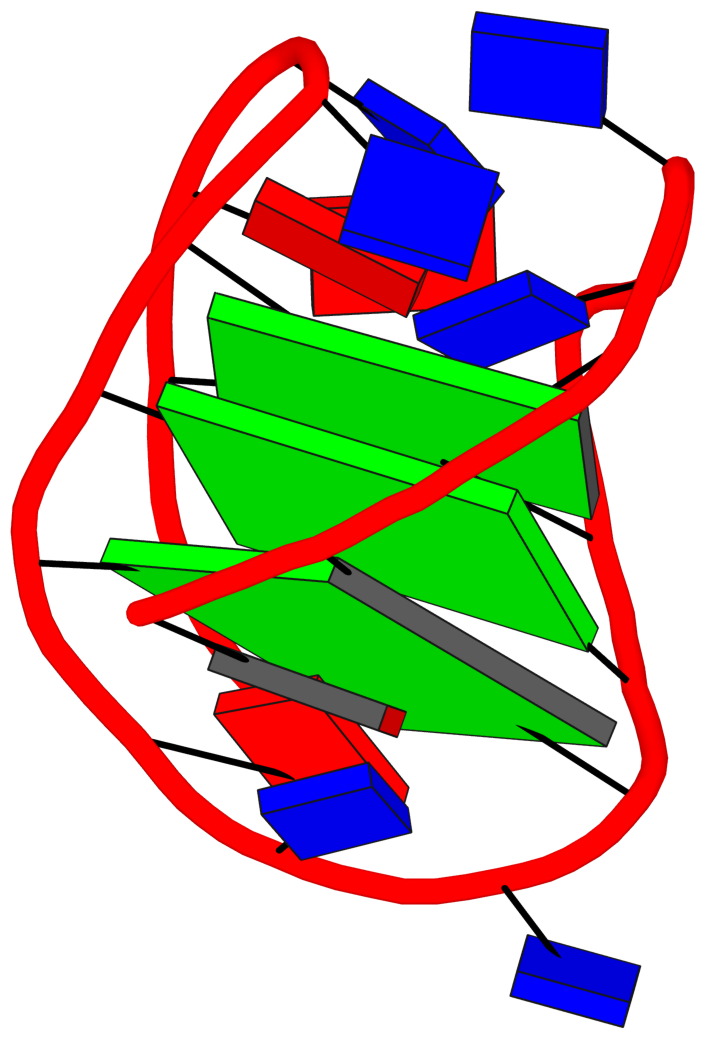
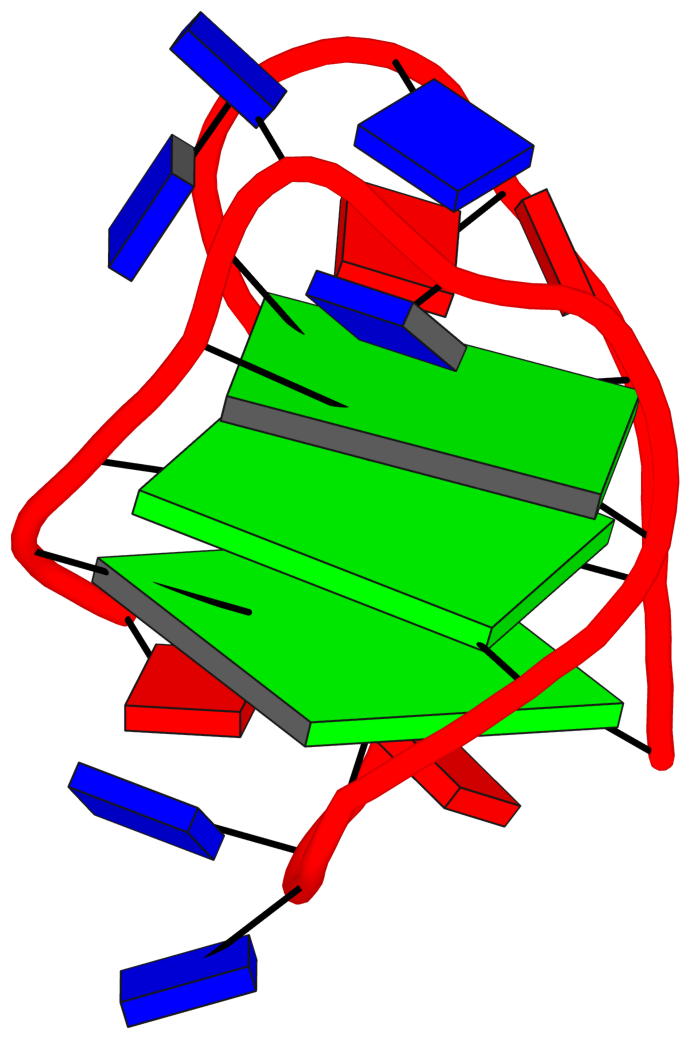
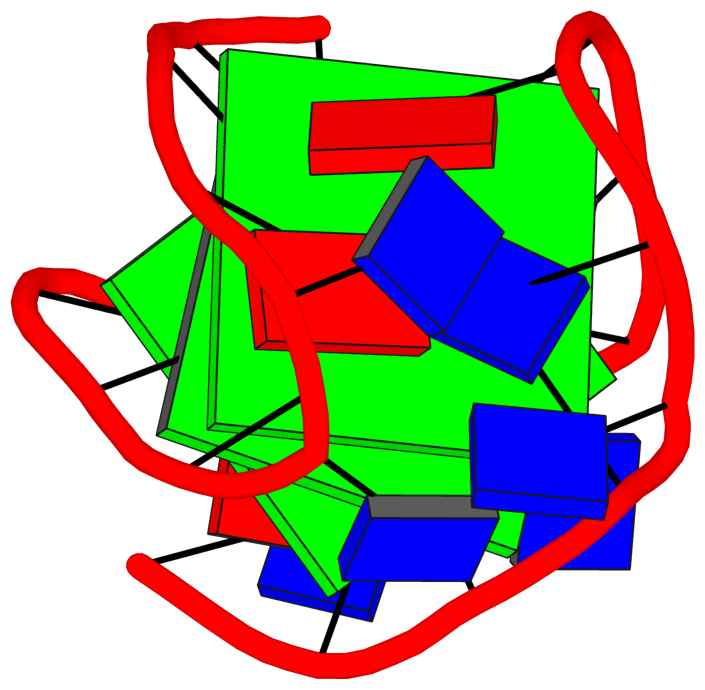
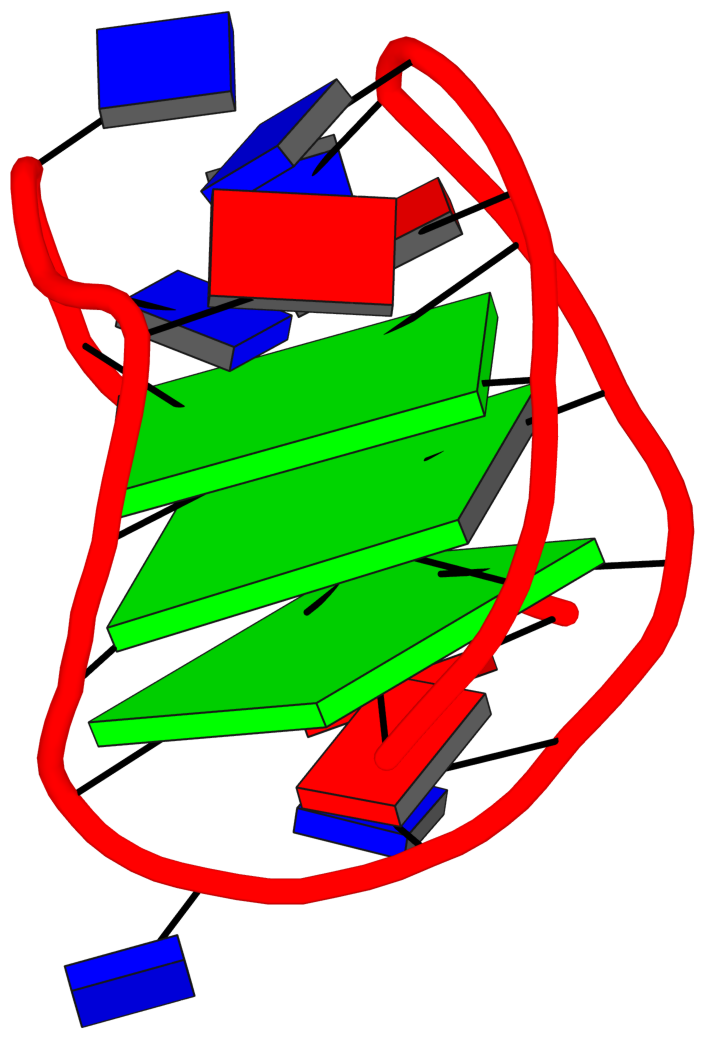
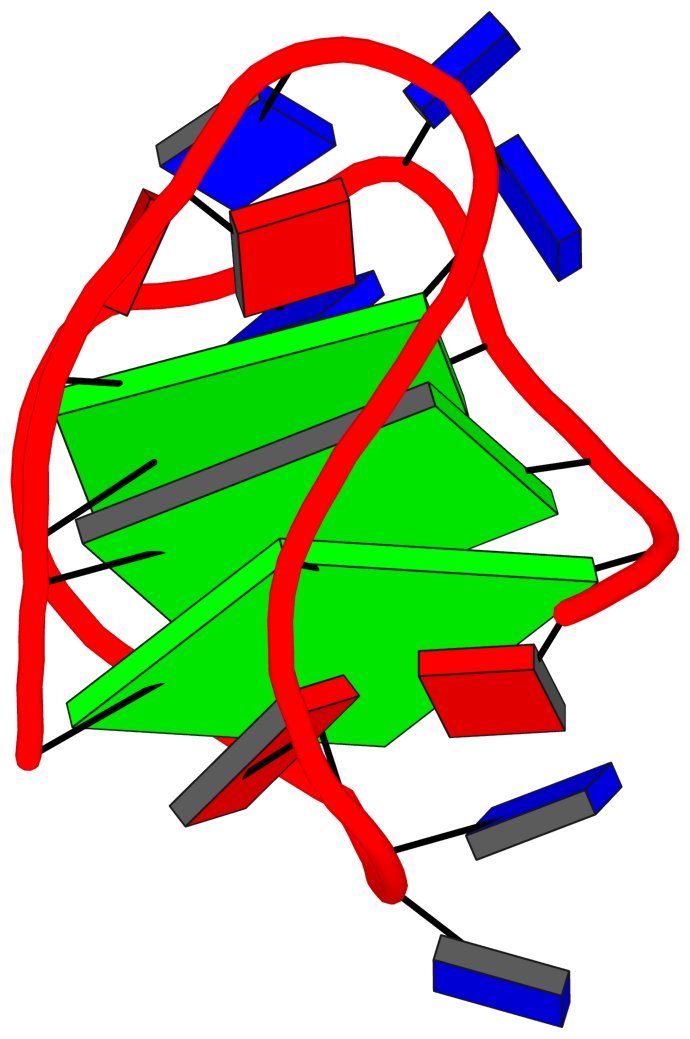
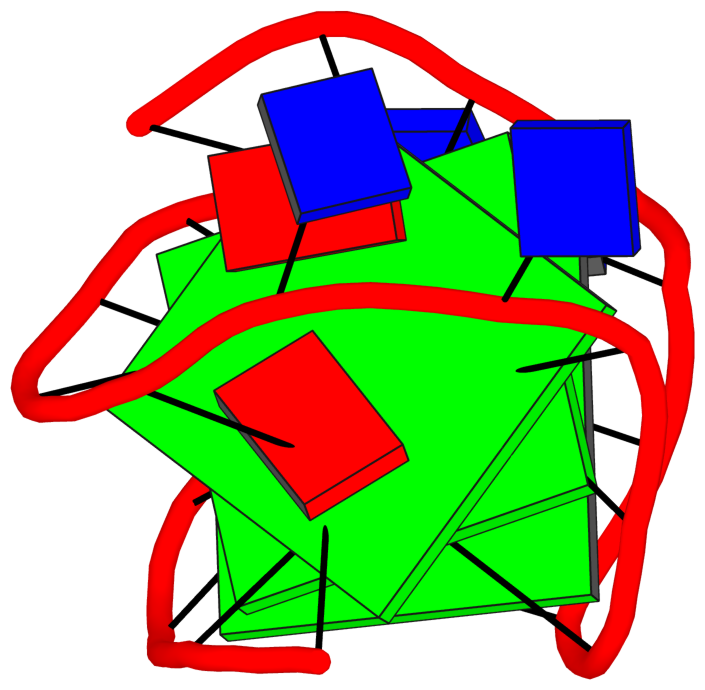
List of 3 G-tetrads
 1 glyco-bond=-ss- sugar=---- groove=w-n- planarity=0.412 type=other  N+ nts=4 GGGG A.DG2,A.DG10,A.DG22,A.DG14
 2 glyco-bond=s--s sugar=.--- groove=w-n- planarity=0.275 type=bowl   N- nts=4 GGGG A.DG3,A.DG9,A.DG21,A.DG15
 3 glyco-bond=-ss- sugar=---- groove=w-n- planarity=0.341 type=other  N+ nts=4 GGGG A.DG4,A.DG8,A.DG20,A.DG16
List of 1 G4-helix
In DSSR, a G4-helix is defined by stacking interactions of G-tetrads, regardless of backbone connectivity, and may contain more than one G4-stem.
Helix#1, 3 G-tetrads, INTRA-molecular, with 1 stem
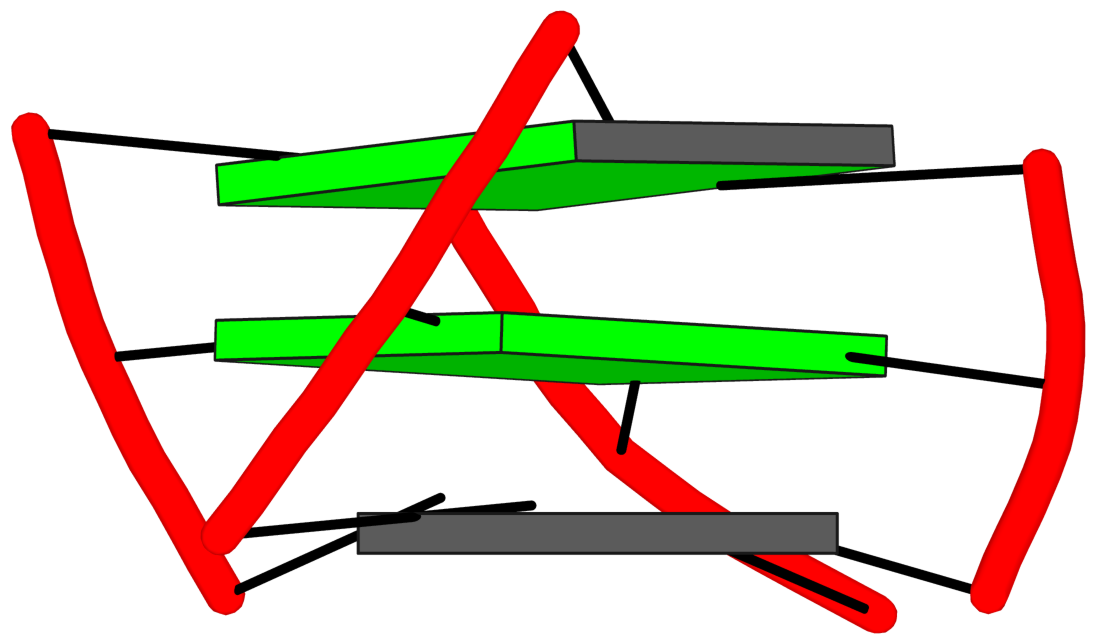
|
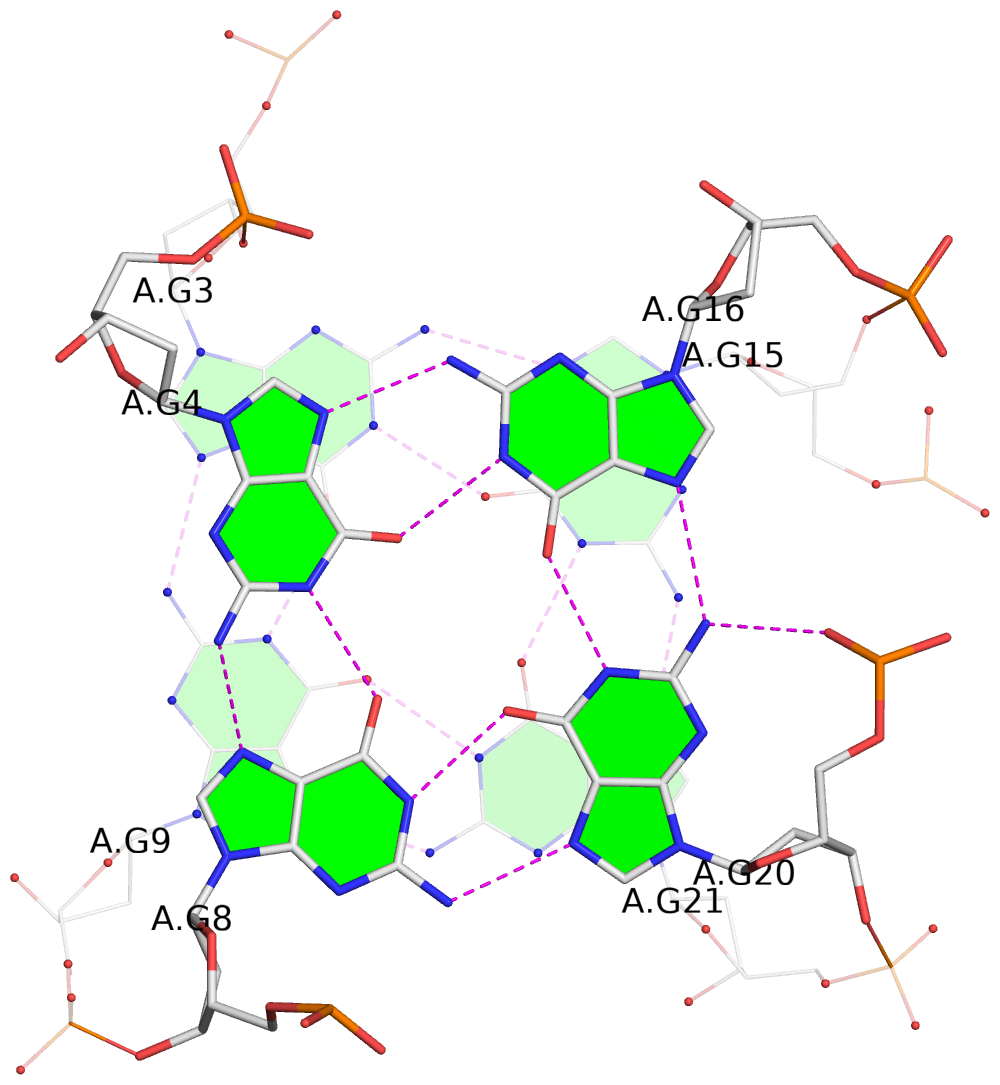
1 glyco-bond=-ss- sugar=---- groove=w-n- WC-->Major N+ nts=4 GGGG A.DG2,A.DG10,A.DG22,A.DG14 2 glyco-bond=s--s sugar=.--- groove=w-n- Major-->WC N- nts=4 GGGG A.DG3,A.DG9,A.DG21,A.DG15 3 glyco-bond=-ss- sugar=---- groove=w-n- WC-->Major N+ nts=4 GGGG A.DG4,A.DG8,A.DG20,A.DG16 step#1 pp(><,inward) area=15.12 rise=3.70 twist=36.6 step#2 mm(<>,outward) area=14.88 rise=3.71 twist=11.7 strand#1 DNA glyco-bond=-s- sugar=-.- nts=3 GGG A.DG2,A.DG3,A.DG4 strand#2 DNA glyco-bond=s-s sugar=--- nts=3 GGG A.DG10,A.DG9,A.DG8 strand#3 DNA glyco-bond=s-s sugar=--- nts=3 GGG A.DG22,A.DG21,A.DG20 strand#4 DNA glyco-bond=-s- sugar=--- nts=3 GGG A.DG14,A.DG15,A.DG16 |
| 2 stacking diagrams | |
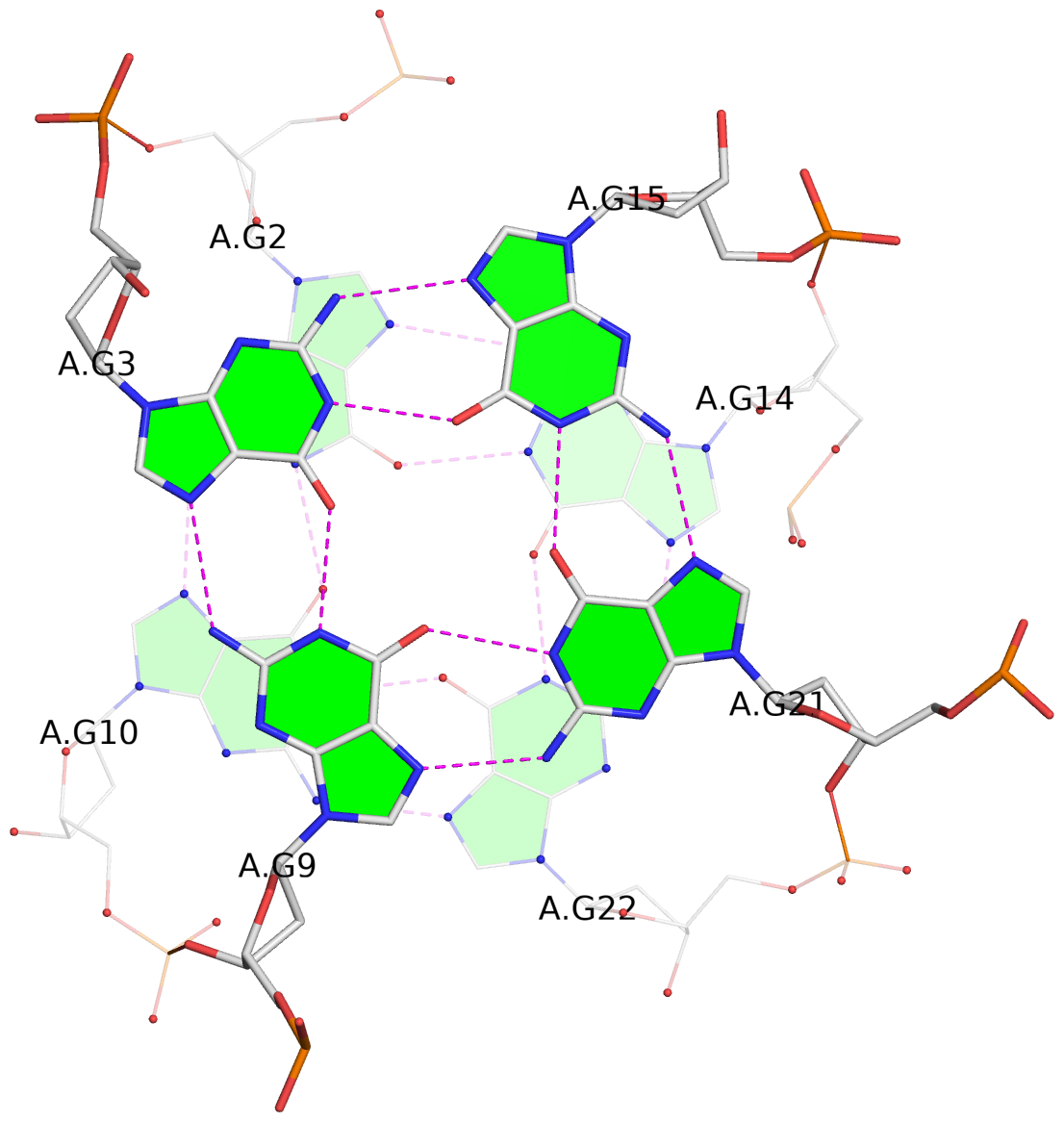
|
1 glyco-bond=-ss- sugar=---- groove=w-n- WC-->Major N+ nts=4 GGGG A.DG2,A.DG10,A.DG22,A.DG14 |
|
2 glyco-bond=s--s sugar=.--- groove=w-n- Major-->WC N- nts=4 GGGG A.DG3,A.DG9,A.DG21,A.DG15 |
List of 1 G4-stem
In DSSR, a G4-stem is defined as a G4-helix with backbone connectivity. Bulges are also allowed along each of the four strands.
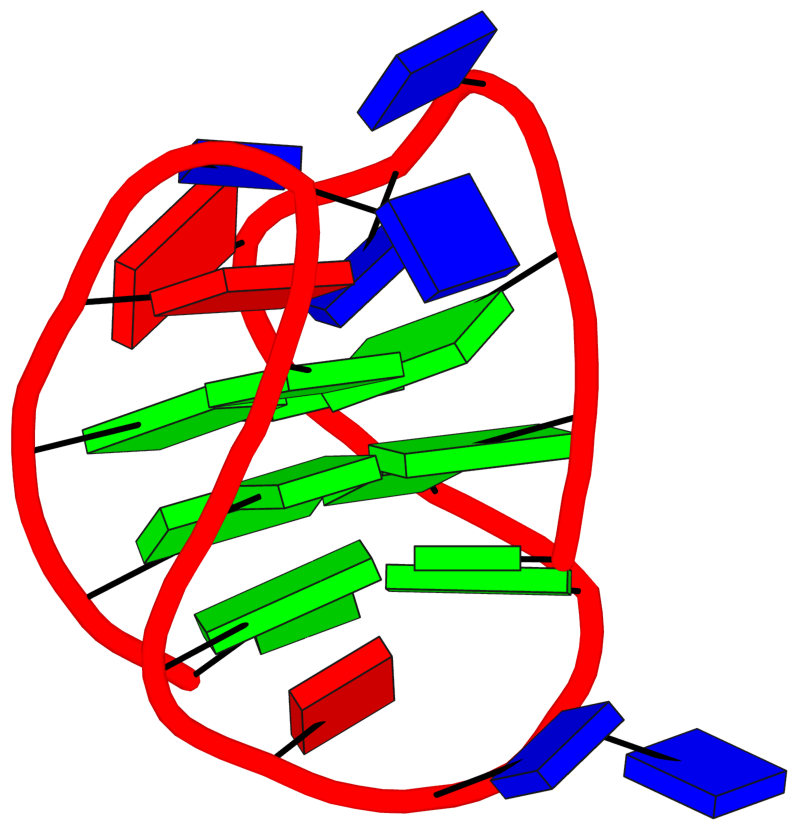
Stem#1, 3 G-tetrads, 3 loops, INTRA-molecular, UDDU, anti-parallel:basket, 2+2, 3(-LwD+Ln)
|
1 glyco-bond=-ss- sugar=---- groove=w-n- WC-->Major N+ nts=4 GGGG A.DG2,A.DG10,A.DG22,A.DG14 2 glyco-bond=s--s sugar=.--- groove=w-n- Major-->WC N- nts=4 GGGG A.DG3,A.DG9,A.DG21,A.DG15 3 glyco-bond=-ss- sugar=---- groove=w-n- WC-->Major N+ nts=4 GGGG A.DG4,A.DG8,A.DG20,A.DG16 step#1 pp(><,inward) area=15.12 rise=3.70 twist=36.6 step#2 mm(<>,outward) area=14.88 rise=3.71 twist=11.7 strand#1 U DNA glyco-bond=-s- sugar=-.- nts=3 GGG A.DG2,A.DG3,A.DG4 strand#2 D DNA glyco-bond=s-s sugar=--- nts=3 GGG A.DG10,A.DG9,A.DG8 strand#3 D DNA glyco-bond=s-s sugar=--- nts=3 GGG A.DG22,A.DG21,A.DG20 strand#4 U DNA glyco-bond=-s- sugar=--- nts=3 GGG A.DG14,A.DG15,A.DG16 loop#1 type=lateral strands=[#1,#2] nts=3 TTA A.DT5,A.DT6,A.DA7 loop#2 type=diagonal strands=[#2,#4] nts=3 TTA A.DT11,A.DT12,A.DA13 loop#3 type=lateral strands=[#4,#3] nts=3 TTA A.DT17,A.DT18,A.DA19 |