DSSR-enabled G4 identification/annotation: PDB entry 1a6h
Summary information and primary citation
- PDB-id
- 1a6h
- Class
- DNA
- Method
- NMR
- Summary
- DNA quadruplex containing gcgc tetrad, NMR, 4 structures
- Reference
- Kettani A, Kumar RA, Patel DJ (1995): "Solution structure of a DNA quadruplex containing the fragile X syndrome triplet repeat." J.Mol.Biol., 254, 638-656. doi: 10.1006/jmbi.1995.0644.
- Abstract
- Both X-ray and NMR structural studies have defined the polymorphic nature of G-quadruplexes generated through mutual stacking of G.G.G.G tetrads by guanine rich telomeric sequences. Recently, the fragile X syndrome d(C-G-G)n triplet nucleotide repeat has been shown to form a stable quadruplex of undefined structure in monovalent cation solution. We have undertaken a structural characterization of the d(G-C-G-G-T3-G-C-G-G) undecanucleotide to elucidate the structural alignments associated with quadruplex formation by this oligomer which contains sequence elements associated with the fragile X syndrome triplet repeat. d(G-C-G-G-T3-G-C-G-G) in Na+ cation solution forms a quadruplex through dimerization of two symmetry related hairpins with the lateral connecting T3 loops positioned at opposite ends of the quadruplex. This novel NMR-molecular dynamics based solution structure contains internal G.C.G.C tetrads sandwiched between terminal G.G.G.G tetrads. Watson-Crick G.C base-pairs within individual hairpins dimerize through their major groove edges using bifurcated hydrogen bonds to form internal G(anti).C(anti).G(anti).C(anti) tetrads. Adjacent strands are anti-parallel to each other around the symmetric G-quadruplex which contains two distinct narrow and two symmetric wide grooves. By contrast, the terminal G-tetrads adopt G(syn).G(anti).G(syn).G(anti) alignments. The structure of the d(G-C-G-G-T3-G-C-G-G) quadruplex with its multi-layer arrangement of G.G.G.G and G.C.G.C tetrads greatly expands on our current knowledge of quadruplex folding topologies. Our results establish the pairing alignments that can be potentially utilized by the fragile X syndrome triplet repeat to form quadruplex structures through dimerization of hairpin stems. The formation of novel G.C.G.C tetrads through dimerization of Watson-Crick G.C base-pairs is directly relevant to the potential pairing alignments of helical stems in genetic recombination.
- G4 notes
- 4 G-tetrads, 1 G4 helix, 1 G4 stem, UDUD, anti-parallel:chair, 2+2
Cartoon-block schematics in six views (download the tarball)
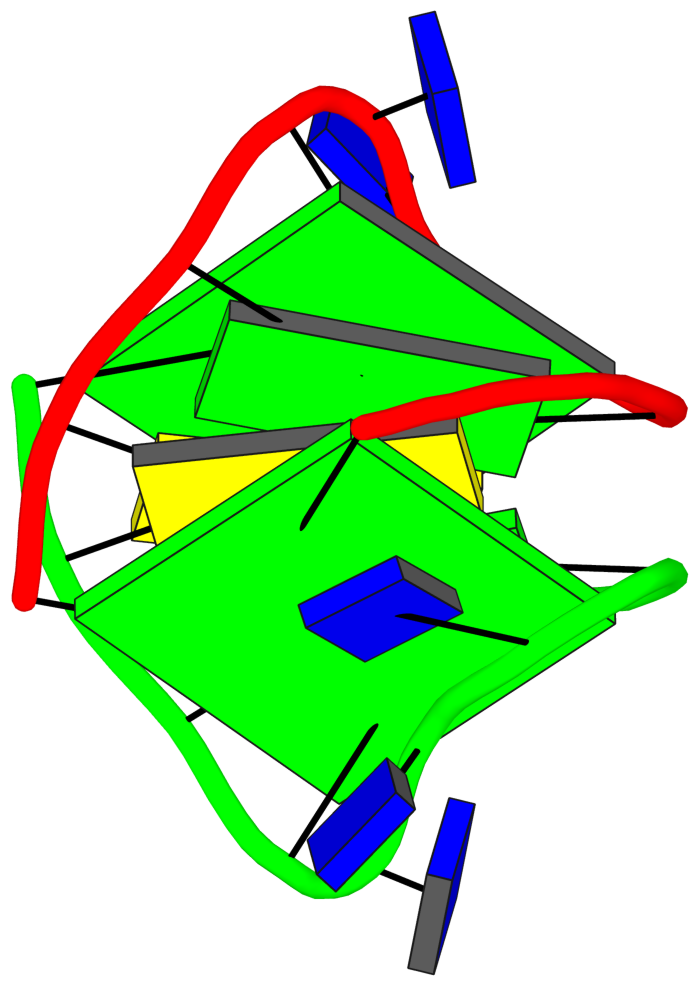
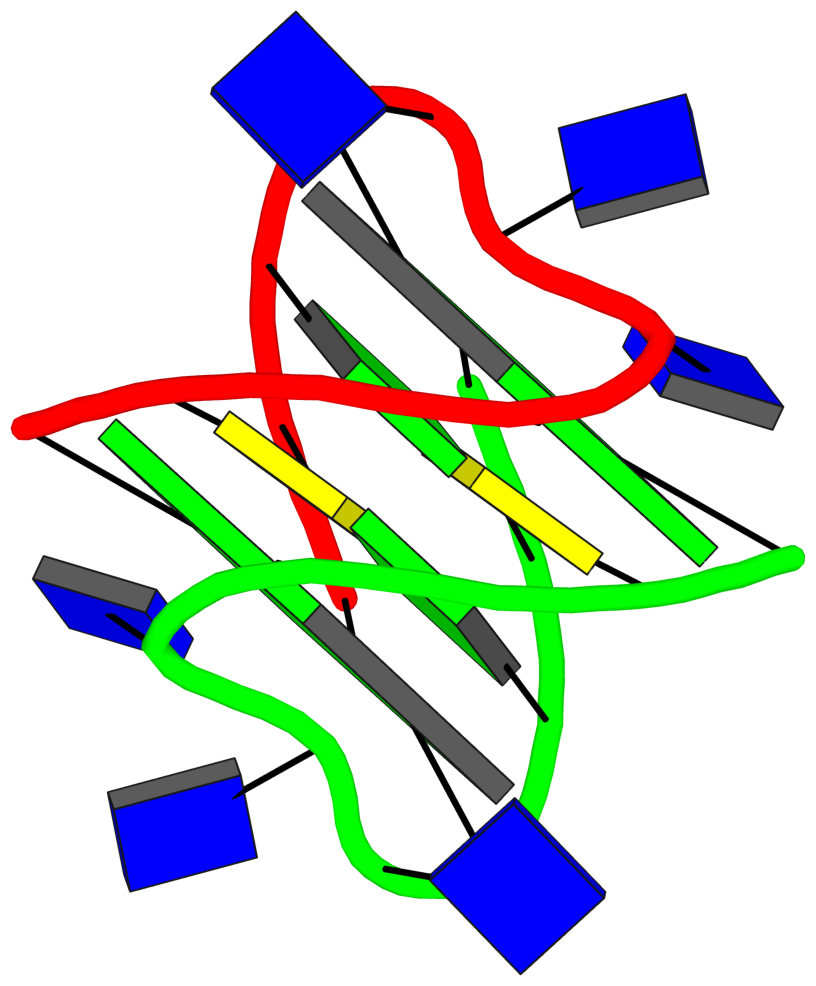
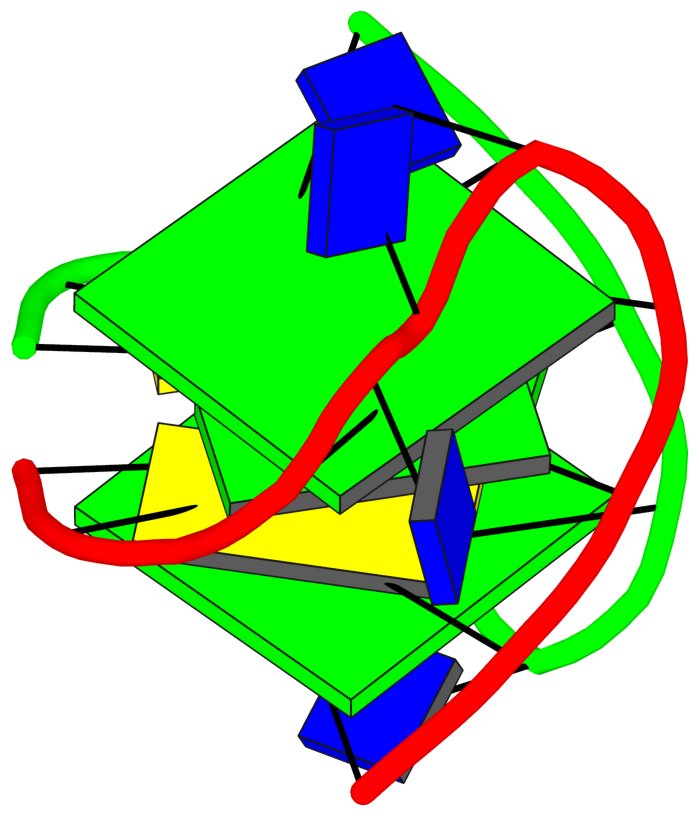
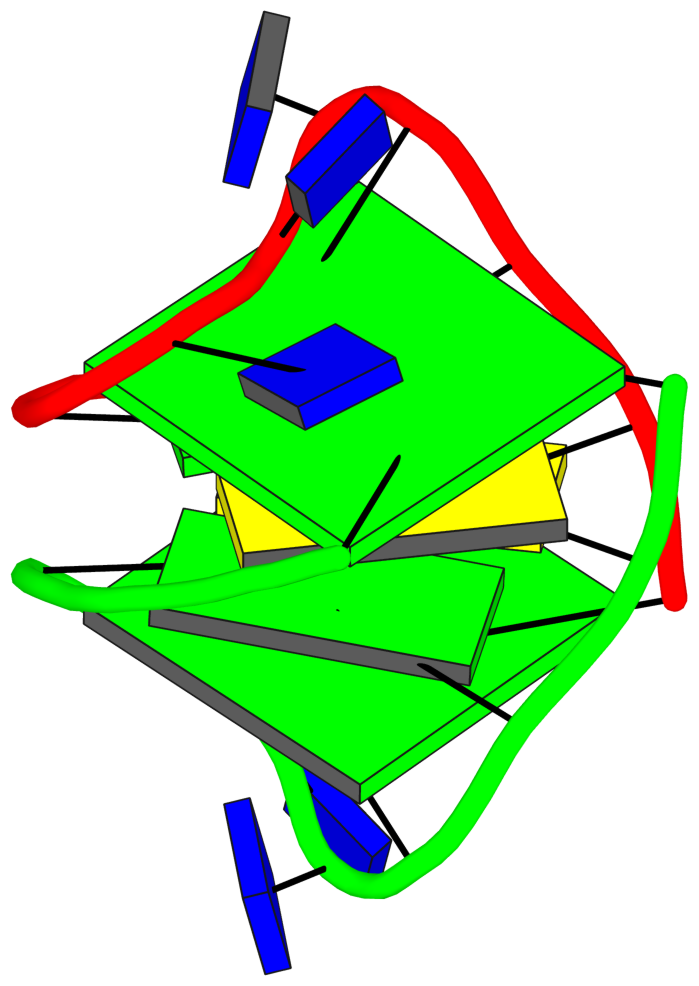
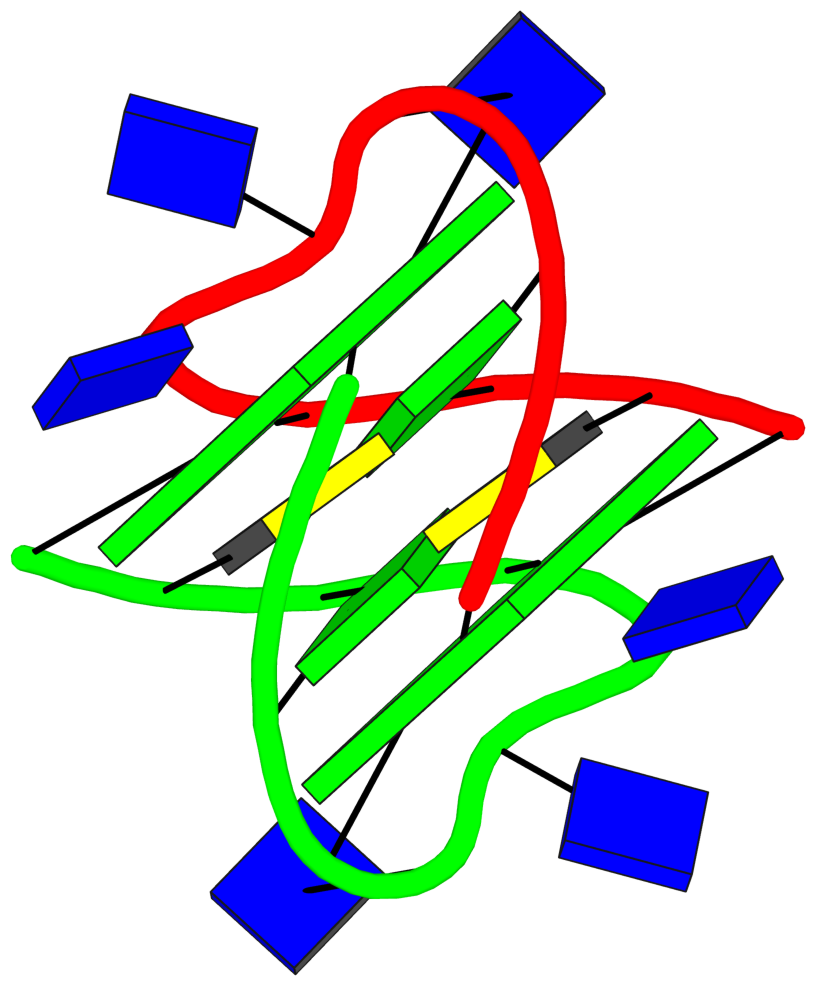
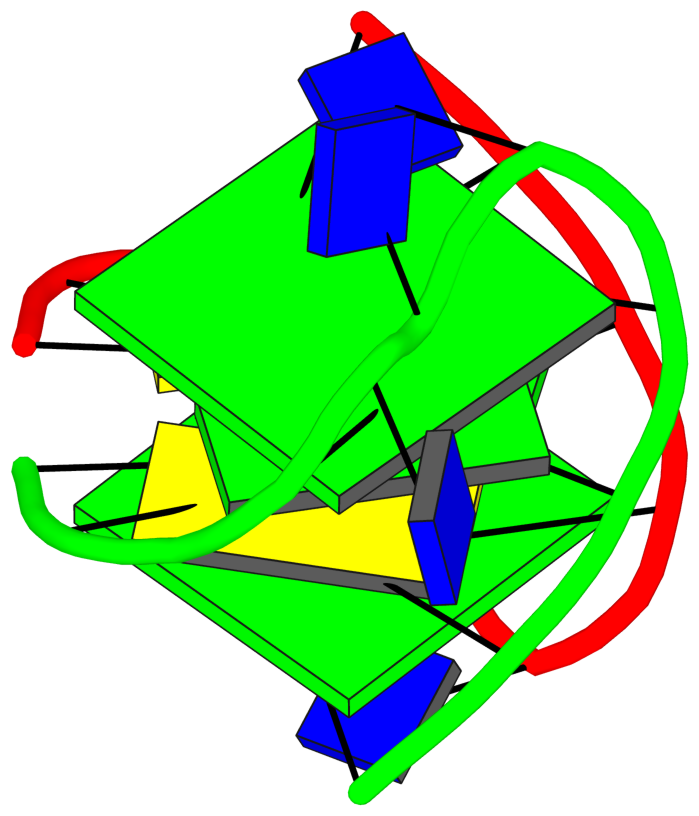
List of 4 G-tetrads
 1 glyco-bond=s-s- sugar=---. groove=wnwn planarity=0.390 type=bowl   -- nts=4 GGGG A.DG1,A.DG11,B.DG8,B.DG4
 2 glyco-bond=---- sugar=-.-- groove=---- planarity=0.175 type=other  -- nts=4 CGCG A.DC2,A.DG10,B.DC9,B.DG3
 3 glyco-bond=---- sugar=--.- groove=---- planarity=0.175 type=other  -- nts=4 GCGC A.DG3,A.DC9,B.DG10,B.DC2
 4 glyco-bond=-s-s sugar=.--- groove=wnwn planarity=0.391 type=bowl   -- nts=4 GGGG A.DG4,A.DG8,B.DG11,B.DG1
List of 1 G4-helix
In DSSR, a G4-helix is defined by stacking interactions of G-tetrads, regardless of backbone connectivity, and may contain more than one G4-stem.
Helix#1, 4 G-tetrads, inter-molecular, with 1 stem
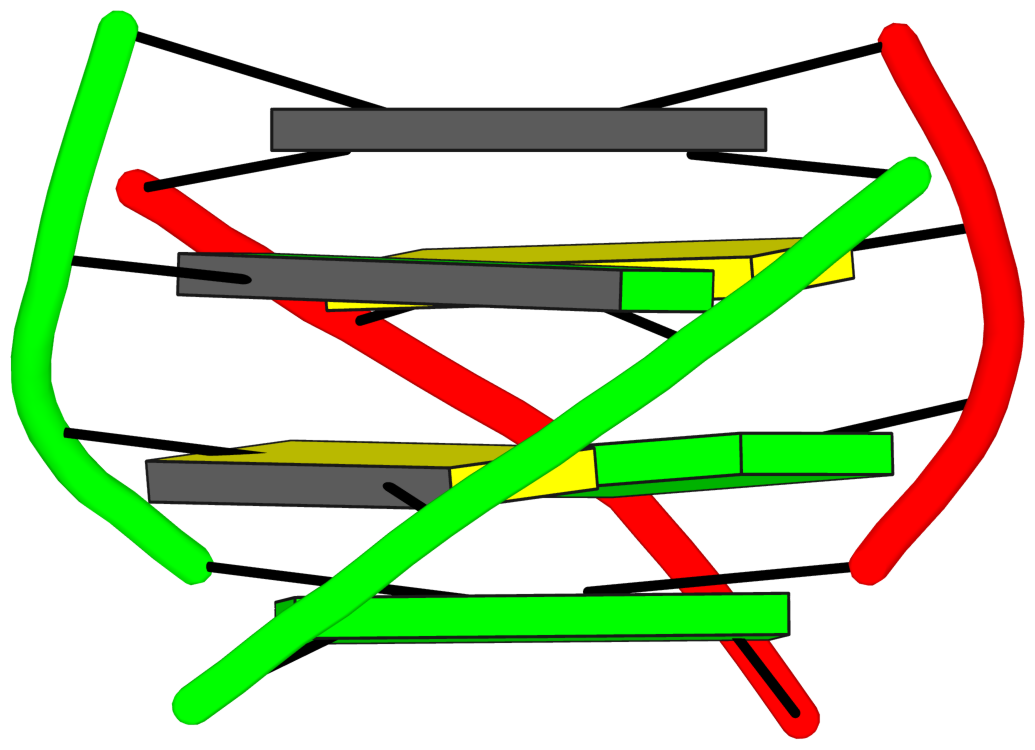
|
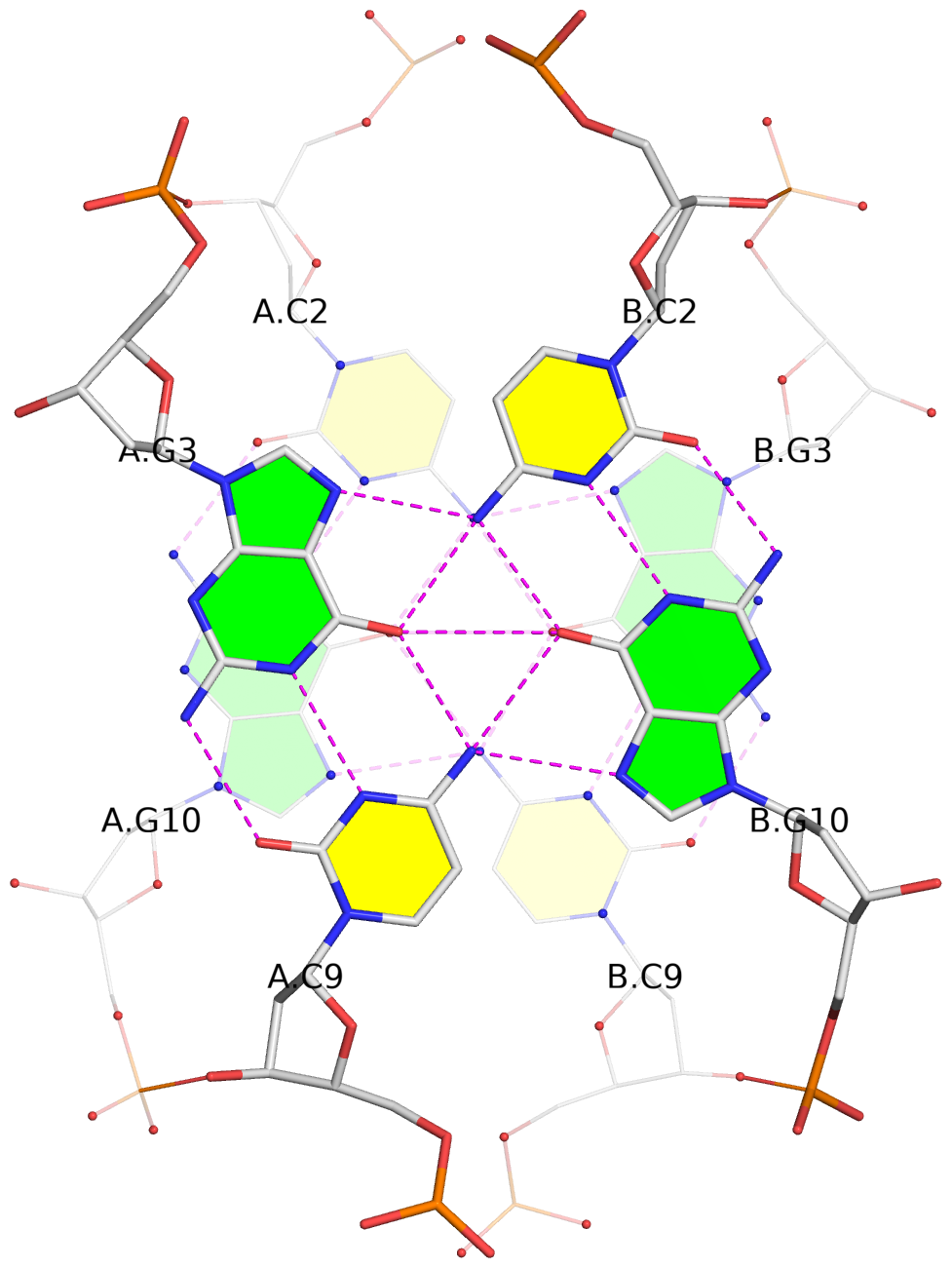
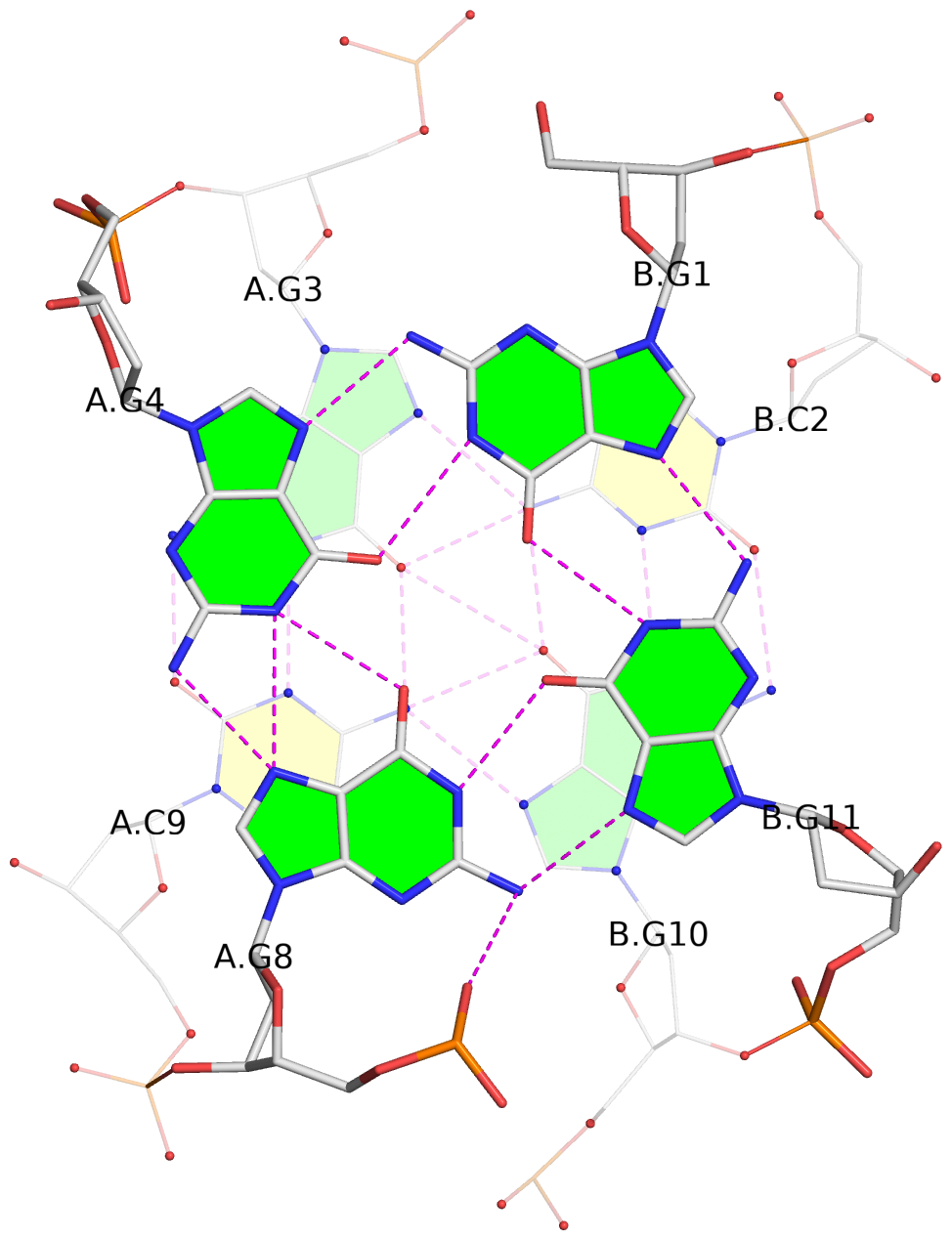
1 glyco-bond=s-s- sugar=---. groove=wnwn Major-->WC -- nts=4 GGGG A.DG1,A.DG11,B.DG8,B.DG4 2 glyco-bond=---- sugar=-.-- groove=---- -- -- nts=4 CGCG A.DC2,A.DG10,B.DC9,B.DG3 3 glyco-bond=---- sugar=--.- groove=---- -- -- nts=4 GCGC A.DG3,A.DC9,B.DG10,B.DC2 4 glyco-bond=-s-s sugar=.--- groove=wnwn WC-->Major -- nts=4 GGGG A.DG4,A.DG8,B.DG11,B.DG1 step#1 mm(<>,outward) area=14.14 rise=3.11 twist=28.0 step#2 pm(>>,forward) area=11.79 rise=3.28 twist=31.6 step#3 pm(>>,forward) area=14.13 rise=3.11 twist=28.1 strand#1 DNA glyco-bond=s--- sugar=---. nts=4 GCGG A.DG1,A.DC2,A.DG3,A.DG4 strand#2 DNA glyco-bond=---s sugar=-.-- nts=4 GGCG A.DG11,A.DG10,A.DC9,A.DG8 strand#3 DNA glyco-bond=s--- sugar=--.- nts=4 GCGG B.DG8,B.DC9,B.DG10,B.DG11 strand#4 DNA glyco-bond=---s sugar=.--- nts=4 GGCG B.DG4,B.DG3,B.DC2,B.DG1 |
| 3 stacking diagrams | |
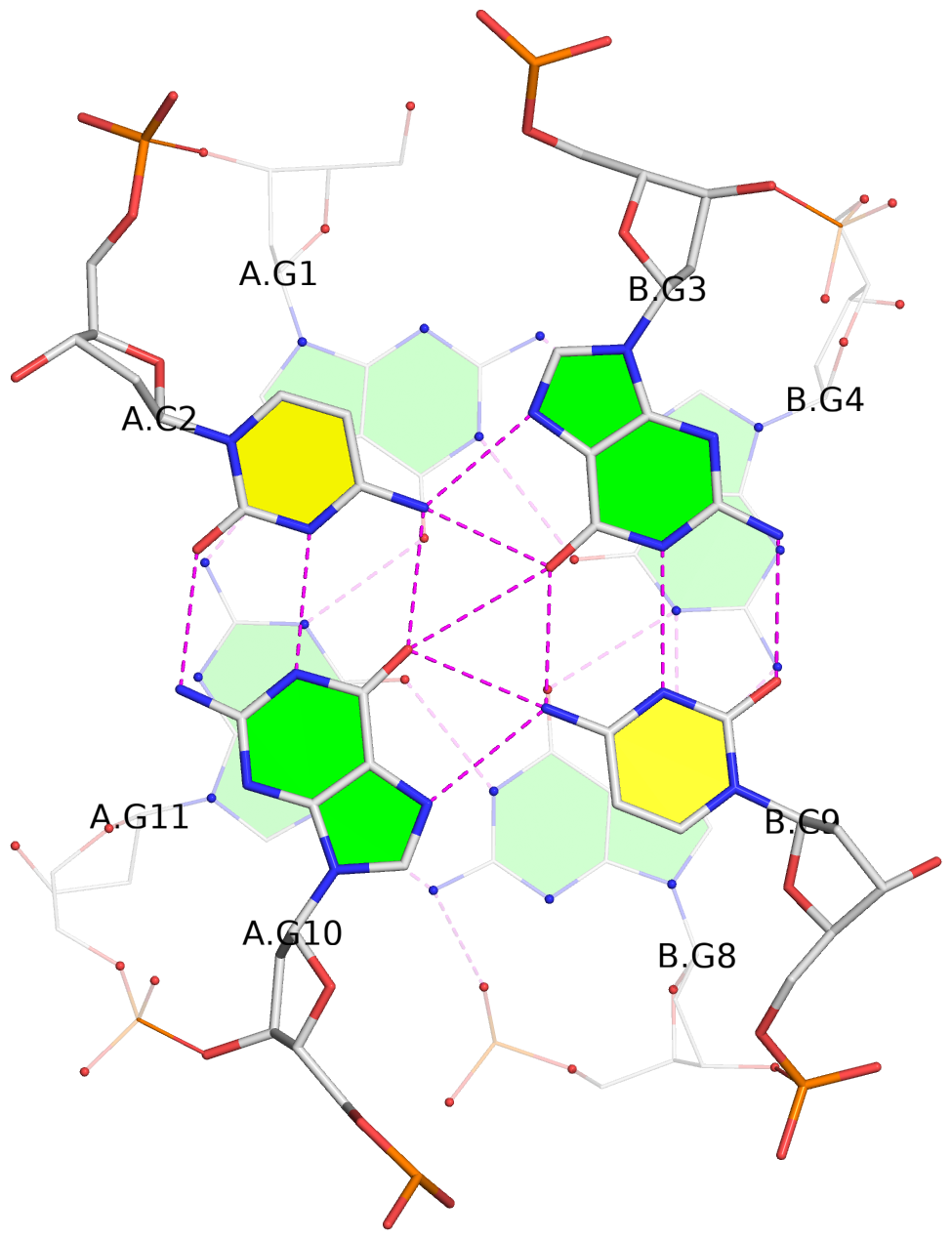
|
1 glyco-bond=s-s- sugar=---. groove=wnwn Major-->WC -- nts=4 GGGG A.DG1,A.DG11,B.DG8,B.DG4 |
|
2 glyco-bond=---- sugar=-.-- groove=---- -- -- nts=4 CGCG A.DC2,A.DG10,B.DC9,B.DG3 |
|
3 glyco-bond=---- sugar=--.- groove=---- -- -- nts=4 GCGC A.DG3,A.DC9,B.DG10,B.DC2 |
List of 1 G4-stem
In DSSR, a G4-stem is defined as a G4-helix with backbone connectivity. Bulges are also allowed along each of the four strands.
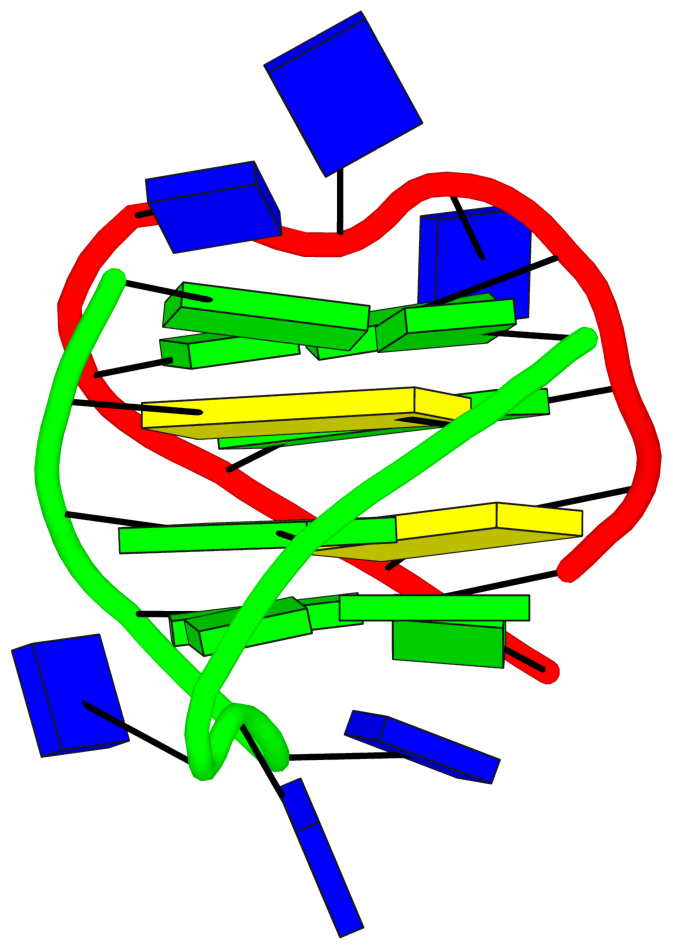
Stem#1, 4 G-tetrads, 2 loops, inter-molecular, UDUD, anti-parallel:chair, 2+2
|
1 glyco-bond=s-s- sugar=---. groove=wnwn Major-->WC -- nts=4 GGGG A.DG1,A.DG11,B.DG8,B.DG4 2 glyco-bond=---- sugar=-.-- groove=---- -- -- nts=4 CGCG A.DC2,A.DG10,B.DC9,B.DG3 3 glyco-bond=---- sugar=--.- groove=---- -- -- nts=4 GCGC A.DG3,A.DC9,B.DG10,B.DC2 4 glyco-bond=-s-s sugar=.--- groove=wnwn WC-->Major -- nts=4 GGGG A.DG4,A.DG8,B.DG11,B.DG1 step#1 mm(<>,outward) area=14.14 rise=3.11 twist=28.0 step#2 pm(>>,forward) area=11.79 rise=3.28 twist=31.6 step#3 pm(>>,forward) area=14.13 rise=3.11 twist=28.1 strand#1 U DNA glyco-bond=s--- sugar=---. nts=4 GCGG A.DG1,A.DC2,A.DG3,A.DG4 strand#2 D DNA glyco-bond=---s sugar=-.-- nts=4 GGCG A.DG11,A.DG10,A.DC9,A.DG8 strand#3 U DNA glyco-bond=s--- sugar=--.- nts=4 GCGG B.DG8,B.DC9,B.DG10,B.DG11 strand#4 D DNA glyco-bond=---s sugar=.--- nts=4 GGCG B.DG4,B.DG3,B.DC2,B.DG1 loop#1 type=lateral strands=[#1,#2] nts=3 TTT A.DT5,A.DT6,A.DT7 loop#2 type=lateral strands=[#4,#3] nts=3 TTT B.DT5,B.DT6,B.DT7 |