DSSR-enabled G4 identification/annotation: PDB entry 244d
Summary information and primary citation
- PDB-id
- 244d
- Class
- DNA
- Method
- X-ray (1.2 Å)
- Summary
- The high-resolution crystal structure of a parallel-stranded guanine tetraplex
- Reference
- Laughlan G, Murchie AI, Norman DG, Moore MH, Moody PC, Lilley DM, Luisi B (1994): "The high-resolution crystal structure of a parallel-stranded guanine tetraplex." Science, 265, 520-524.
- Abstract
- Repeat tracts of guanine bases found in DNA and RNA can form tetraplex structures in the presence of a variety of monovalent cations. Evidence suggests that guanine tetraplexes assume important functions within chromosomal telomeres, immunoglobulin switch regions, and the human immunodeficiency virus genome. The structure of a parallel-stranded tetraplex formed by the hexanucleotide d(TG4T) and stabilized by sodium cations was determined by x-ray crystallography to 1.2 angstroms resolution. Sharply resolved sodium cations were found between and within planes of hydrogen-bonded guanine quartets, and an ordered groove hydration was observed. Distinct intra- and intermolecular stacking arrangements were adopted by the guanine quartets. Thymine bases were exclusively involved in making extensive lattice contacts.
- G4 notes
- 4 G-tetrads, 1 G4 helix, 1 G4 stem, UUUU, parallel, 4+0
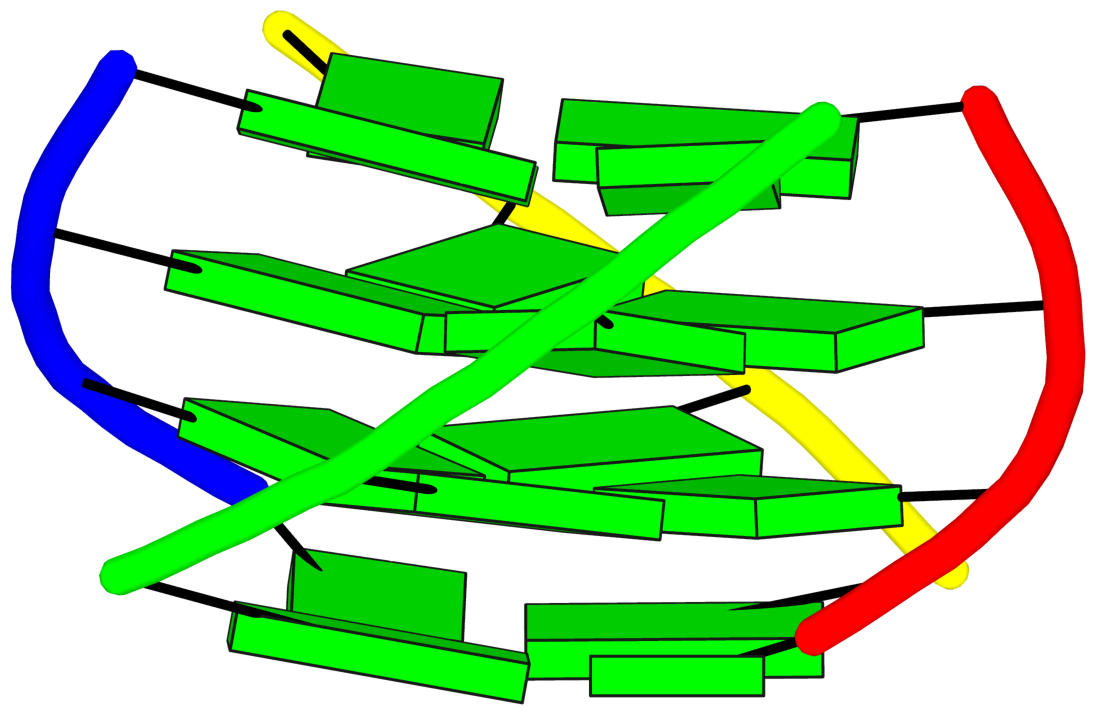
Cartoon-block schematics in six views (download the tarball)
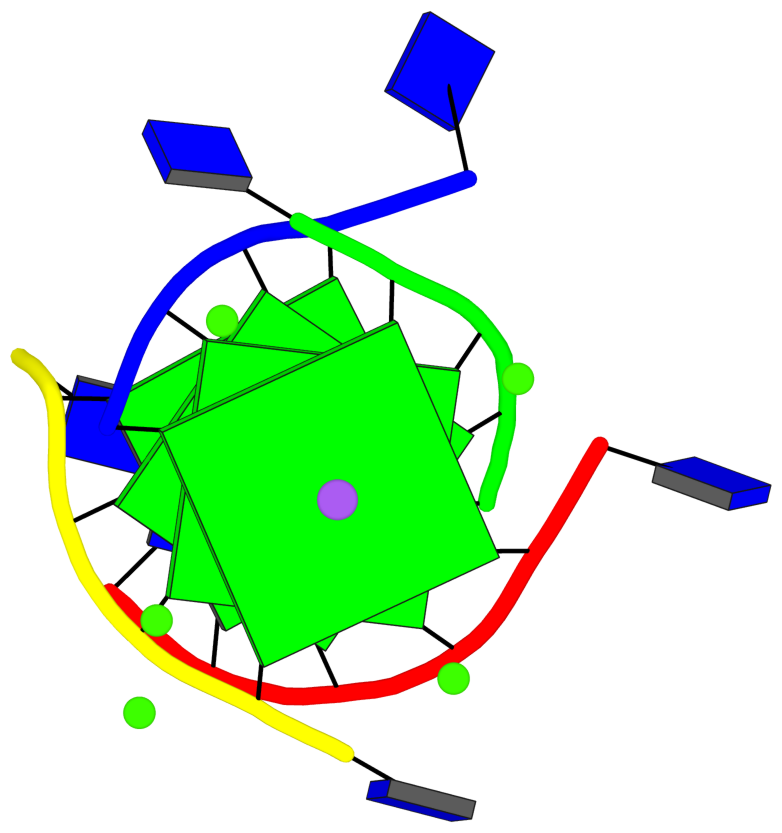
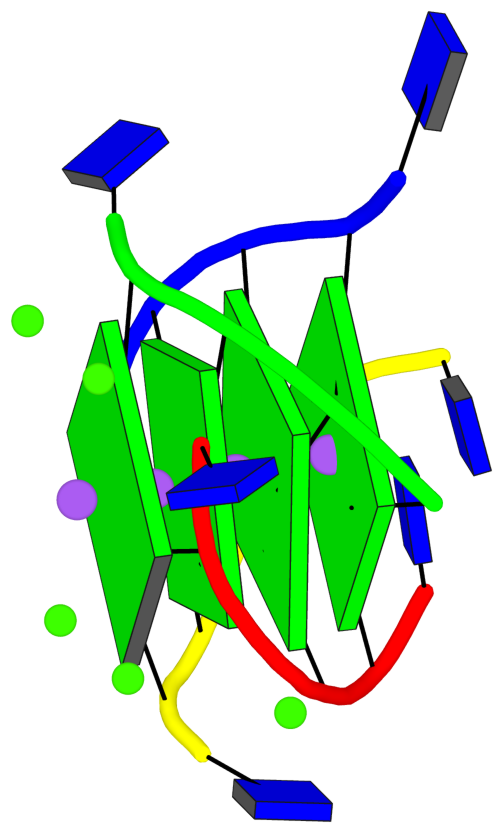
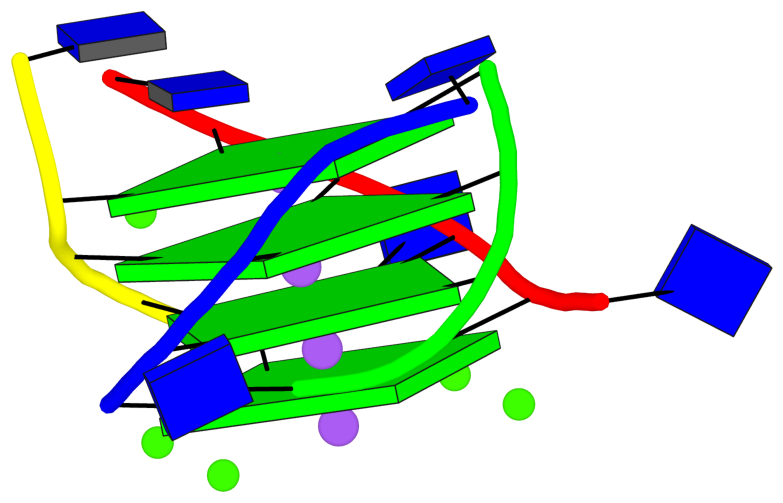
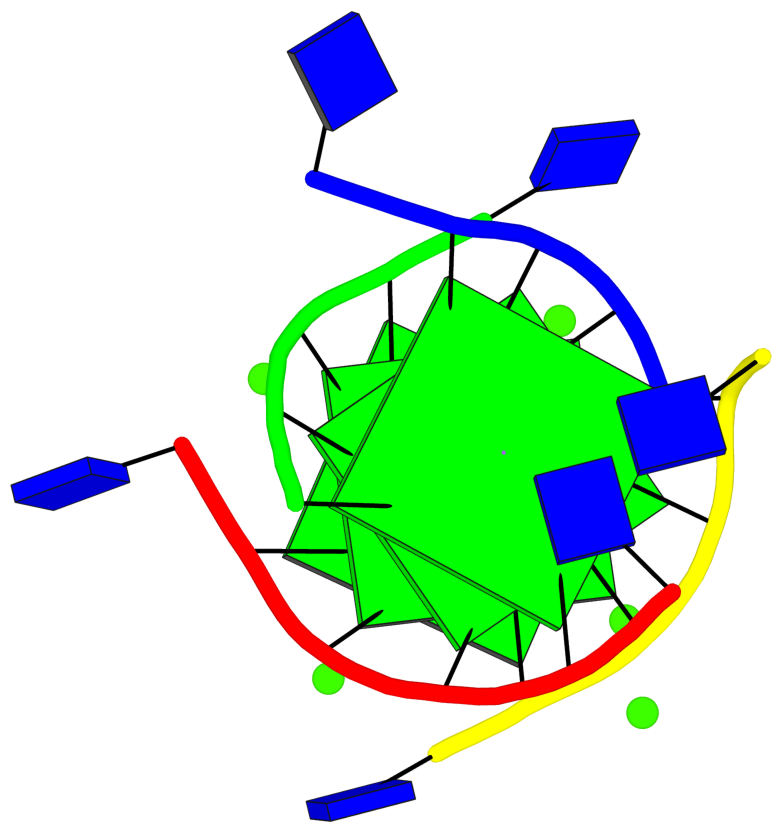
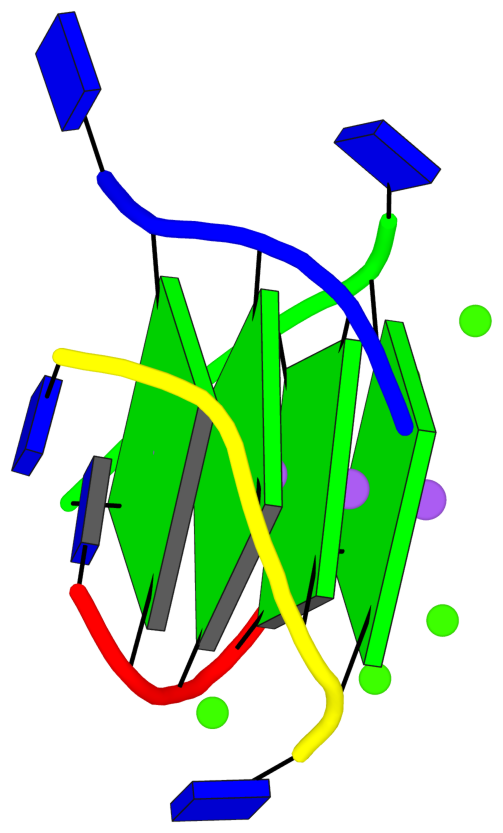
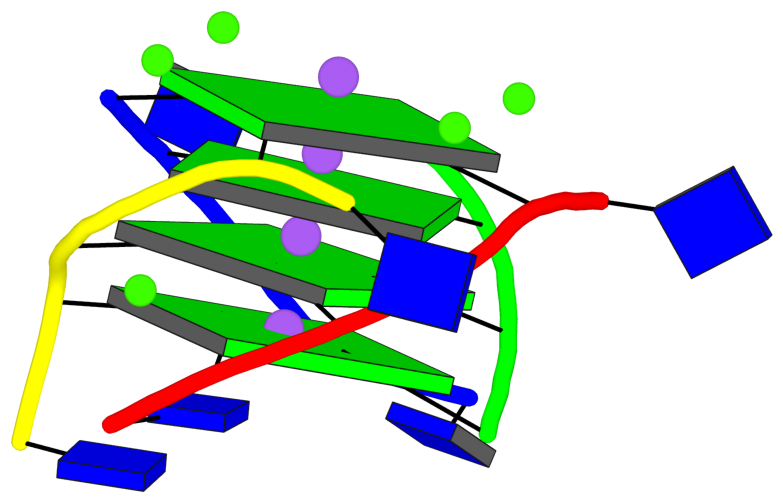
List of 4 G-tetrads
 1 glyco-bond=---- sugar=---- groove=---- planarity=0.214 type=bowl   -- nts=4 GGGG 1:A.DG2,1:D.DG32,1:C.DG22,1:B.DG12
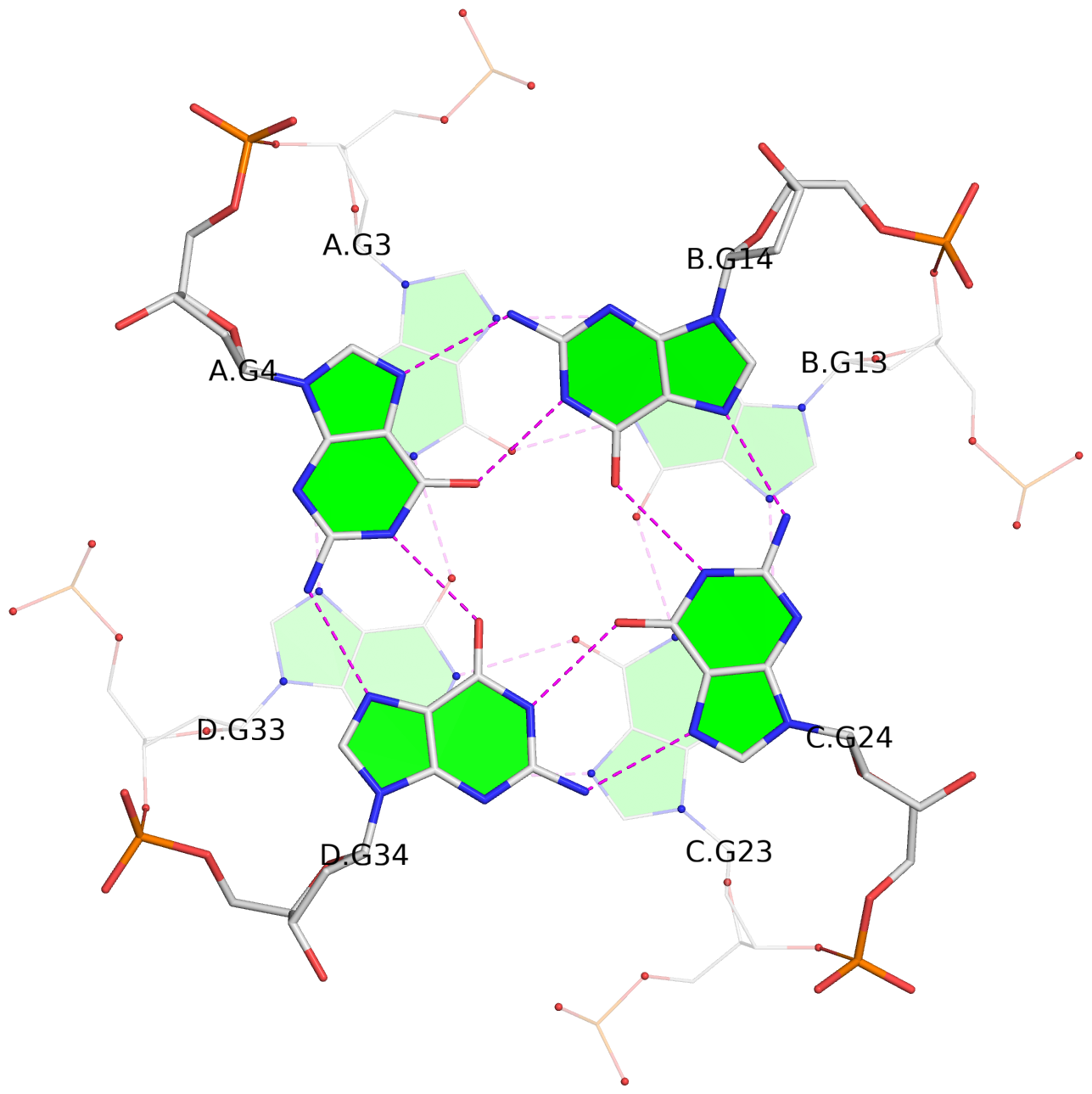
 2 glyco-bond=---- sugar=---- groove=---- planarity=0.200 type=bowl   -- nts=4 GGGG 1:A.DG3,1:D.DG33,1:C.DG23,1:B.DG13
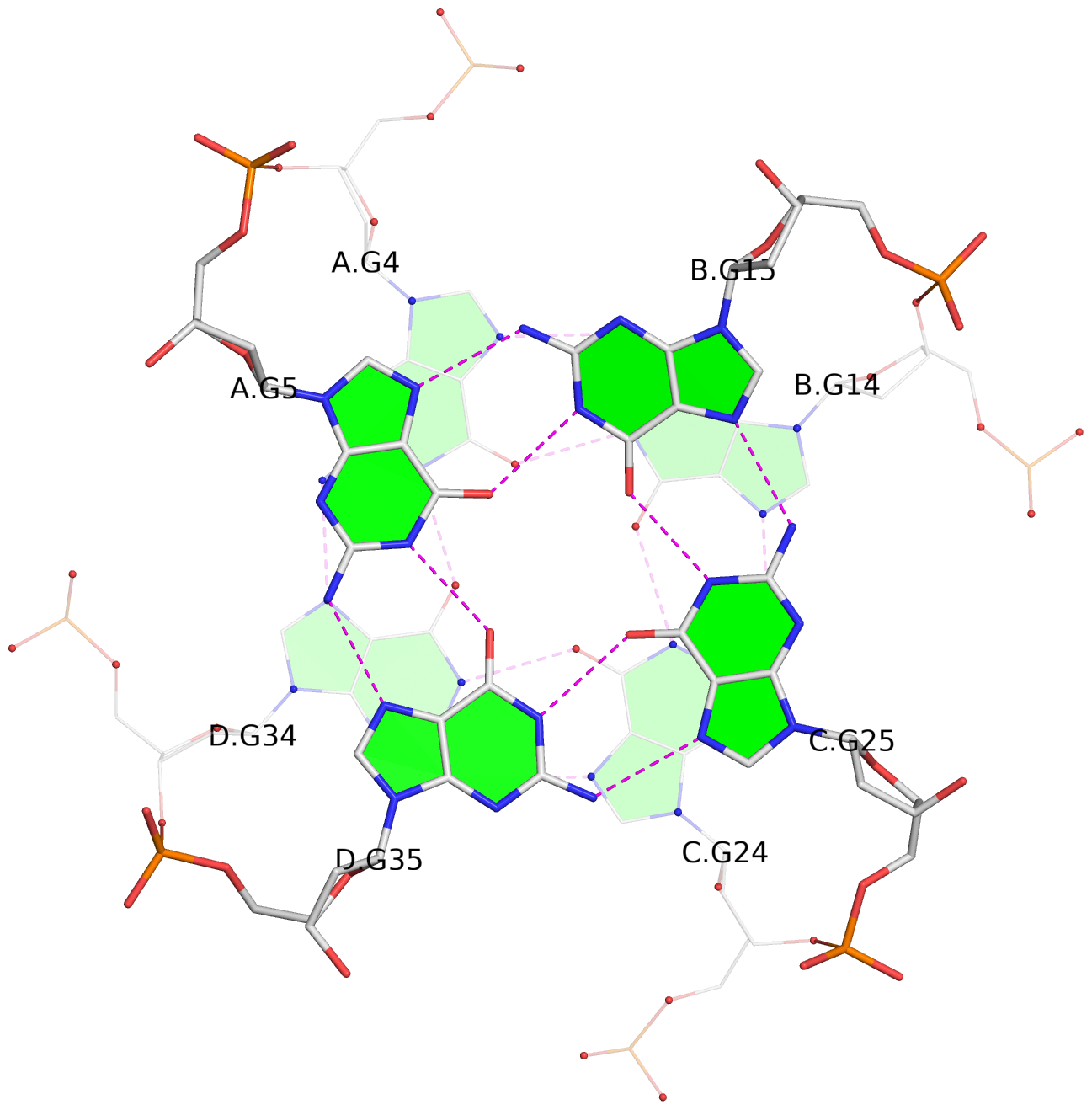
 3 glyco-bond=---- sugar=---- groove=---- planarity=0.237 type=bowl   -- nts=4 GGGG 1:A.DG4,1:D.DG34,1:C.DG24,1:B.DG14
 4 glyco-bond=---- sugar=---- groove=---- planarity=0.289 type=bowl   -- nts=4 GGGG 1:A.DG5,1:D.DG35,1:C.DG25,1:B.DG15
List of 1 G4-helix
In DSSR, a G4-helix is defined by stacking interactions of G-tetrads, regardless of backbone connectivity, and may contain more than one G4-stem.
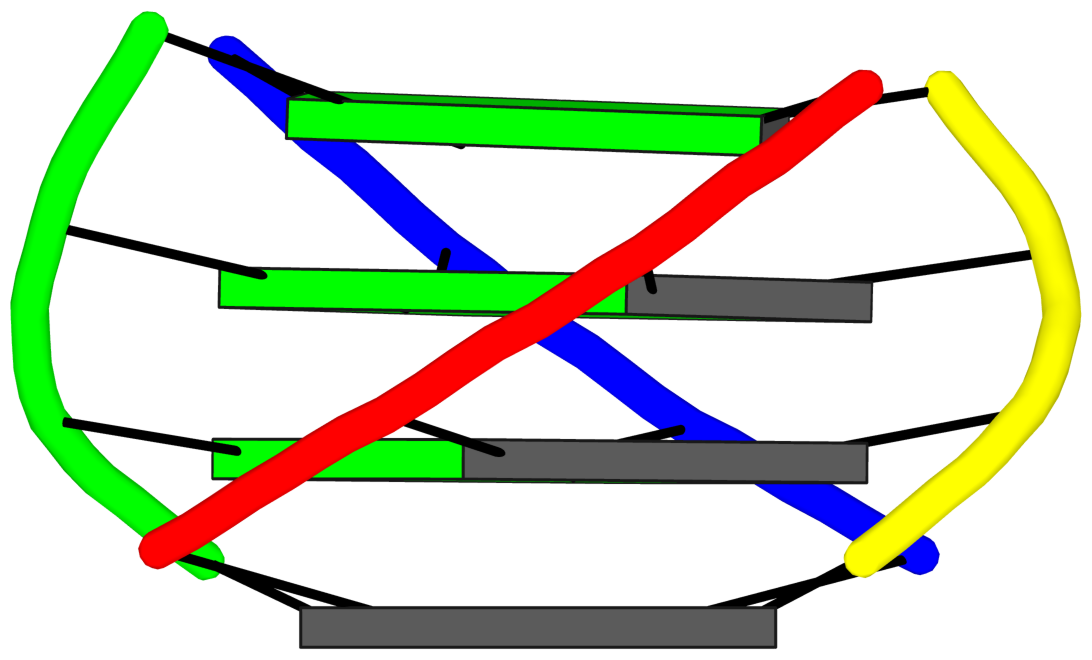
Helix#1, 4 G-tetrads, inter-molecular, with 1 stem
|
1 glyco-bond=---- sugar=---- groove=---- WC-->Major -- nts=4 GGGG 1:A.DG2,1:D.DG32,1:C.DG22,1:B.DG12 2 glyco-bond=---- sugar=---- groove=---- WC-->Major -- nts=4 GGGG 1:A.DG3,1:D.DG33,1:C.DG23,1:B.DG13 3 glyco-bond=---- sugar=---- groove=---- WC-->Major -- nts=4 GGGG 1:A.DG4,1:D.DG34,1:C.DG24,1:B.DG14 4 glyco-bond=---- sugar=---- groove=---- WC-->Major -- nts=4 GGGG 1:A.DG5,1:D.DG35,1:C.DG25,1:B.DG15 step#1 pm(>>,forward) area=8.98 rise=3.36 twist=31.8 step#2 pm(>>,forward) area=11.73 rise=3.36 twist=27.2 step#3 pm(>>,forward) area=11.28 rise=3.45 twist=27.8 strand#1 DNA glyco-bond=---- sugar=---- nts=4 GGGG 1:A.DG2,1:A.DG3,1:A.DG4,1:A.DG5 strand#2 DNA glyco-bond=---- sugar=---- nts=4 GGGG 1:D.DG32,1:D.DG33,1:D.DG34,1:D.DG35 strand#3 DNA glyco-bond=---- sugar=---- nts=4 GGGG 1:C.DG22,1:C.DG23,1:C.DG24,1:C.DG25 strand#4 DNA glyco-bond=---- sugar=---- nts=4 GGGG 1:B.DG12,1:B.DG13,1:B.DG14,1:B.DG15 |
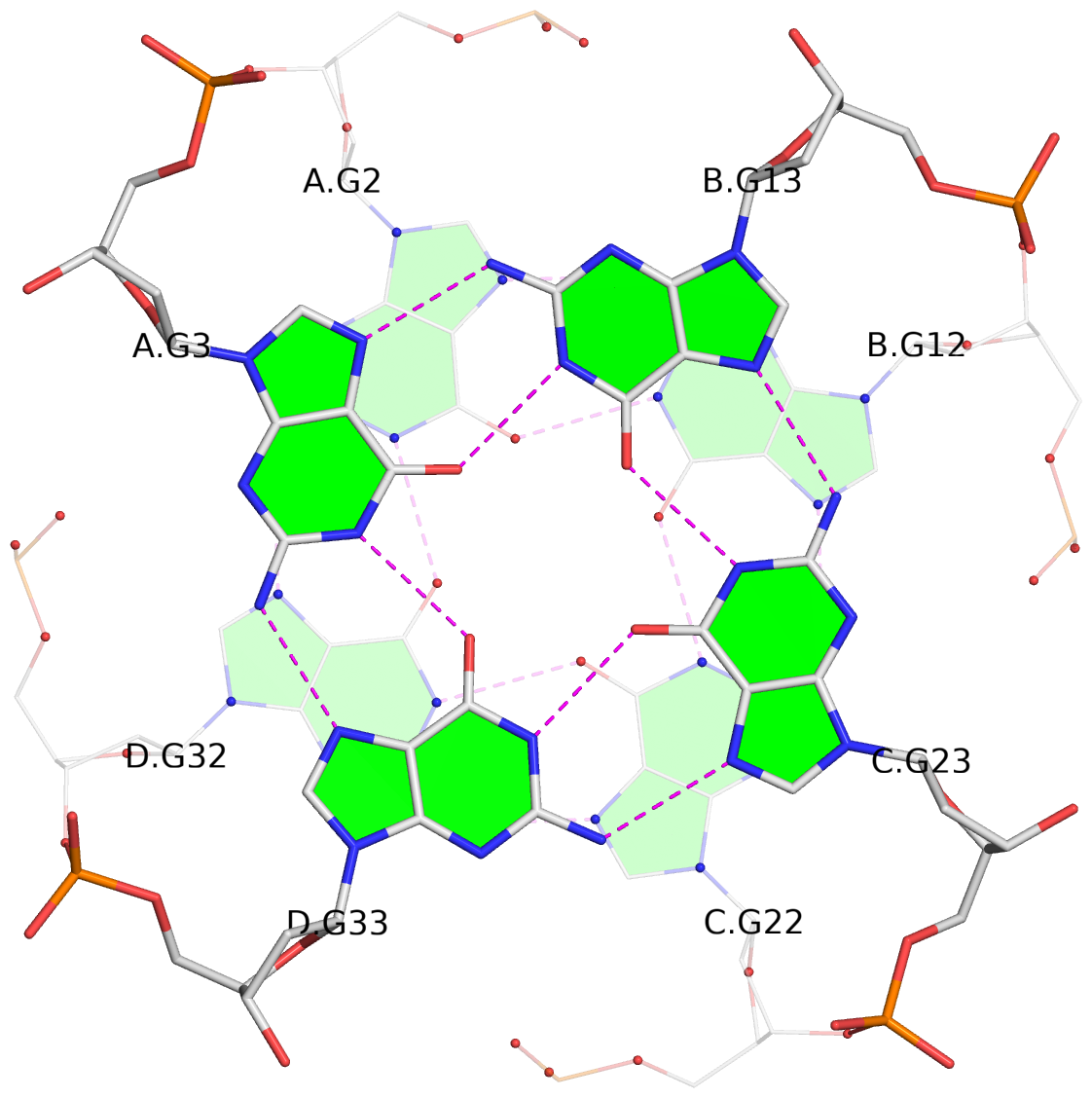
| 3 stacking diagrams | |
|
1 glyco-bond=---- sugar=---- groove=---- WC-->Major -- nts=4 GGGG 1:A.DG2,1:D.DG32,1:C.DG22,1:B.DG12 |
|
2 glyco-bond=---- sugar=---- groove=---- WC-->Major -- nts=4 GGGG 1:A.DG3,1:D.DG33,1:C.DG23,1:B.DG13 |
|
3 glyco-bond=---- sugar=---- groove=---- WC-->Major -- nts=4 GGGG 1:A.DG4,1:D.DG34,1:C.DG24,1:B.DG14 |
List of 1 G4-stem
In DSSR, a G4-stem is defined as a G4-helix with backbone connectivity. Bulges are also allowed along each of the four strands.
Stem#1, 4 G-tetrads, 0 loops, inter-molecular, UUUU, parallel, 4+0
|
1 glyco-bond=---- sugar=---- groove=---- WC-->Major -- nts=4 GGGG 1:A.DG2,1:D.DG32,1:C.DG22,1:B.DG12 2 glyco-bond=---- sugar=---- groove=---- WC-->Major -- nts=4 GGGG 1:A.DG3,1:D.DG33,1:C.DG23,1:B.DG13 3 glyco-bond=---- sugar=---- groove=---- WC-->Major -- nts=4 GGGG 1:A.DG4,1:D.DG34,1:C.DG24,1:B.DG14 4 glyco-bond=---- sugar=---- groove=---- WC-->Major -- nts=4 GGGG 1:A.DG5,1:D.DG35,1:C.DG25,1:B.DG15 step#1 pm(>>,forward) area=8.98 rise=3.36 twist=31.8 step#2 pm(>>,forward) area=11.73 rise=3.36 twist=27.2 step#3 pm(>>,forward) area=11.28 rise=3.45 twist=27.8 strand#1 U DNA glyco-bond=---- sugar=---- nts=4 GGGG 1:A.DG2,1:A.DG3,1:A.DG4,1:A.DG5 strand#2 U DNA glyco-bond=---- sugar=---- nts=4 GGGG 1:D.DG32,1:D.DG33,1:D.DG34,1:D.DG35 strand#3 U DNA glyco-bond=---- sugar=---- nts=4 GGGG 1:C.DG22,1:C.DG23,1:C.DG24,1:C.DG25 strand#4 U DNA glyco-bond=---- sugar=---- nts=4 GGGG 1:B.DG12,1:B.DG13,1:B.DG14,1:B.DG15 |