DSSR-enabled G4 identification/annotation: PDB entry 2n2d
Summary information and primary citation
- PDB-id
- 2n2d
- Class
- DNA
- Method
- NMR
- Summary
- Structure of DNA g-quadruplex adopted by als and ftd related ggggcc repeat with g21 to br-g21 substitution
- Reference
- Brcic J, Plavec J (2015): "Solution structure of a DNA quadruplex containing ALS and FTD related GGGGCC repeat stabilized by 8-bromodeoxyguanosine substitution." Nucleic Acids Res., 43, 8590-8600. doi: 10.1093/nar/gkv815.
- Abstract
- A prolonged expansion of GGGGCC repeat within non-coding region of C9orf72 gene has been identified as the most common cause of familial amyotrophic lateral sclerosis (ALS) and frontotemporal dementia (FTD), which are devastating neurodegenerative disorders. Formation of unusual secondary structures within expanded GGGGCC repeat, including DNA and RNA G-quadruplexes and R-loops was proposed to drive ALS and FTD pathogenesis. Initial NMR investigation on DNA oligonucleotides with four repeat units as the shortest model with the ability to form an unimolecular G-quadruplex indicated their folding into multiple G-quadruplex structures in the presence of K(+) ions. Single dG to 8Br-dG substitution at position 21 in oligonucleotide d[(G4C2)3G4] and careful optimization of folding conditions enabled formation of mostly a single G-quadruplex species, which enabled determination of a high-resolution structure with NMR. G-quadruplex structure adopted by d[(G4C2)3GG(Br)GG] is composed of four G-quartets, which are connected by three edgewise C-C loops. All four strands adopt antiparallel orientation to one another and have alternating syn-anti progression of glycosidic conformation of guanine residues. One of the cytosines in every loop is stacked upon the G-quartet contributing to a very compact and stable structure.
- G4 notes
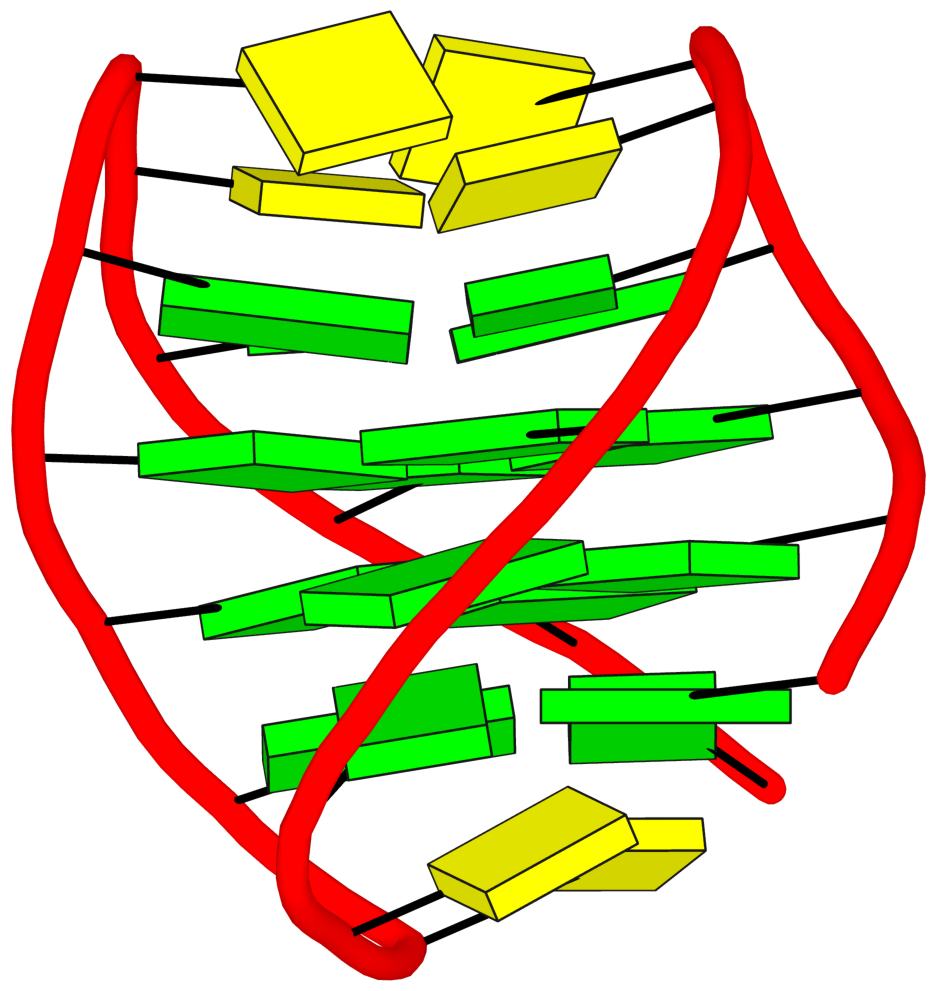
- 4 G-tetrads, 1 G4 helix, 1 G4 stem, UDUD, anti-parallel:chair, 2+2, 4(+Ln+Lw+Ln)
Cartoon-block schematics in six views (download the tarball)
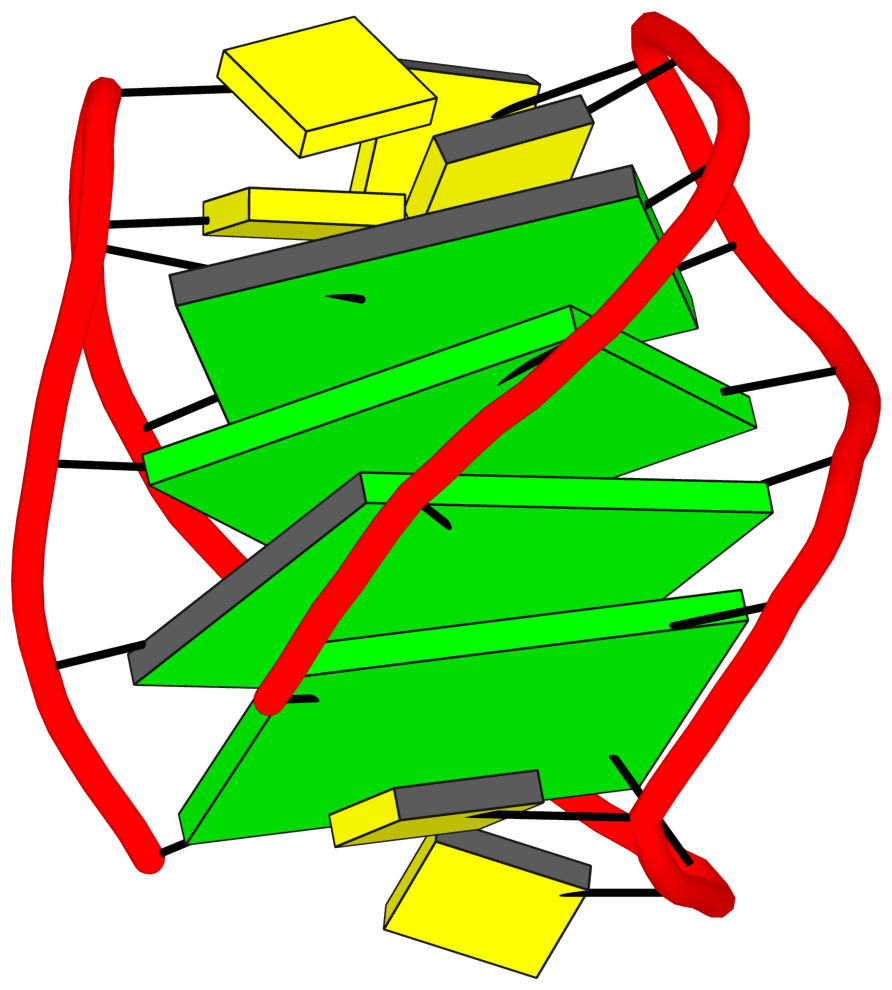
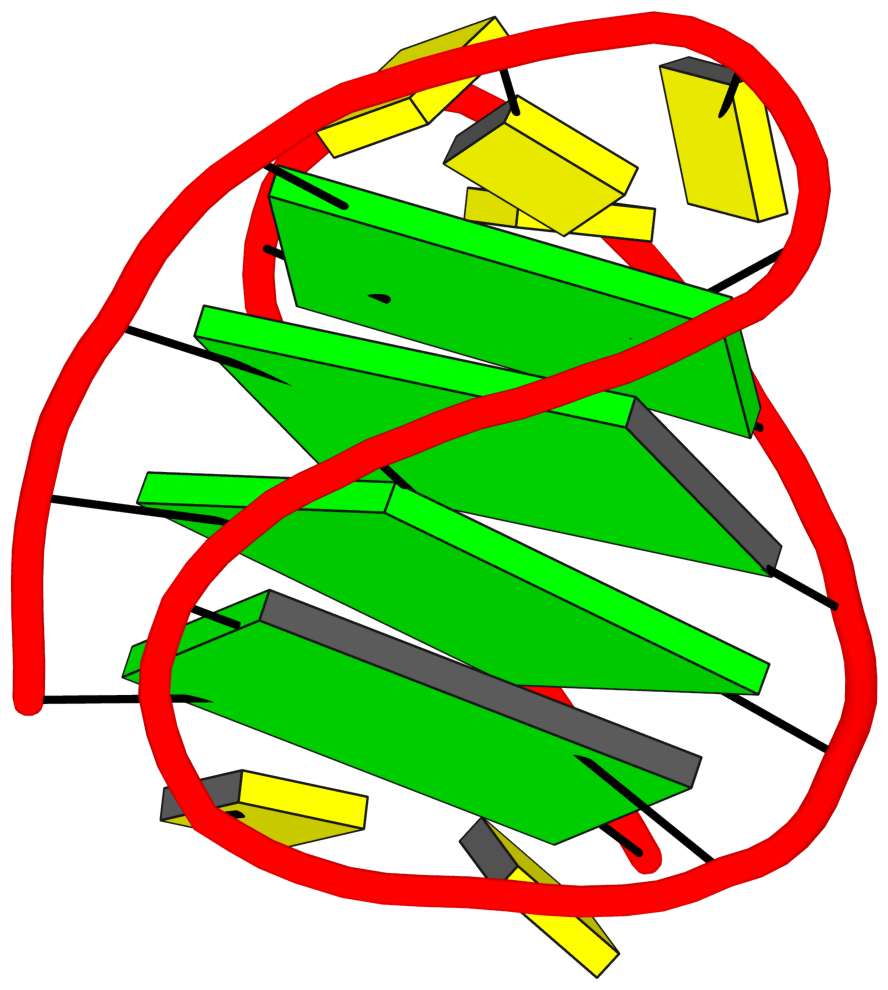
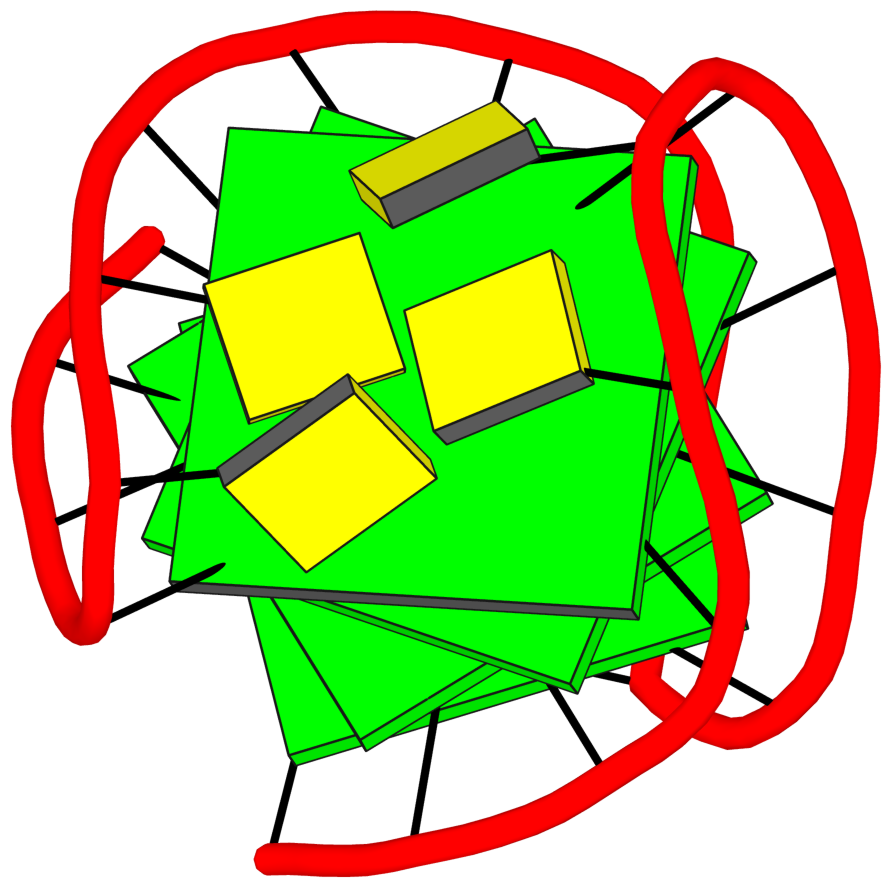
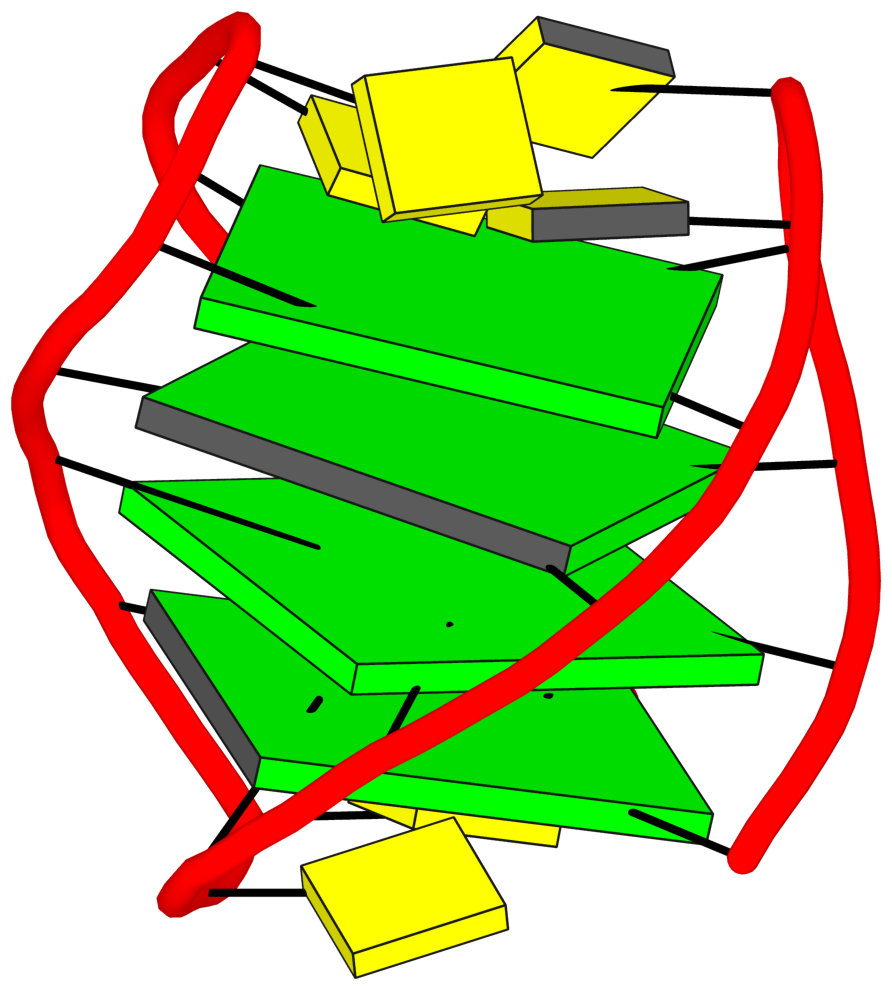
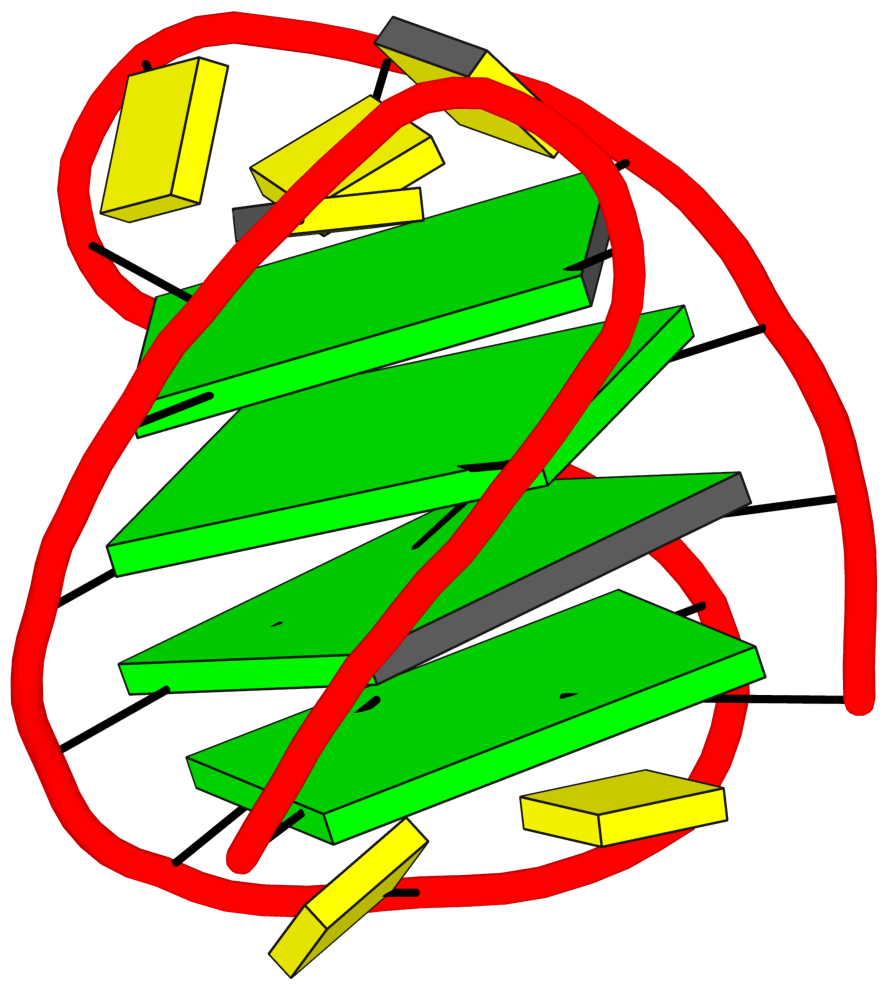
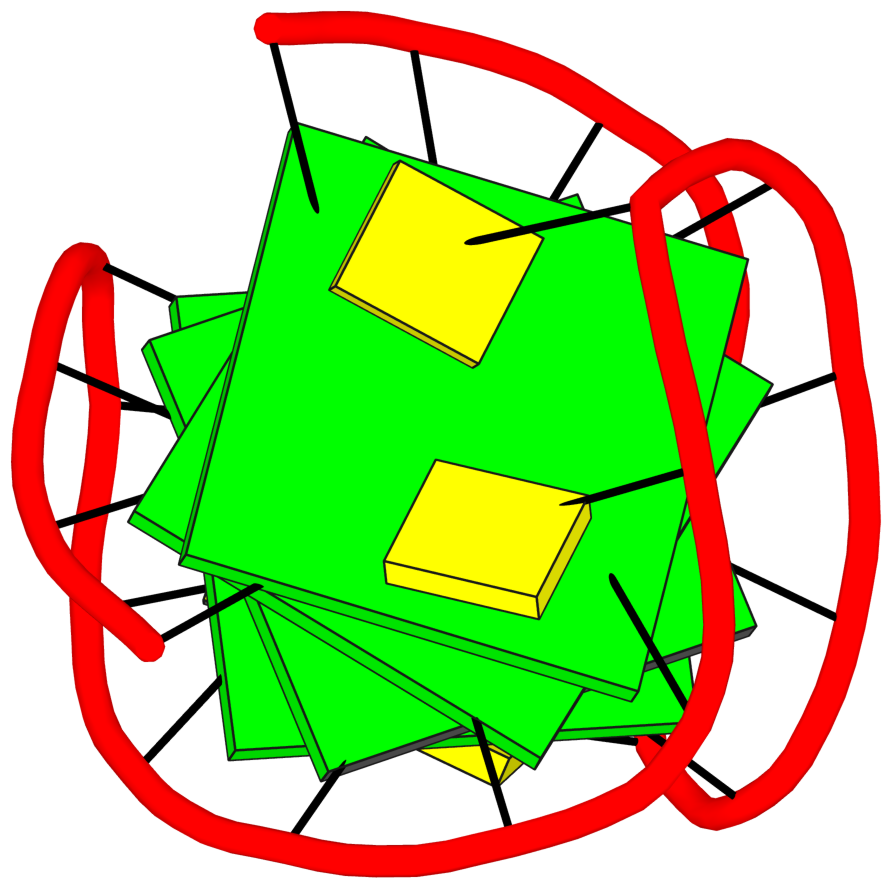
List of 4 G-tetrads
 1 glyco-bond=s-s- sugar=---- groove=wnwn planarity=0.359 type=bowl   O+ nts=4 GGGG A.DG1,A.DG22,A.DG13,A.DG10
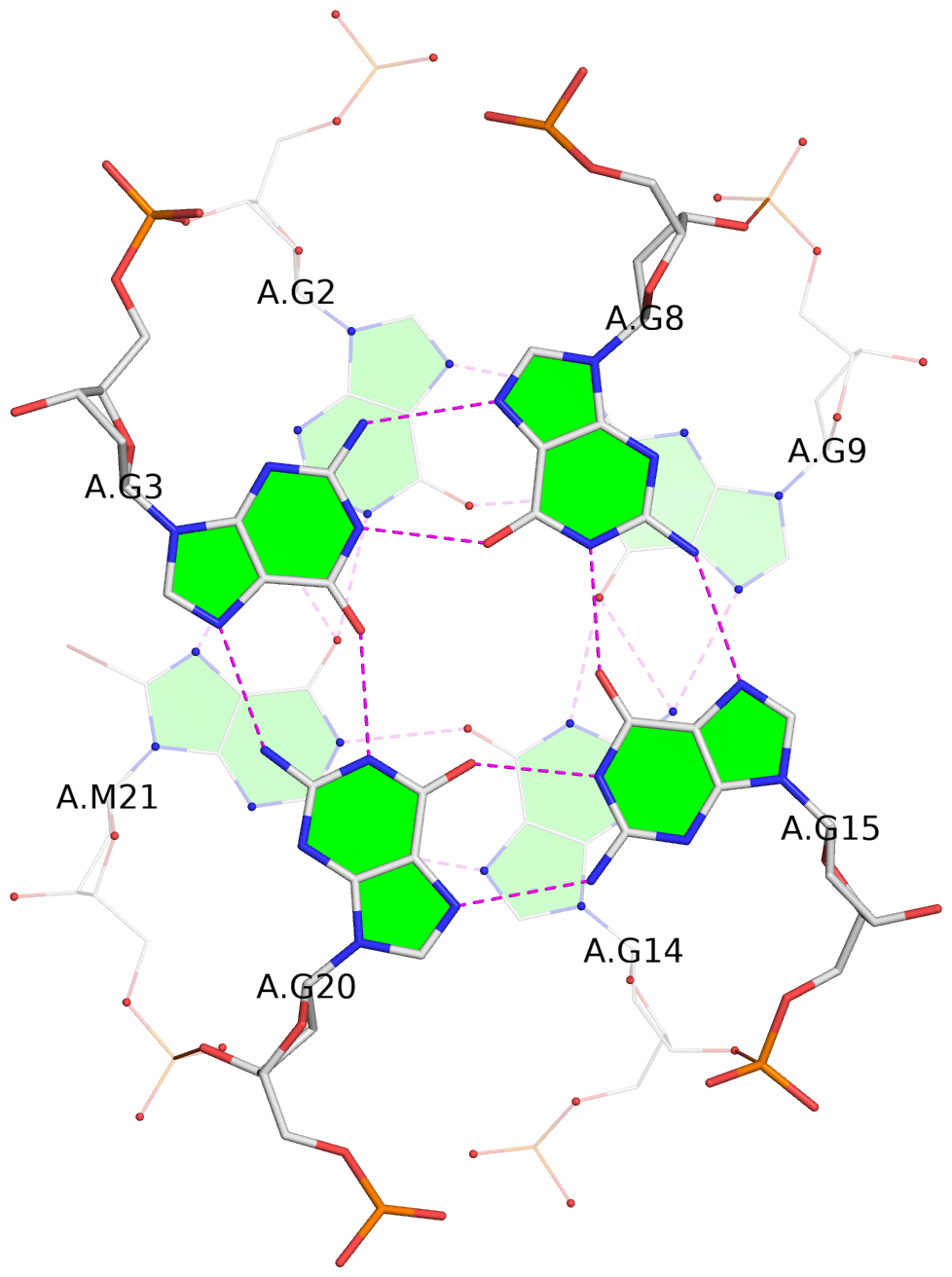
 2 glyco-bond=-s-s sugar=---- groove=wnwn planarity=0.215 type=other  O- nts=4 GgGG A.DG2,A.BGM21,A.DG14,A.DG9
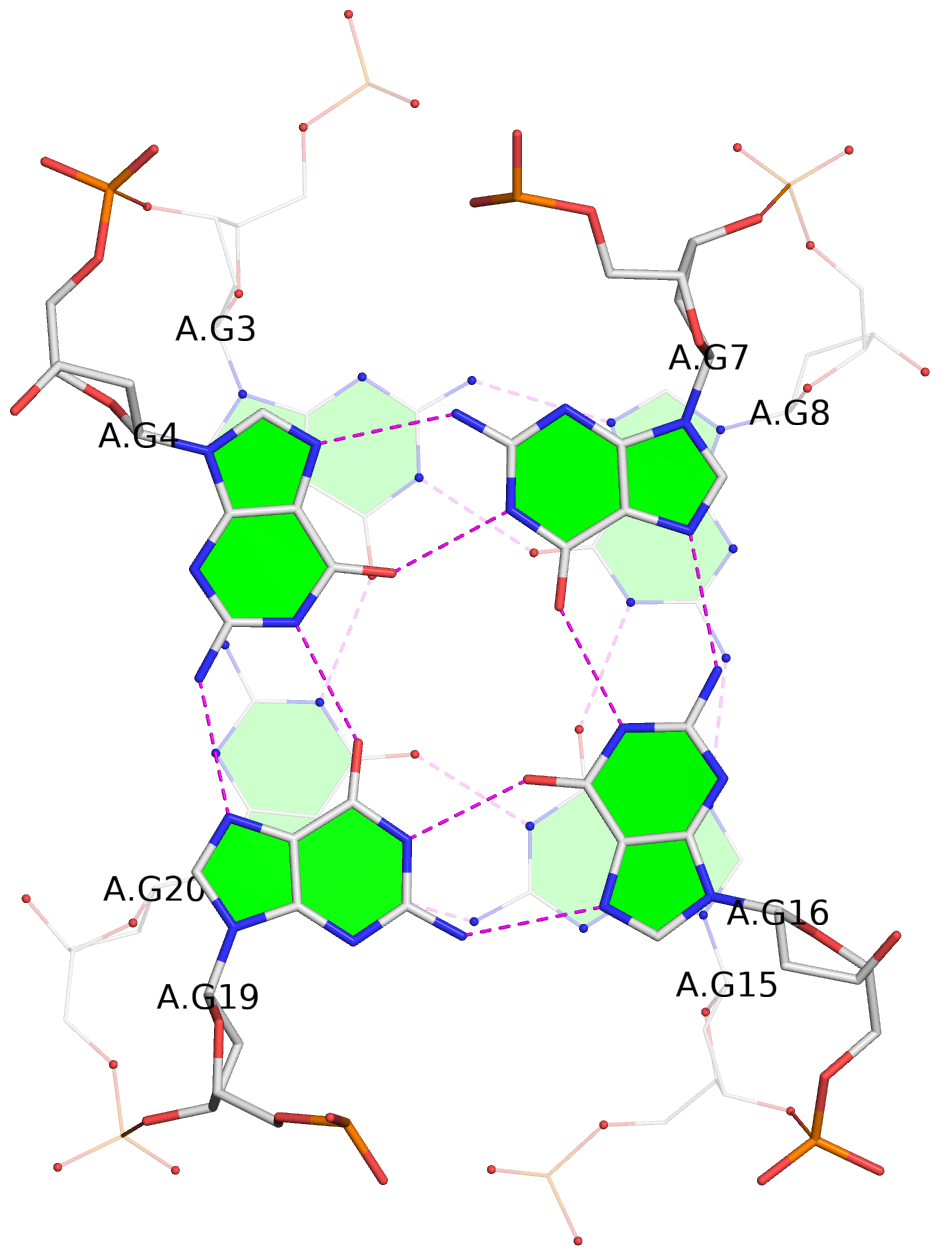
 3 glyco-bond=s-s- sugar=---- groove=wnwn planarity=0.090 type=planar O+ nts=4 GGGG A.DG3,A.DG20,A.DG15,A.DG8
 4 glyco-bond=-s-s sugar=---- groove=wnwn planarity=0.280 type=bowl   O- nts=4 GGGG A.DG4,A.DG19,A.DG16,A.DG7
List of 1 G4-helix
In DSSR, a G4-helix is defined by stacking interactions of G-tetrads, regardless of backbone connectivity, and may contain more than one G4-stem.
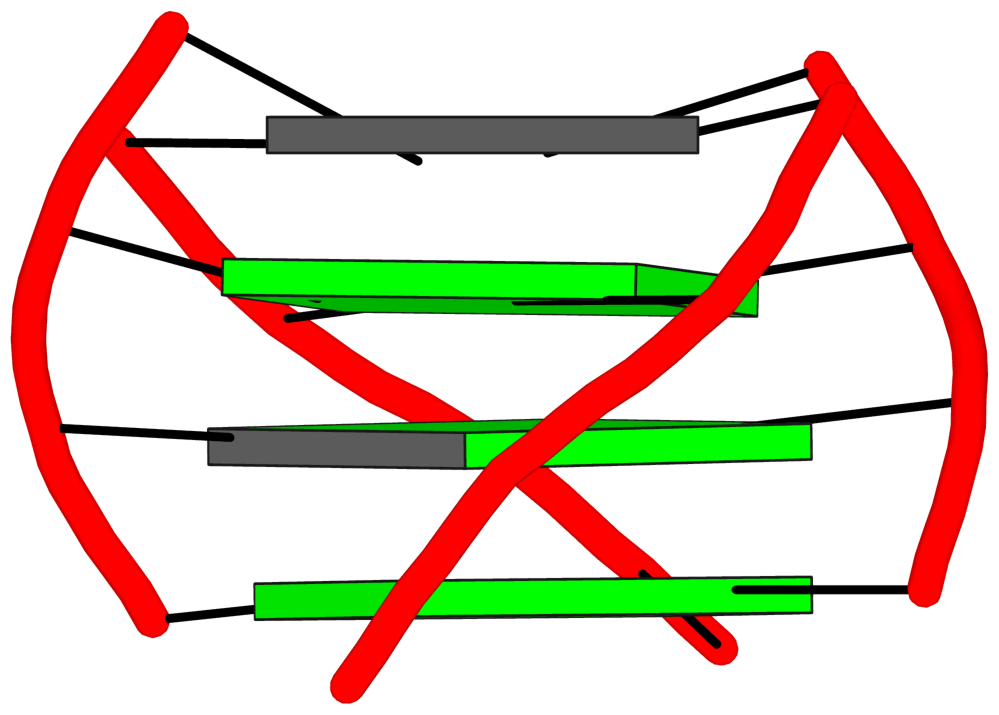
Helix#1, 4 G-tetrads, INTRA-molecular, with 1 stem
|
1 glyco-bond=s-s- sugar=---- groove=wnwn Major-->WC O+ nts=4 GGGG A.DG1,A.DG22,A.DG13,A.DG10 2 glyco-bond=-s-s sugar=---- groove=wnwn WC-->Major O- nts=4 GgGG A.DG2,A.BGM21,A.DG14,A.DG9 3 glyco-bond=s-s- sugar=---- groove=wnwn Major-->WC O+ nts=4 GGGG A.DG3,A.DG20,A.DG15,A.DG8 4 glyco-bond=-s-s sugar=---- groove=wnwn WC-->Major O- nts=4 GGGG A.DG4,A.DG19,A.DG16,A.DG7 step#1 mm(<>,outward) area=20.51 rise=3.40 twist=16.4 step#2 pp(><,inward) area=11.34 rise=3.49 twist=37.1 step#3 mm(<>,outward) area=18.82 rise=3.44 twist=15.5 strand#1 DNA glyco-bond=s-s- sugar=---- nts=4 GGGG A.DG1,A.DG2,A.DG3,A.DG4 strand#2 DNA glyco-bond=-s-s sugar=---- nts=4 GgGG A.DG22,A.BGM21,A.DG20,A.DG19 strand#3 DNA glyco-bond=s-s- sugar=---- nts=4 GGGG A.DG13,A.DG14,A.DG15,A.DG16 strand#4 DNA glyco-bond=-s-s sugar=---- nts=4 GGGG A.DG10,A.DG9,A.DG8,A.DG7 |
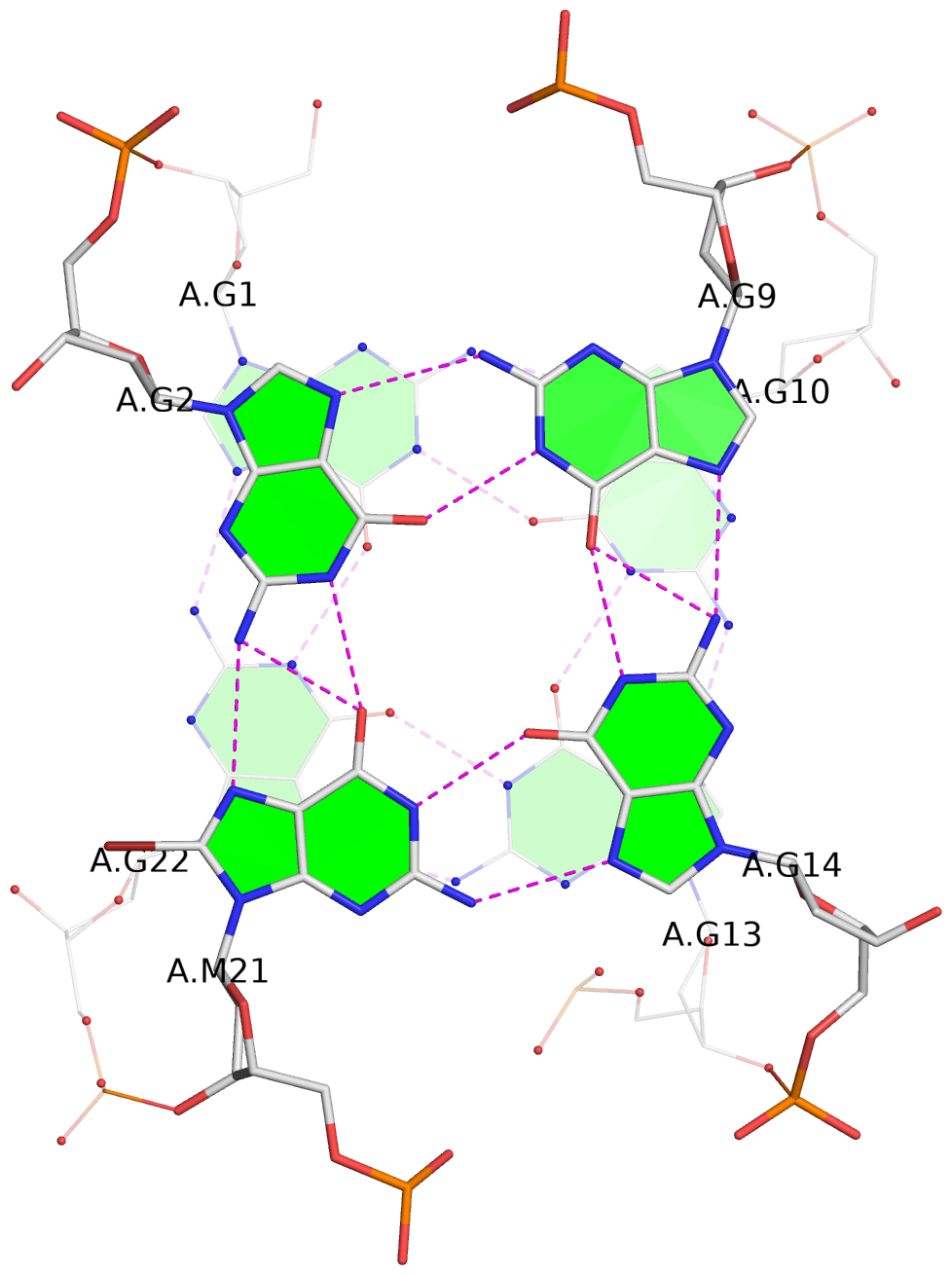
| 3 stacking diagrams | |
|
1 glyco-bond=s-s- sugar=---- groove=wnwn Major-->WC O+ nts=4 GGGG A.DG1,A.DG22,A.DG13,A.DG10 |
|
2 glyco-bond=-s-s sugar=---- groove=wnwn WC-->Major O- nts=4 GgGG A.DG2,A.BGM21,A.DG14,A.DG9 |
|
3 glyco-bond=s-s- sugar=---- groove=wnwn Major-->WC O+ nts=4 GGGG A.DG3,A.DG20,A.DG15,A.DG8 |
List of 1 G4-stem
In DSSR, a G4-stem is defined as a G4-helix with backbone connectivity. Bulges are also allowed along each of the four strands.
Stem#1, 4 G-tetrads, 3 loops, INTRA-molecular, UDUD, anti-parallel:chair, 2+2, 4(+Ln+Lw+Ln)
|
1 glyco-bond=s-s- sugar=---- groove=wnwn Major-->WC O+ nts=4 GGGG A.DG1,A.DG22,A.DG13,A.DG10 2 glyco-bond=-s-s sugar=---- groove=wnwn WC-->Major O- nts=4 GgGG A.DG2,A.BGM21,A.DG14,A.DG9 3 glyco-bond=s-s- sugar=---- groove=wnwn Major-->WC O+ nts=4 GGGG A.DG3,A.DG20,A.DG15,A.DG8 4 glyco-bond=-s-s sugar=---- groove=wnwn WC-->Major O- nts=4 GGGG A.DG4,A.DG19,A.DG16,A.DG7 step#1 mm(<>,outward) area=20.51 rise=3.40 twist=16.4 step#2 pp(><,inward) area=11.34 rise=3.49 twist=37.1 step#3 mm(<>,outward) area=18.82 rise=3.44 twist=15.5 strand#1 U DNA glyco-bond=s-s- sugar=---- nts=4 GGGG A.DG1,A.DG2,A.DG3,A.DG4 strand#2 D DNA glyco-bond=-s-s sugar=---- nts=4 GgGG A.DG22,A.BGM21,A.DG20,A.DG19 strand#3 U DNA glyco-bond=s-s- sugar=---- nts=4 GGGG A.DG13,A.DG14,A.DG15,A.DG16 strand#4 D DNA glyco-bond=-s-s sugar=---- nts=4 GGGG A.DG10,A.DG9,A.DG8,A.DG7 loop#1 type=lateral strands=[#1,#4] nts=2 CC A.DC5,A.DC6 loop#2 type=lateral strands=[#4,#3] nts=2 CC A.DC11,A.DC12 loop#3 type=lateral strands=[#3,#2] nts=2 CC A.DC17,A.DC18 |