DSSR-enabled G4 identification/annotation: PDB entry 6k84
Summary information and primary citation
- PDB-id
- 6k84
- Class
- RNA
- Method
- NMR
- Summary
- Structure of anti-prion RNA aptamer
- Reference
- Mashima T, Lee JH, Kamatari YO, Hayashi T, Nagata T, Nishikawa F, Nishikawa S, Kinoshita M, Kuwata K, Katahira M (2020): "Development and structural determination of an anti-PrPCaptamer that blocks pathological conformational conversion of prion protein." Sci Rep, 10, 4934. doi: 10.1038/s41598-020-61966-4.
- Abstract
- Prion diseases comprise a fatal neuropathy caused by the conversion of prion protein from a cellular (PrP<sub>C</sub>) to a pathological (PrP<sub>Sc</sub>) isoform. Previously, we obtained an RNA aptamer, r(GGAGGAGGAGGA) (R12), that folds into a unique G-quadruplex. The R12 homodimer binds to a PrP<sub>C</sub> molecule, inhibiting PrP<sub>C</sub>-to-PrP<sub>Sc</sub> conversion. Here, we developed a new RNA aptamer, r(GGAGGAGGAGGAGGAGGAGGAGGA) (R24), where two R12s are tandemly connected. The 50% inhibitory concentration for the formation of PrP<sub>Sc</sub> (IC<sub>50</sub>) of R24 in scrapie-infected cell lines was ca. 100 nM, i.e., much lower than that of R12 by two orders. Except for some antibodies, R24 exhibited the lowest recorded IC<sub>50</sub> and the highest anti-prion activity. We also developed a related aptamer, r(GGAGGAGGAGGA-A-GGAGGAGGAGGA) (R12-A-R12), IC<sub>50</sub> being ca. 500 nM. The structure of a single R12-A-R12 molecule determined by NMR resembled that of the R12 homodimer. The quadruplex structure of either R24 or R12-A-R12 is unimolecular, and therefore the structure could be stably formed when they are administered to a prion-infected cell culture. This may be the reason they can exert high anti-prion activity.
- G4 notes
- 4 G-tetrads, 1 G4 helix, 2 G4 stems, 1 G4 coaxial stack, UUUU, parallel, 4+0, 2(-P-P-P), coaxial interfaces: 5'/5'
Cartoon-block schematics in six views (download the tarball)
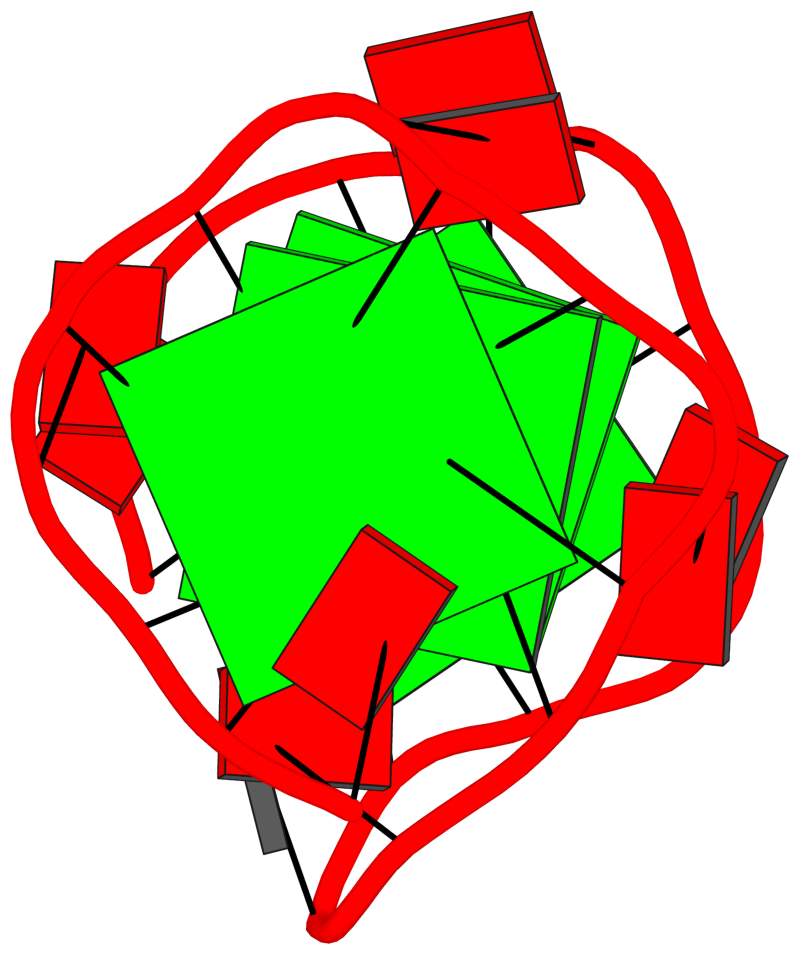
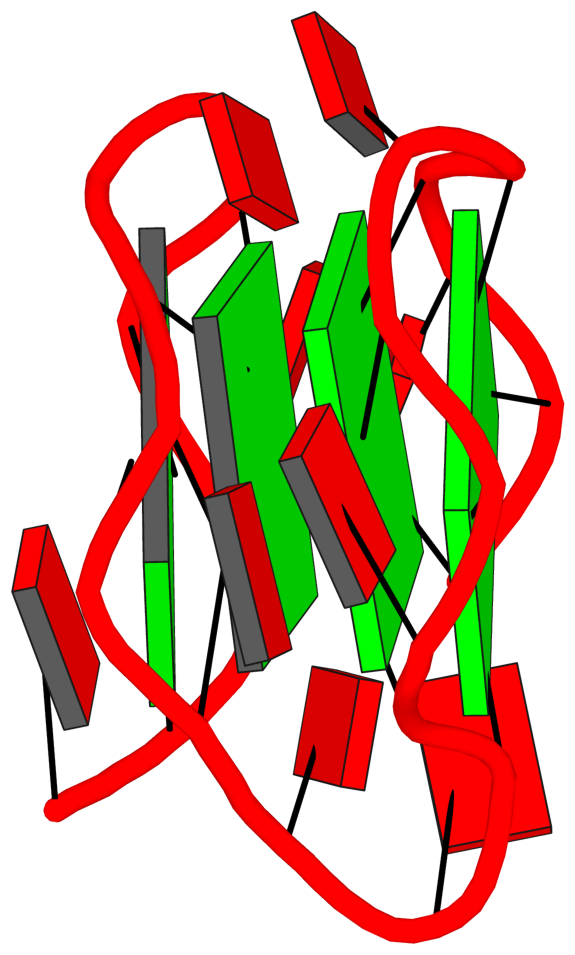
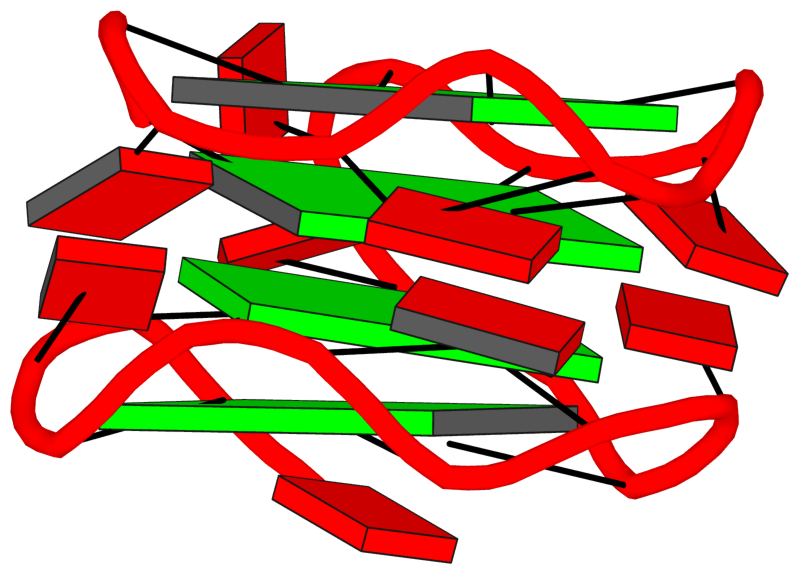
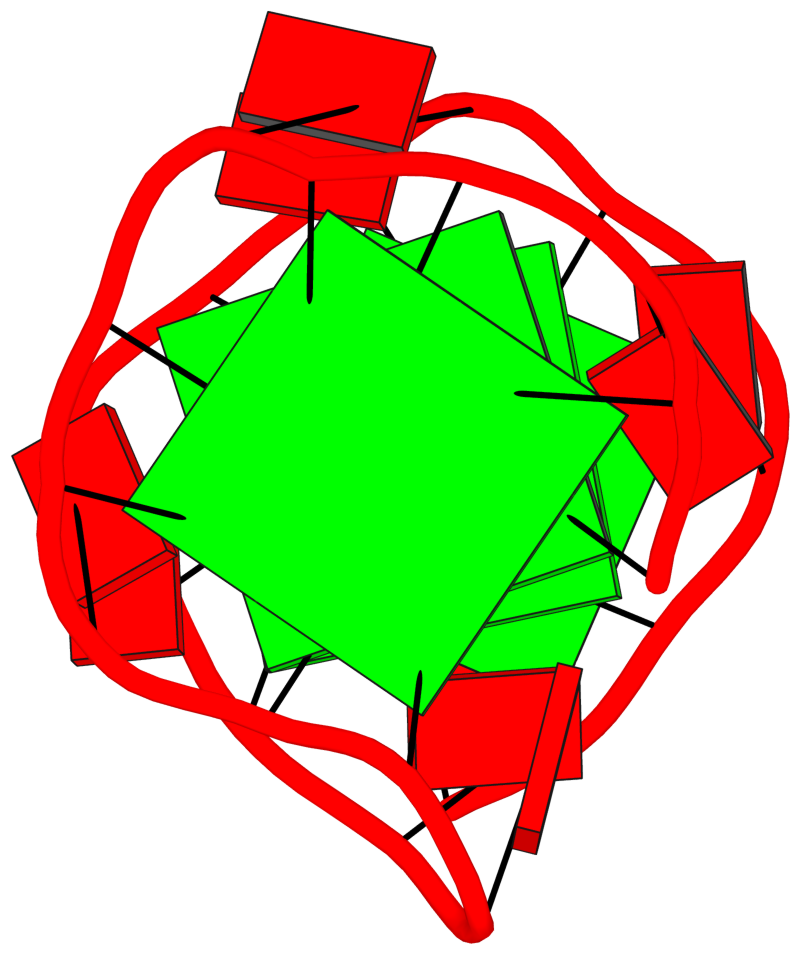
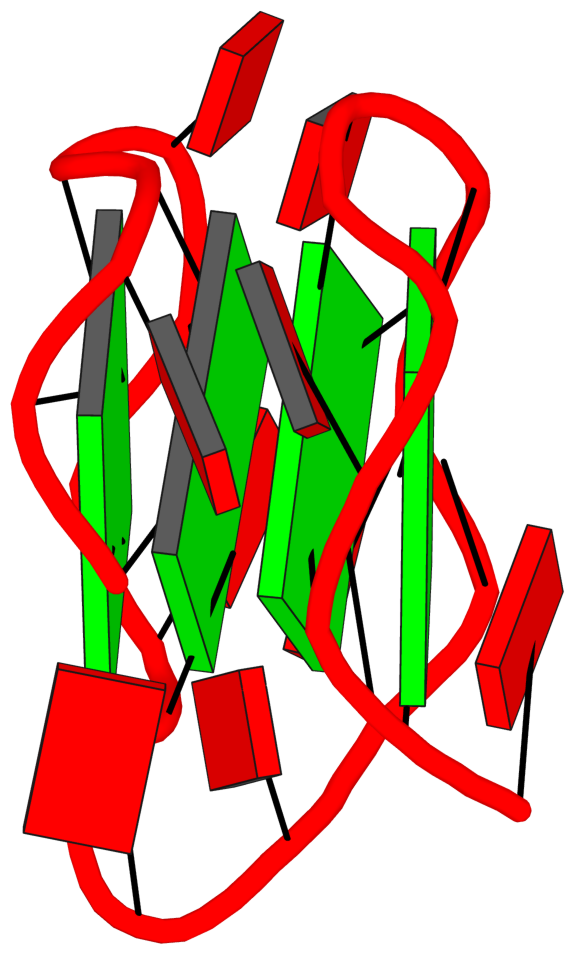
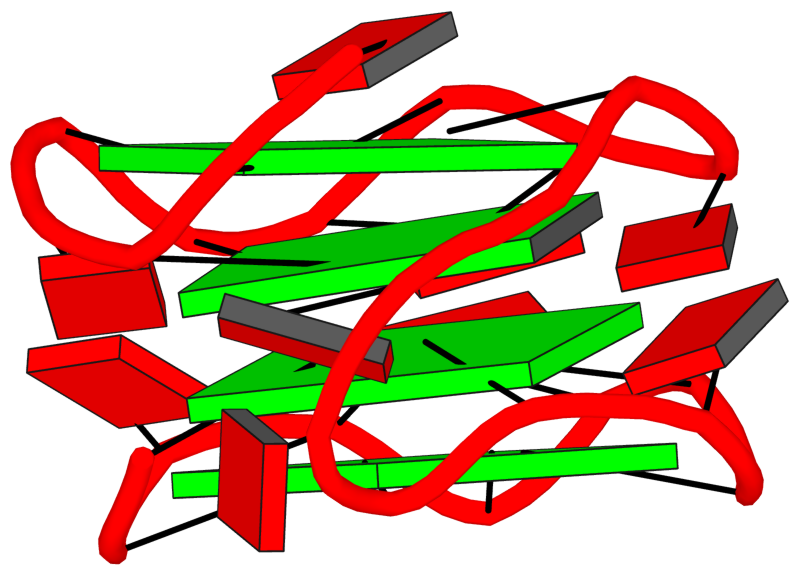
List of 4 G-tetrads
 1 glyco-bond=---- sugar=-3-3 groove=---- planarity=0.364 type=bowl   O+ nts=4 GGGG A.G1,A.G4,A.G7,A.G10
 2 glyco-bond=---- sugar=---- groove=---- planarity=0.385 type=bowl   O+ nts=4 GGGG A.G2,A.G5,A.G8,A.G11
 3 glyco-bond=---- sugar=-3-. groove=---- planarity=0.193 type=other  O+ nts=4 GGGG A.G14,A.G17,A.G20,A.G23
 4 glyco-bond=---- sugar=---3 groove=---- planarity=0.390 type=other  O+ nts=4 GGGG A.G15,A.G18,A.G21,A.G24
List of 1 G4-helix
In DSSR, a G4-helix is defined by stacking interactions of G-tetrads, regardless of backbone connectivity, and may contain more than one G4-stem.
Helix#1, 4 G-tetrads, INTRA-molecular, with 2 stems
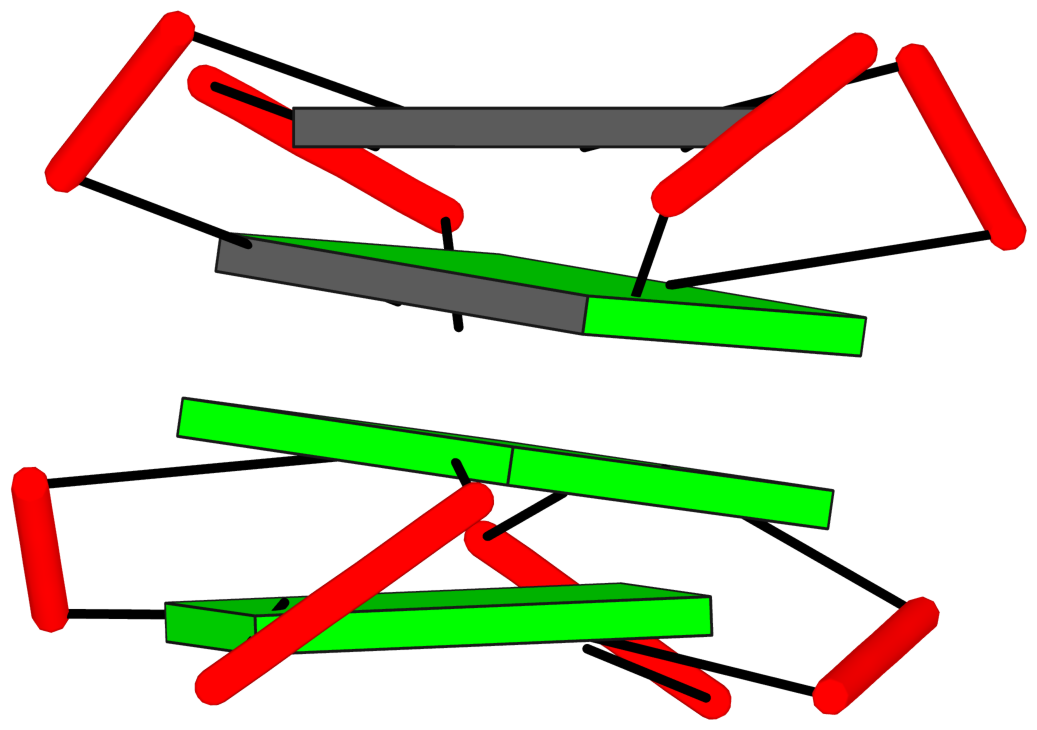
|
1 glyco-bond=---- sugar=---- groove=---- WC-->Major O+ nts=4 GGGG A.G2,A.G5,A.G8,A.G11 2* glyco-bond=---- sugar=-3-3 groove=---- WC-->Major O+ nts=4 GGGG A.G1,A.G4,A.G7,A.G10 3 glyco-bond=---- sugar=.-3- groove=---- Major-->WC O+ nts=4 GGGG A.G23,A.G20,A.G17,A.G14 4 glyco-bond=---- sugar=3--- groove=---- Major-->WC O+ nts=4 GGGG A.G24,A.G21,A.G18,A.G15 step#1 mp(<<,backward) area=6.14 rise=3.41 twist=37.0 step#2 mm(<>,outward) area=24.05 rise=3.56 twist=7.3 step#3 pm(>>,forward) area=10.02 rise=3.27 twist=34.7 strand#1 RNA glyco-bond=---- sugar=--.3 nts=4 GGGG A.G2,A.G1,A.G23,A.G24 strand#2 RNA glyco-bond=---- sugar=-3-- nts=4 GGGG A.G5,A.G4,A.G20,A.G21 strand#3 RNA glyco-bond=---- sugar=--3- nts=4 GGGG A.G8,A.G7,A.G17,A.G18 strand#4 RNA glyco-bond=---- sugar=-3-- nts=4 GGGG A.G11,A.G10,A.G14,A.G15 |
| 3 stacking diagrams | |
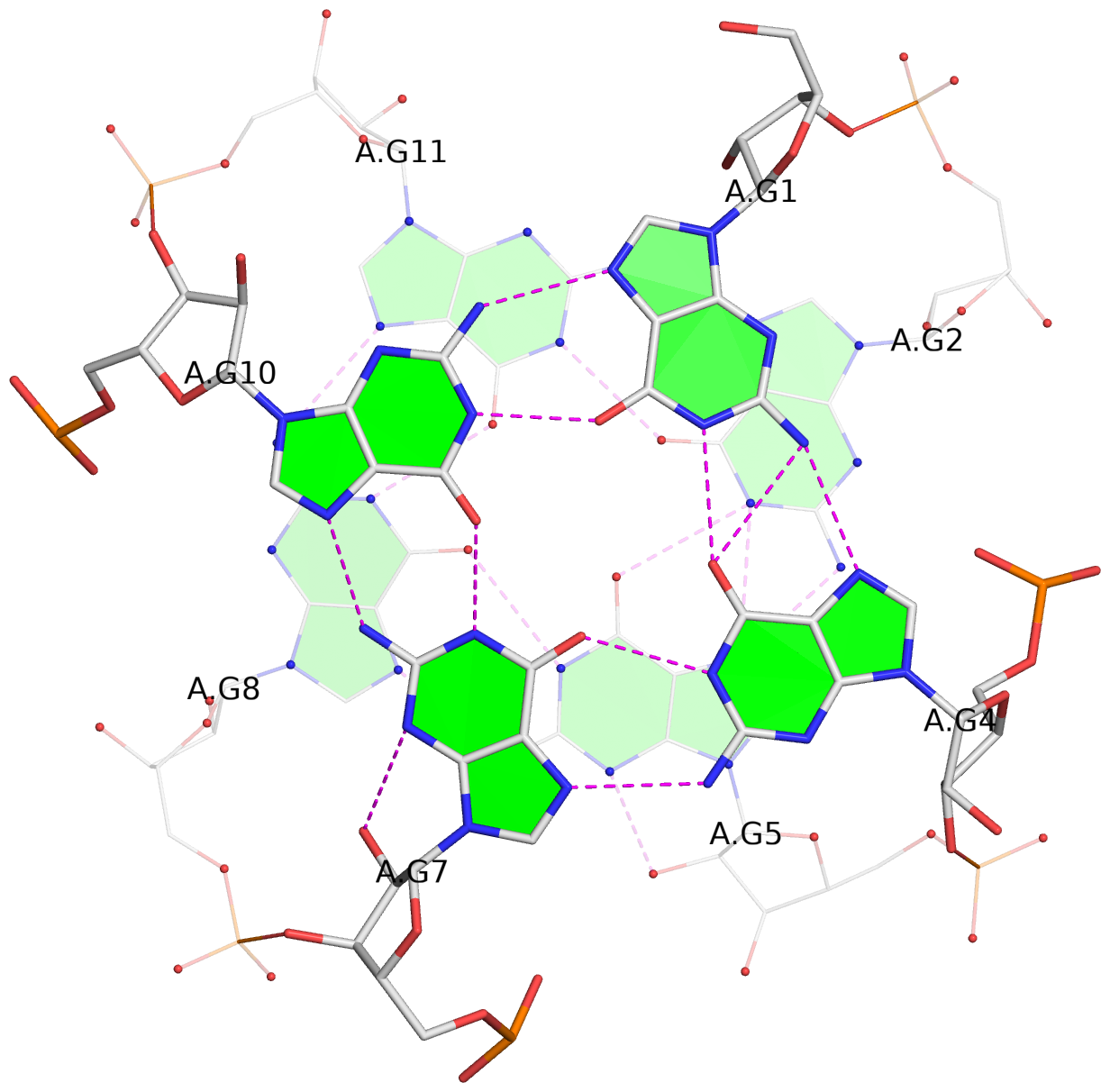
|
1 glyco-bond=---- sugar=---- groove=---- WC-->Major O+ nts=4 GGGG A.G2,A.G5,A.G8,A.G11 |
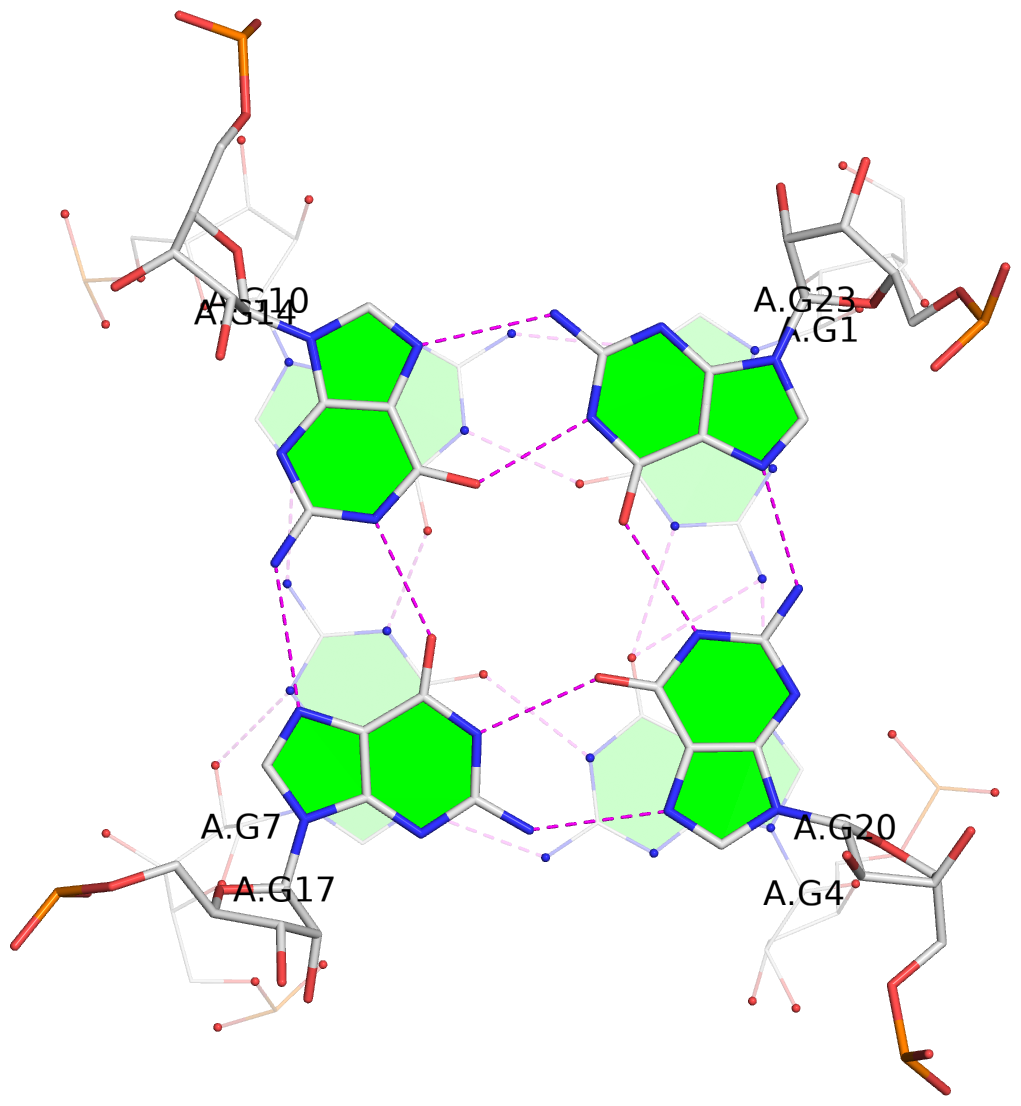
|
2* glyco-bond=---- sugar=-3-3 groove=---- WC-->Major O+ nts=4 GGGG A.G1,A.G4,A.G7,A.G10 |
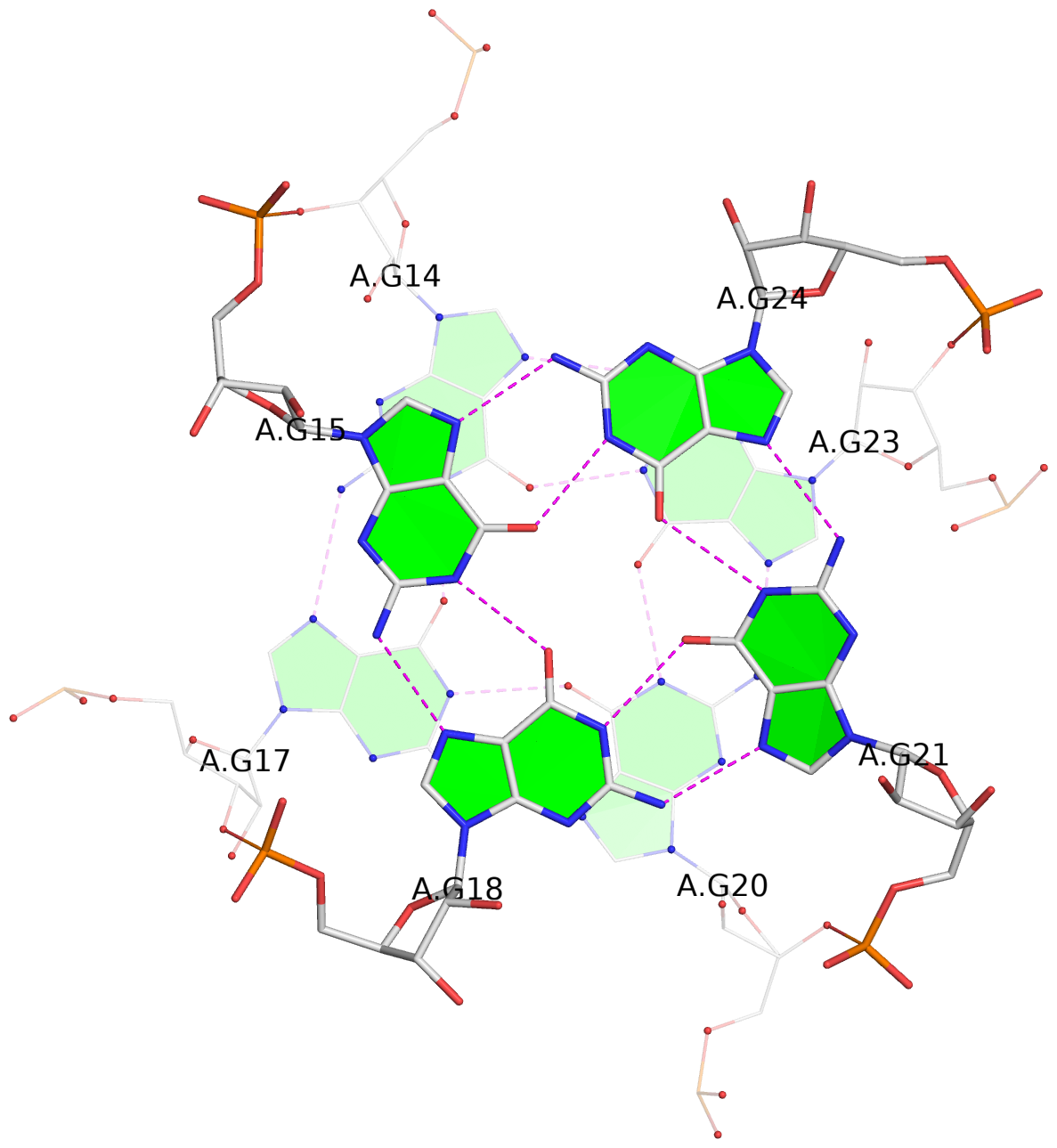
|
3 glyco-bond=---- sugar=.-3- groove=---- Major-->WC O+ nts=4 GGGG A.G23,A.G20,A.G17,A.G14 |
List of 2 G4-stems
In DSSR, a G4-stem is defined as a G4-helix with backbone connectivity. Bulges are also allowed along each of the four strands.
Stem#1, 2 G-tetrads, 3 loops, INTRA-molecular, UUUU, parallel, 4+0, 2(-P-P-P)
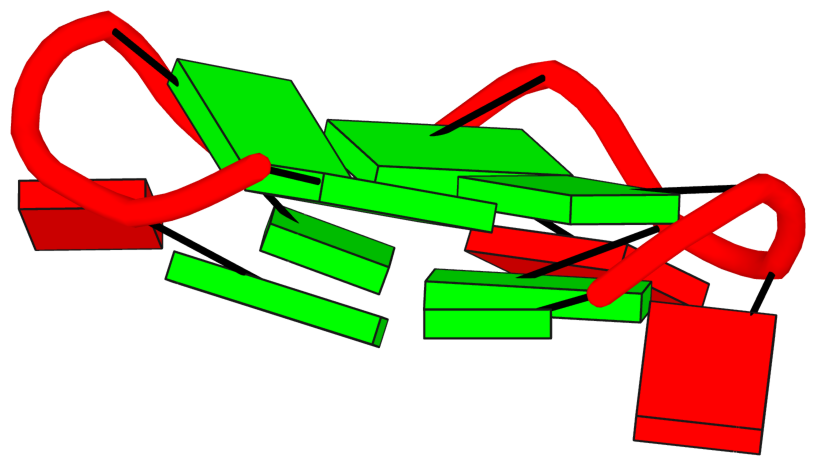
|
1 glyco-bond=---- sugar=-3-3 groove=---- WC-->Major O+ nts=4 GGGG A.G1,A.G4,A.G7,A.G10 2 glyco-bond=---- sugar=---- groove=---- WC-->Major O+ nts=4 GGGG A.G2,A.G5,A.G8,A.G11 step#1 pm(>>,forward) area=6.14 rise=3.41 twist=37.0 strand#1 U RNA glyco-bond=-- sugar=-- nts=2 GG A.G1,A.G2 strand#2 U RNA glyco-bond=-- sugar=3- nts=2 GG A.G4,A.G5 strand#3 U RNA glyco-bond=-- sugar=-- nts=2 GG A.G7,A.G8 strand#4 U RNA glyco-bond=-- sugar=3- nts=2 GG A.G10,A.G11 loop#1 type=propeller strands=[#1,#2] nts=1 A A.A3 loop#2 type=propeller strands=[#2,#3] nts=1 A A.A6 loop#3 type=propeller strands=[#3,#4] nts=1 A A.A9 |
Stem#2, 2 G-tetrads, 3 loops, INTRA-molecular, UUUU, parallel, 4+0, 2(-P-P-P)
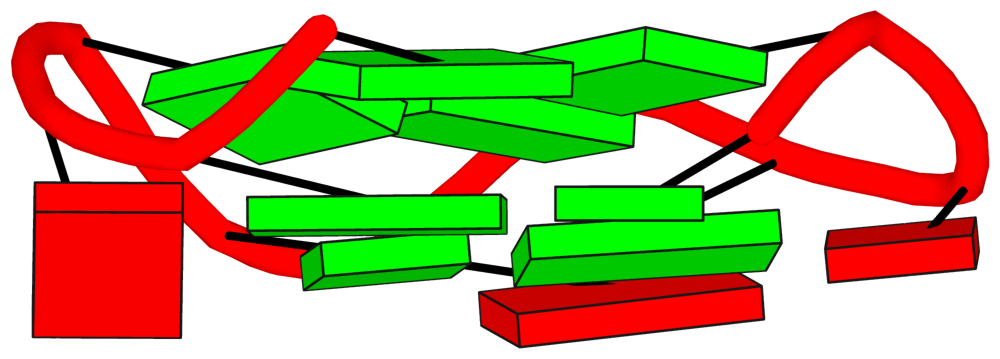
|
1 glyco-bond=---- sugar=-3-. groove=---- WC-->Major O+ nts=4 GGGG A.G14,A.G17,A.G20,A.G23 2 glyco-bond=---- sugar=---3 groove=---- WC-->Major O+ nts=4 GGGG A.G15,A.G18,A.G21,A.G24 step#1 pm(>>,forward) area=10.02 rise=3.27 twist=34.7 strand#1 U RNA glyco-bond=-- sugar=-- nts=2 GG A.G14,A.G15 strand#2 U RNA glyco-bond=-- sugar=3- nts=2 GG A.G17,A.G18 strand#3 U RNA glyco-bond=-- sugar=-- nts=2 GG A.G20,A.G21 strand#4 U RNA glyco-bond=-- sugar=.3 nts=2 GG A.G23,A.G24 loop#1 type=propeller strands=[#1,#2] nts=1 A A.A16 loop#2 type=propeller strands=[#2,#3] nts=1 A A.A19 loop#3 type=propeller strands=[#3,#4] nts=1 A A.A22 |
List of 1 G4 coaxial stack
1 G4 helix#1 contains 2 G4 stems: [#1,#2] [5'/5']