DSSR-enabled G4 identification/annotation: PDB entry 8c7b
Summary information and primary citation
- PDB-id
- 8c7b
- Class
- DNA
- Method
- NMR
- Summary
- Slow cation movements within tetramolecular g-quadruplex: vacant cation binding sites in addition to all syn g-quartet
- Reference
- Zalar M, Wang B, Plavec J, Sket P (2023): "Insight into Tetramolecular DNA G-Quadruplexes Associated with ALS and FTLD: Cation Interactions and Formation of Higher-Ordered Structure." Int J Mol Sci, 24. doi: 10.3390/ijms241713437.
- Abstract
- The G<sub>4</sub>C<sub>2</sub> hexanucleotide repeat expansion in the <i>c9orf72</i> gene is a major genetic cause of familial amyotrophic lateral sclerosis (ALS) and frontotemporal lobar degeneration (FTLD), with the formation of G-quadruplexes directly linked to the development of these diseases. Cations play a crucial role in the formation and structure of G-quadruplexes. In this study, we investigated the impact of biologically relevant potassium ions on G-quadruplex structures and utilized <sub>15</sub>N-labeled ammonium cations as a substitute for K<sub>+</sub> ions to gain further insights into cation binding and exchange dynamics. Through nuclear magnetic resonance spectroscopy and molecular dynamics simulations, we demonstrate that the single d(G<sub>4</sub>C<sub>2</sub>) repeat, in the presence of <sub>15</sub>NH<sub>4</sub><sub>+</sub> ions, adopts a tetramolecular G-quadruplex with an all-<i>syn</i> quartet at the 5'-end. The movement of <sub>15</sub>NH<sub>4</sub><sub>+</sub> ions through the central channel of the G-quadruplex, as well as to the bulk solution, is governed by the vacant cation binding site, in addition to the all-<i>syn</i> quartet at the 5'-end. Furthermore, the addition of K<sub>+</sub> ions to G-quadruplexes folded in the presence of <sub>15</sub>NH<sub>4</sub><sub>+</sub> ions induces stacking of G-quadruplexes via their 5'-end G-quartets, leading to the formation of stable higher-ordered species.
- G4 notes
- 4 G-tetrads, 1 G4 helix, 1 G4 stem, UUUU, parallel, 4+0
Cartoon-block schematics in six views (download the tarball)
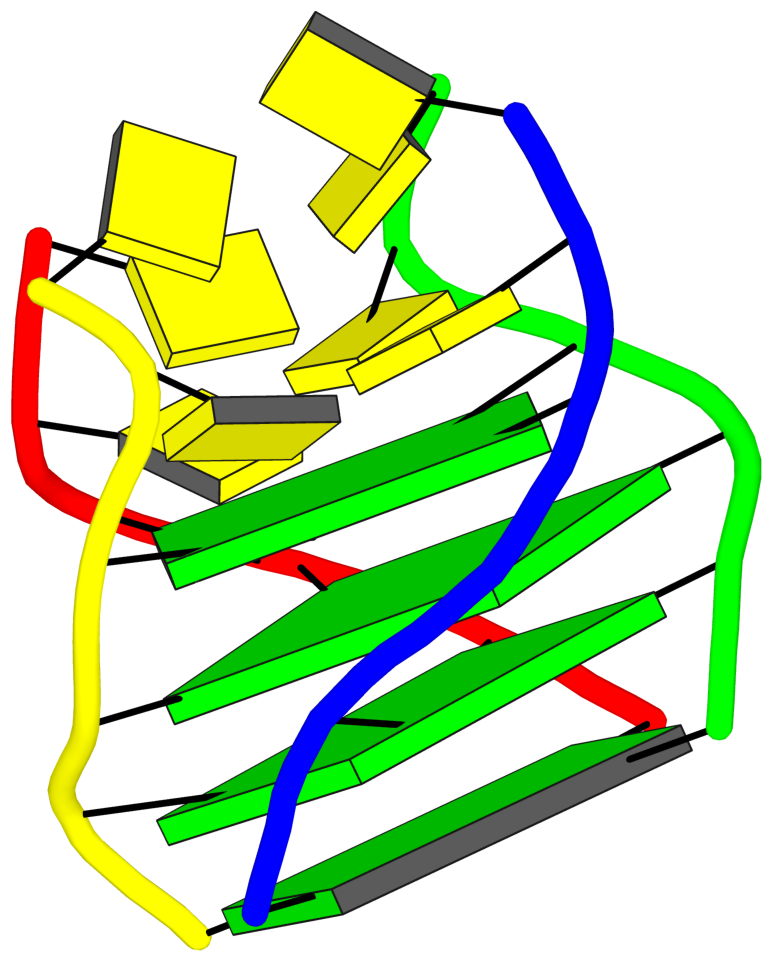
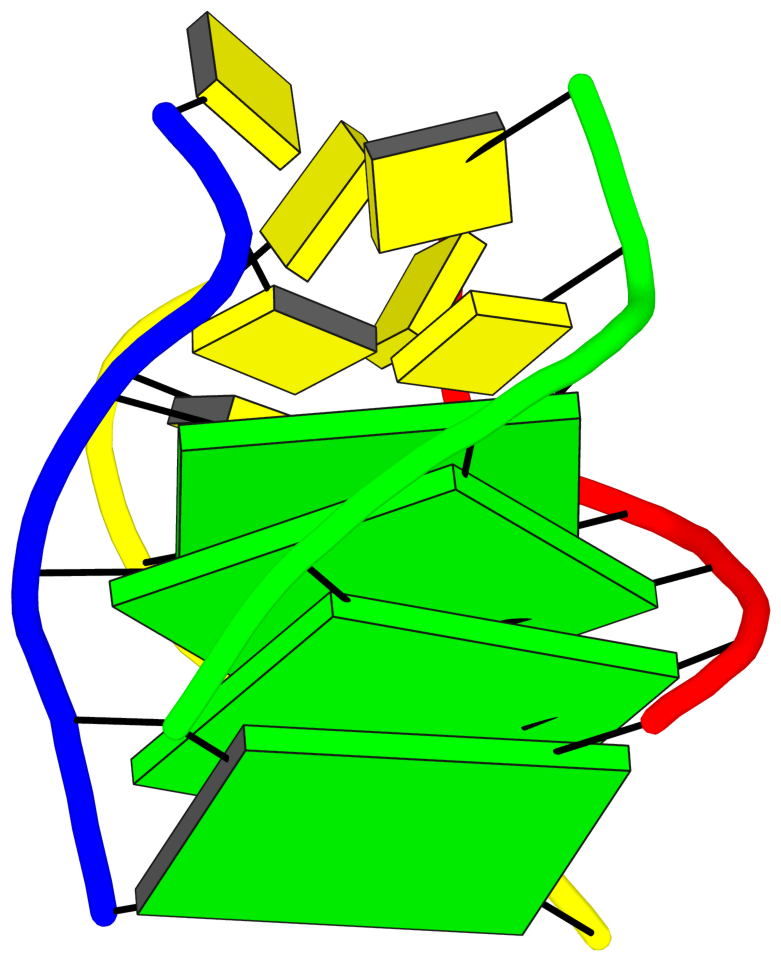
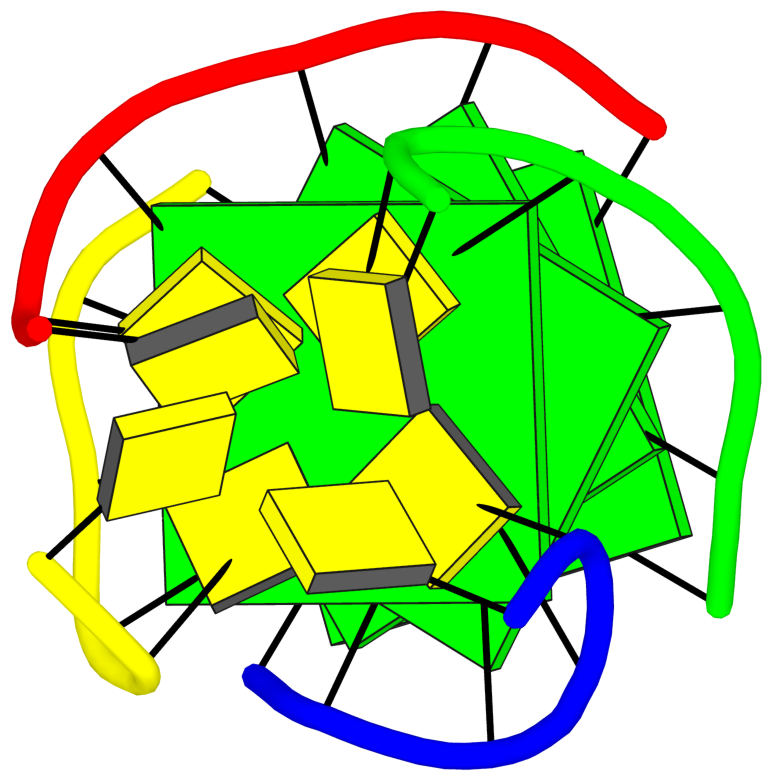
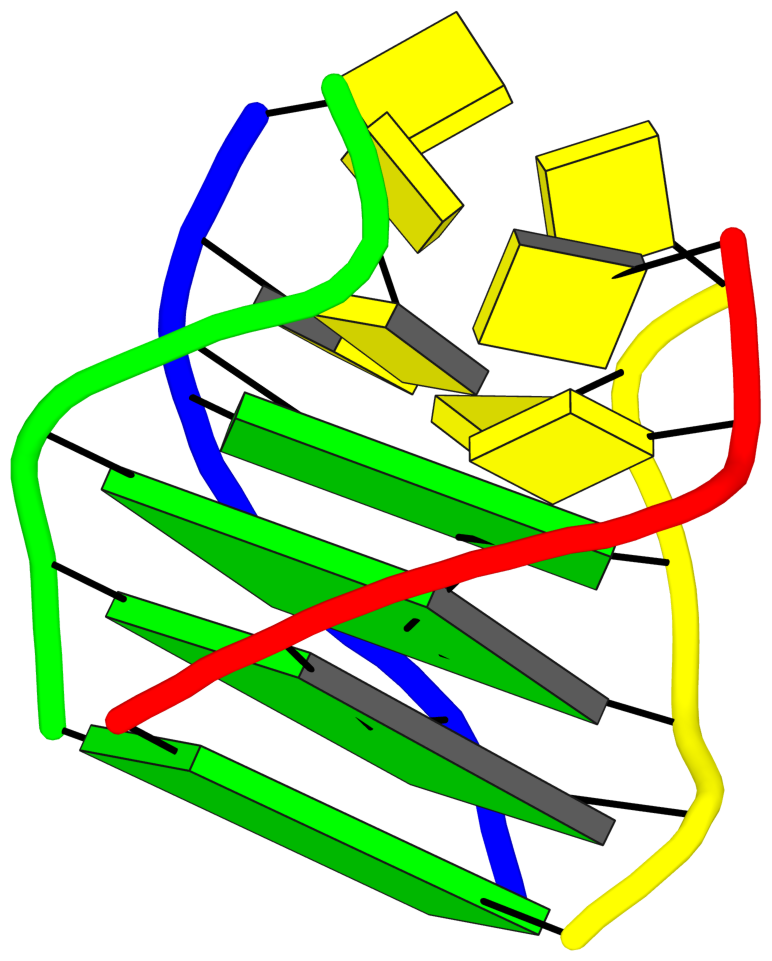
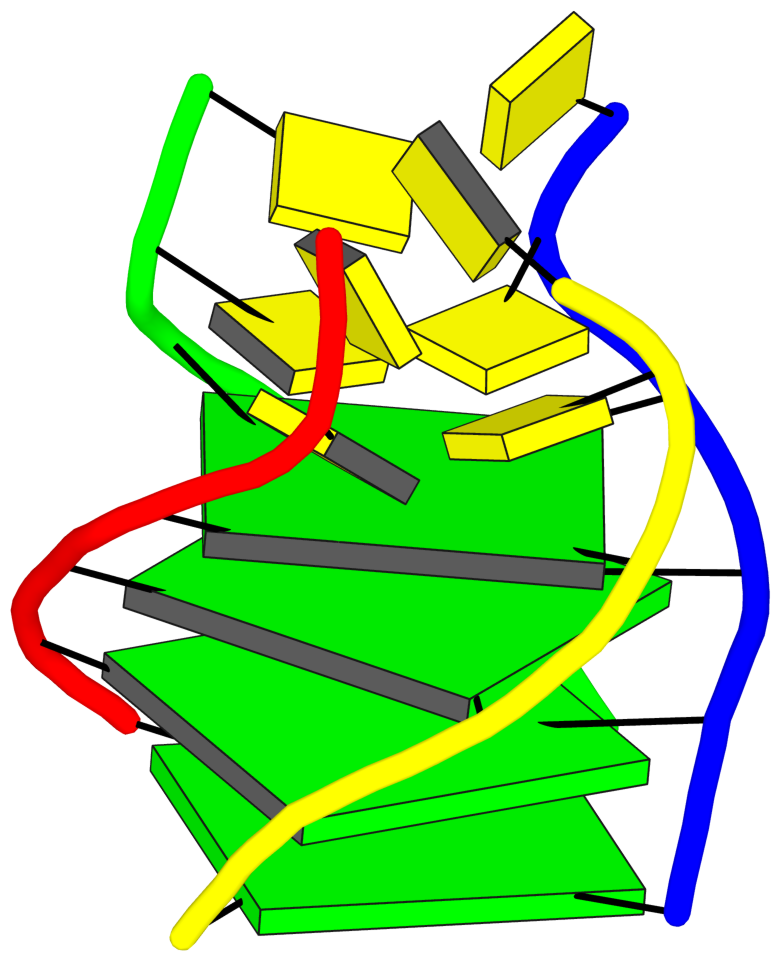
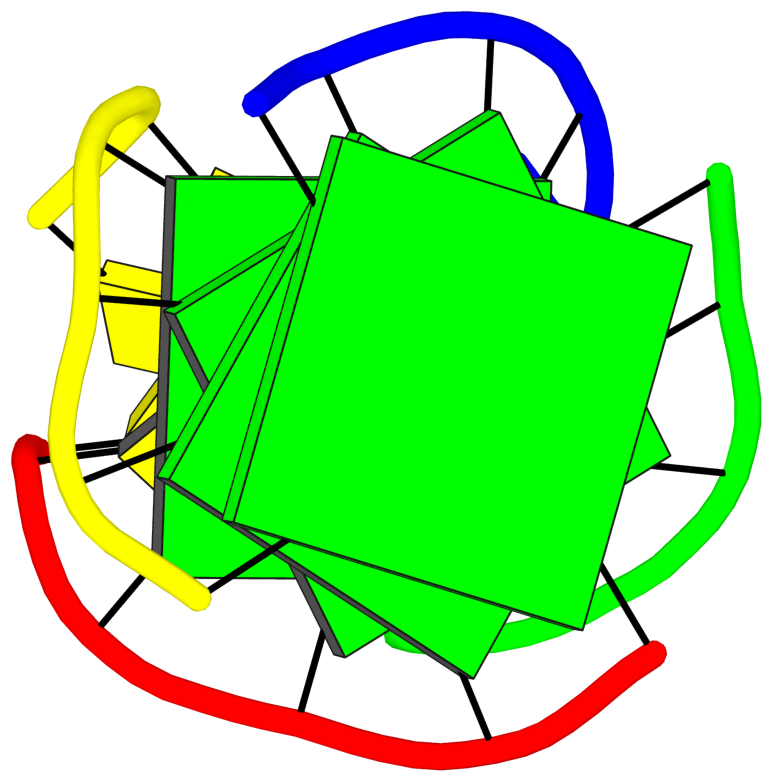
List of 4 G-tetrads
 1 glyco-bond=ssss sugar=---- groove=---- planarity=0.122 type=planar -- nts=4 GGGG A.DG1,D.DG19,C.DG13,B.DG7
 2 glyco-bond=---- sugar=---- groove=---- planarity=0.216 type=other  -- nts=4 GGGG A.DG2,D.DG20,C.DG14,B.DG8
 3 glyco-bond=---- sugar=---- groove=---- planarity=0.254 type=other  -- nts=4 GGGG A.DG3,D.DG21,C.DG15,B.DG9
 4 glyco-bond=---- sugar=---- groove=---- planarity=0.413 type=bowl   -- nts=4 GGGG A.DG4,D.DG22,C.DG16,B.DG10
List of 1 G4-helix
In DSSR, a G4-helix is defined by stacking interactions of G-tetrads, regardless of backbone connectivity, and may contain more than one G4-stem.
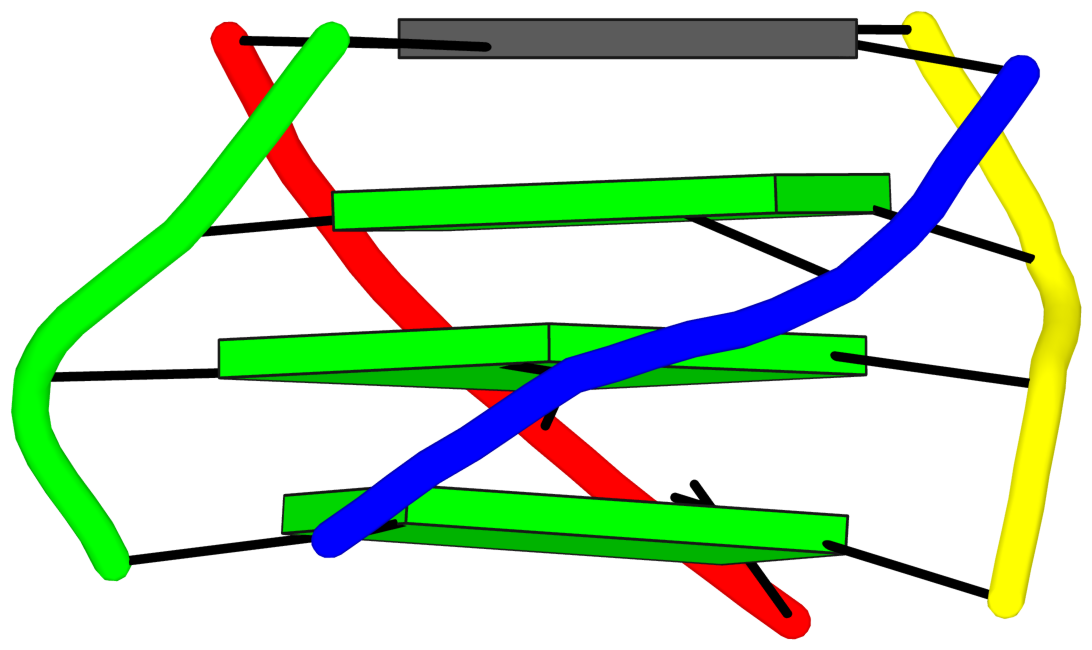
Helix#1, 4 G-tetrads, inter-molecular, with 1 stem
|
1 glyco-bond=ssss sugar=---- groove=---- Major-->WC -- nts=4 GGGG A.DG1,D.DG19,C.DG13,B.DG7 2 glyco-bond=---- sugar=---- groove=---- WC-->Major -- nts=4 GGGG A.DG2,D.DG20,C.DG14,B.DG8 3 glyco-bond=---- sugar=---- groove=---- WC-->Major -- nts=4 GGGG A.DG3,D.DG21,C.DG15,B.DG9 4 glyco-bond=---- sugar=---- groove=---- WC-->Major -- nts=4 GGGG A.DG4,D.DG22,C.DG16,B.DG10 step#1 mm(<>,outward) area=18.68 rise=3.42 twist=14.4 step#2 pm(>>,forward) area=14.10 rise=3.24 twist=29.4 step#3 pm(>>,forward) area=8.95 rise=3.48 twist=30.5 strand#1 DNA glyco-bond=s--- sugar=---- nts=4 GGGG A.DG1,A.DG2,A.DG3,A.DG4 strand#2 DNA glyco-bond=s--- sugar=---- nts=4 GGGG D.DG19,D.DG20,D.DG21,D.DG22 strand#3 DNA glyco-bond=s--- sugar=---- nts=4 GGGG C.DG13,C.DG14,C.DG15,C.DG16 strand#4 DNA glyco-bond=s--- sugar=---- nts=4 GGGG B.DG7,B.DG8,B.DG9,B.DG10 |
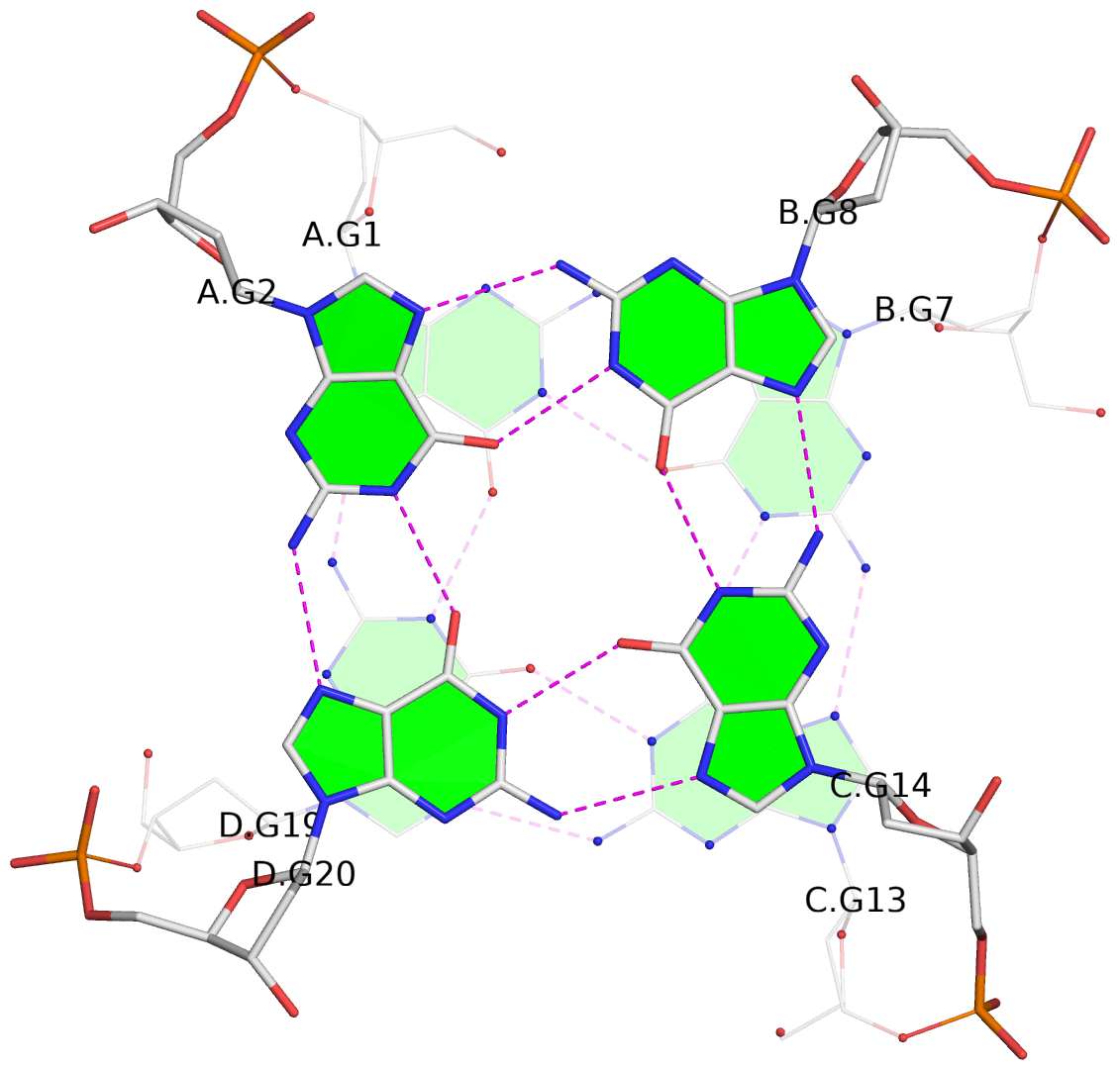
| 3 stacking diagrams | |
|
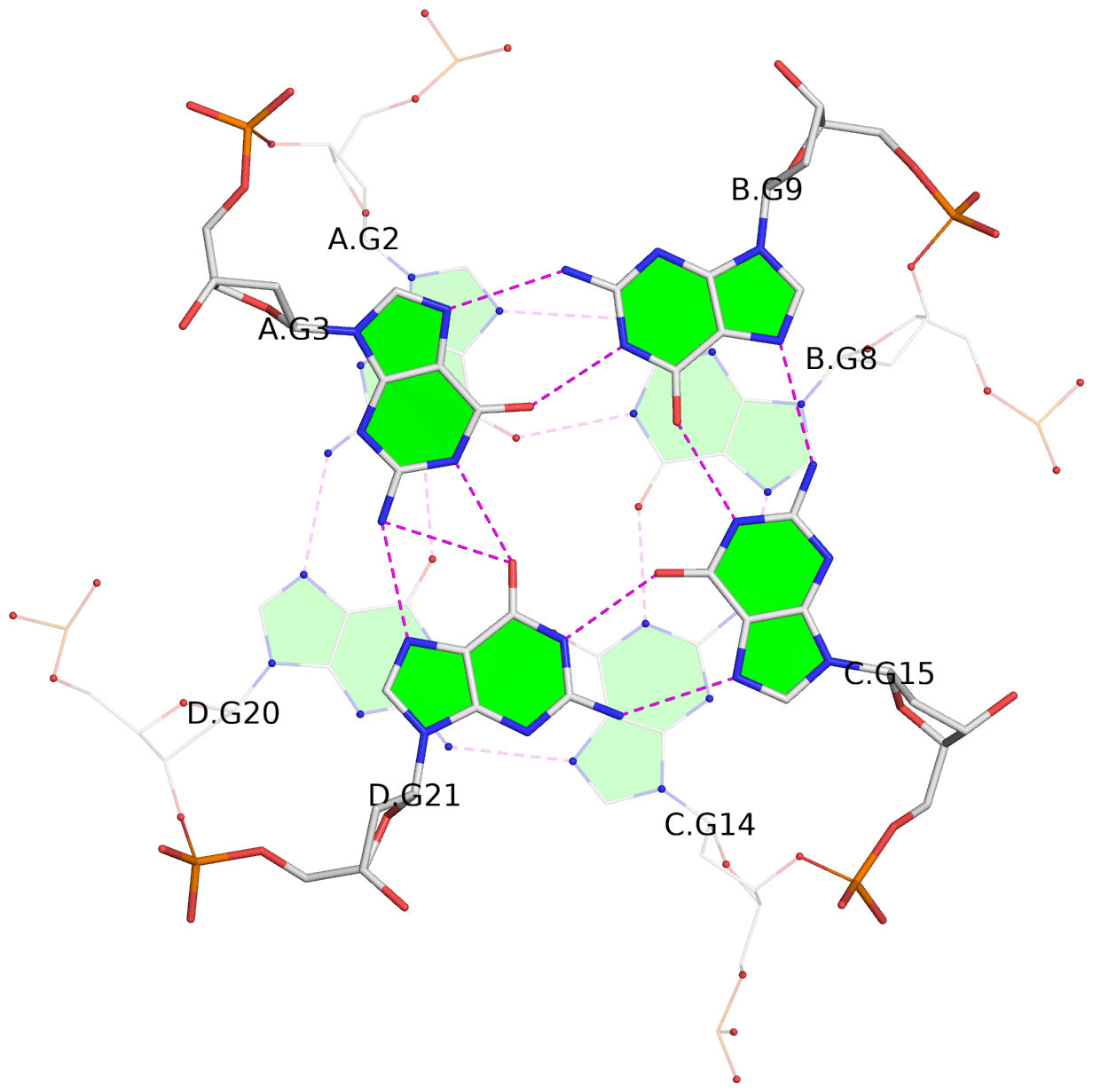
1 glyco-bond=ssss sugar=---- groove=---- Major-->WC -- nts=4 GGGG A.DG1,D.DG19,C.DG13,B.DG7 |
|
2 glyco-bond=---- sugar=---- groove=---- WC-->Major -- nts=4 GGGG A.DG2,D.DG20,C.DG14,B.DG8 |
|
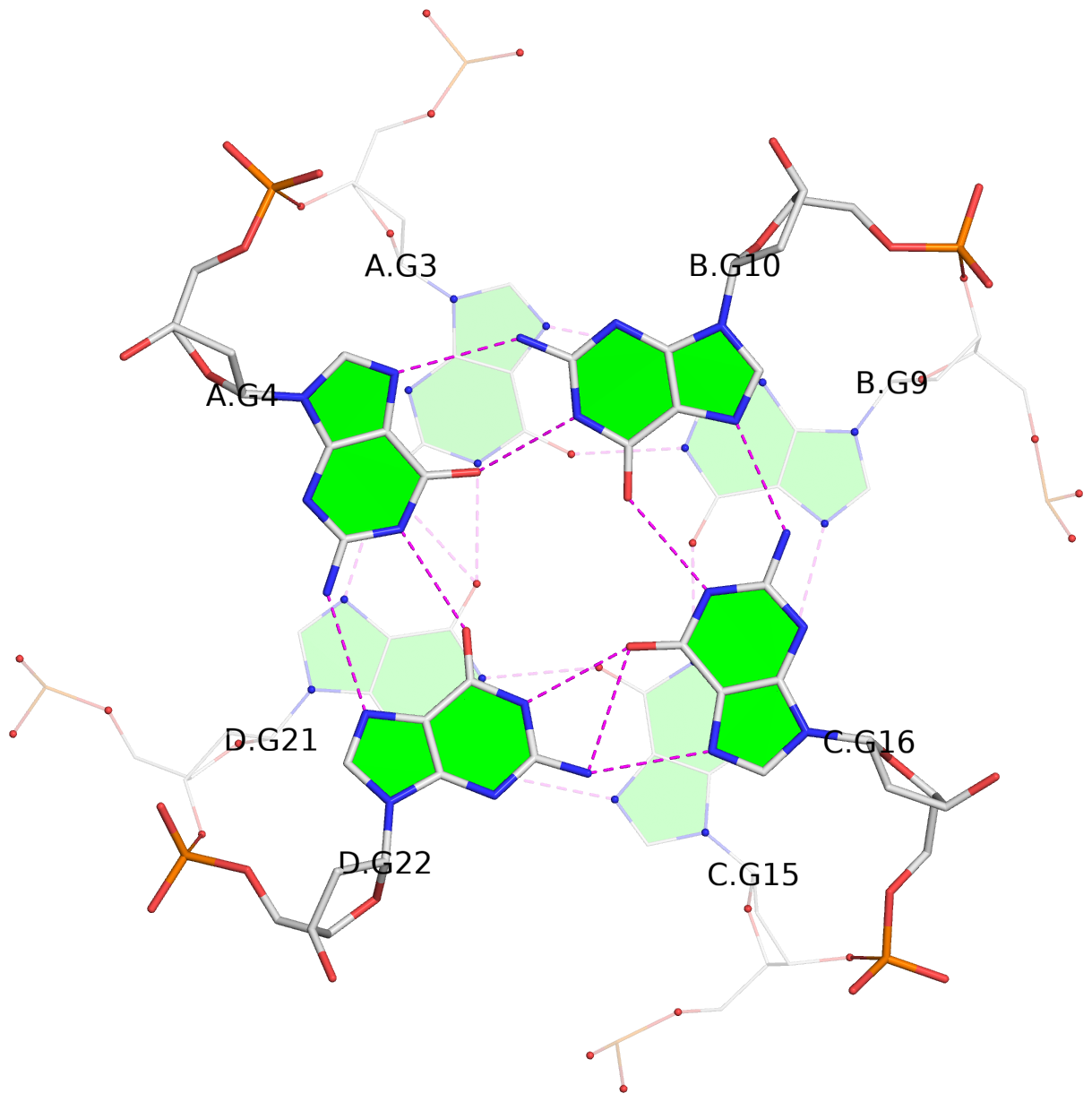
3 glyco-bond=---- sugar=---- groove=---- WC-->Major -- nts=4 GGGG A.DG3,D.DG21,C.DG15,B.DG9 |
List of 1 G4-stem
In DSSR, a G4-stem is defined as a G4-helix with backbone connectivity. Bulges are also allowed along each of the four strands.
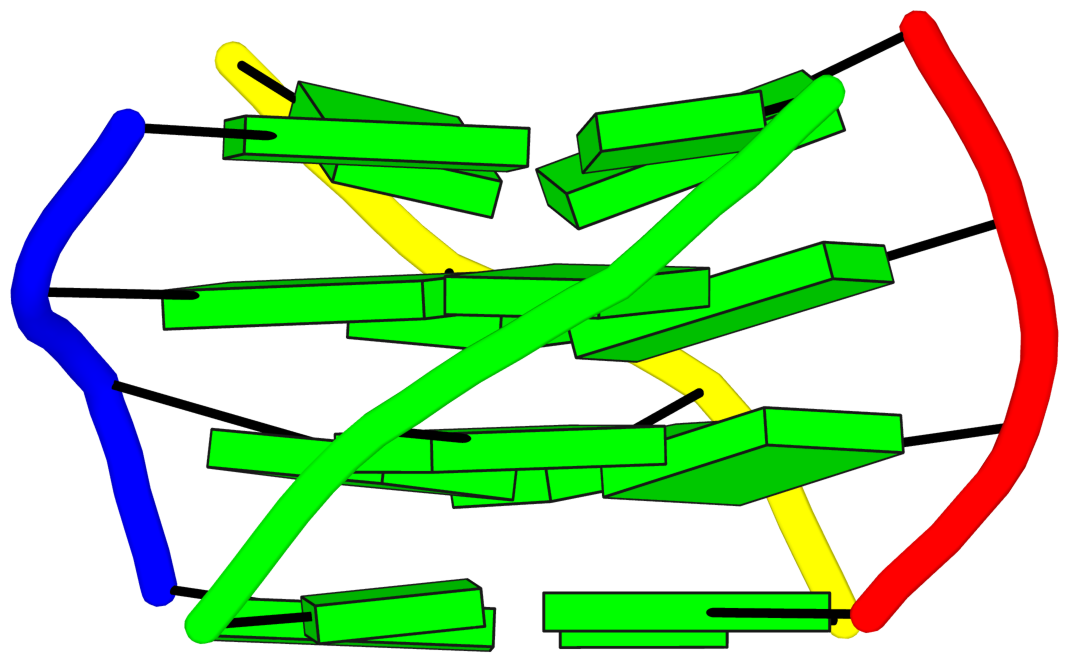
Stem#1, 4 G-tetrads, 0 loops, inter-molecular, UUUU, parallel, 4+0
|
1 glyco-bond=ssss sugar=---- groove=---- Major-->WC -- nts=4 GGGG A.DG1,D.DG19,C.DG13,B.DG7 2 glyco-bond=---- sugar=---- groove=---- WC-->Major -- nts=4 GGGG A.DG2,D.DG20,C.DG14,B.DG8 3 glyco-bond=---- sugar=---- groove=---- WC-->Major -- nts=4 GGGG A.DG3,D.DG21,C.DG15,B.DG9 4 glyco-bond=---- sugar=---- groove=---- WC-->Major -- nts=4 GGGG A.DG4,D.DG22,C.DG16,B.DG10 step#1 mm(<>,outward) area=18.68 rise=3.42 twist=14.4 step#2 pm(>>,forward) area=14.10 rise=3.24 twist=29.4 step#3 pm(>>,forward) area=8.95 rise=3.48 twist=30.5 strand#1 U DNA glyco-bond=s--- sugar=---- nts=4 GGGG A.DG1,A.DG2,A.DG3,A.DG4 strand#2 U DNA glyco-bond=s--- sugar=---- nts=4 GGGG D.DG19,D.DG20,D.DG21,D.DG22 strand#3 U DNA glyco-bond=s--- sugar=---- nts=4 GGGG C.DG13,C.DG14,C.DG15,C.DG16 strand#4 U DNA glyco-bond=s--- sugar=---- nts=4 GGGG B.DG7,B.DG8,B.DG9,B.DG10 |