DSSR-enabled G4 identification/annotation: PDB entry 8tvz
Summary information and primary citation
- PDB-id
- 8tvz
- Class
- RNA
- Method
- cryo-EM (5.94 Å)
- Summary
- RNA origami 3-helix tile traptamer
- Reference
- Vallina NS, McRae EKS, Geary C, Andersen ES (2024): "An RNA origami robot that traps and releases a fluorescent aptamer." Sci Adv, 10, eadk1250. doi: 10.1126/sciadv.adk1250.
- Abstract
- RNA nanotechnology aims to use RNA as a programmable material to create self-assembling nanodevices for application in medicine and synthetic biology. The main challenge is to develop advanced RNA robotic devices that both sense, compute, and actuate to obtain enhanced control over molecular processes. Here, we use the RNA origami method to prototype an RNA robotic device, named the "Traptamer," that mechanically traps the fluorescent aptamer, iSpinach. The Traptamer is shown to sense two RNA key strands, acts as a Boolean AND gate, and reversibly controls the fluorescence of the iSpinach aptamer. Cryo-electron microscopy of the closed Traptamer structure at 5.45-angstrom resolution reveals the mechanical mode of distortion of the iSpinach motif. Our study suggests a general approach to distorting RNA motifs and a path forward to build sophisticated RNA machines that through sensing, computing, and actuation modules can be used to precisely control RNA functionalities in cellular systems.
- G4 notes
- 2 G-tetrads, 1 G4 helix, 1 G4 stem, UUDD, anti-parallel:basket2, 2+2, 2(-P+P)
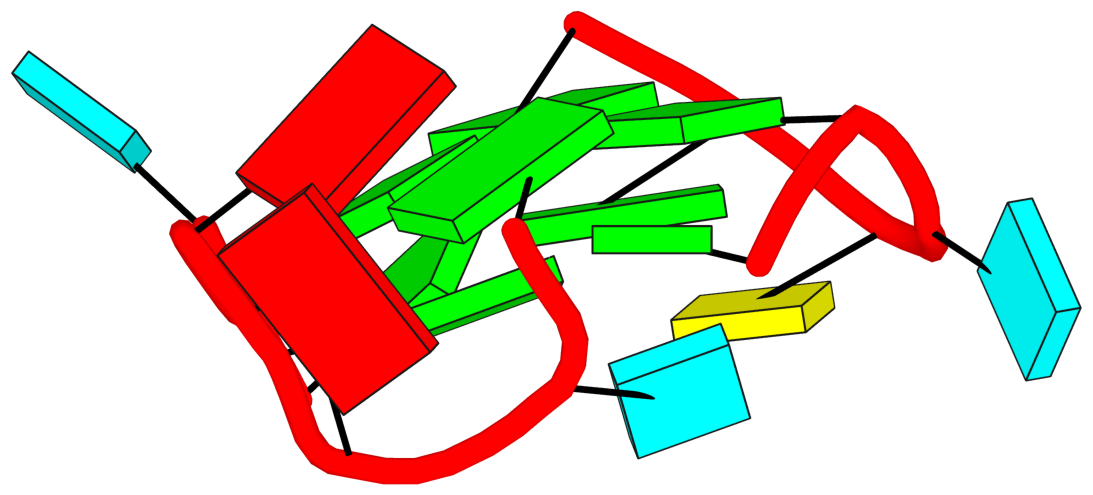
Cartoon-block schematics in six views (download the tarball)
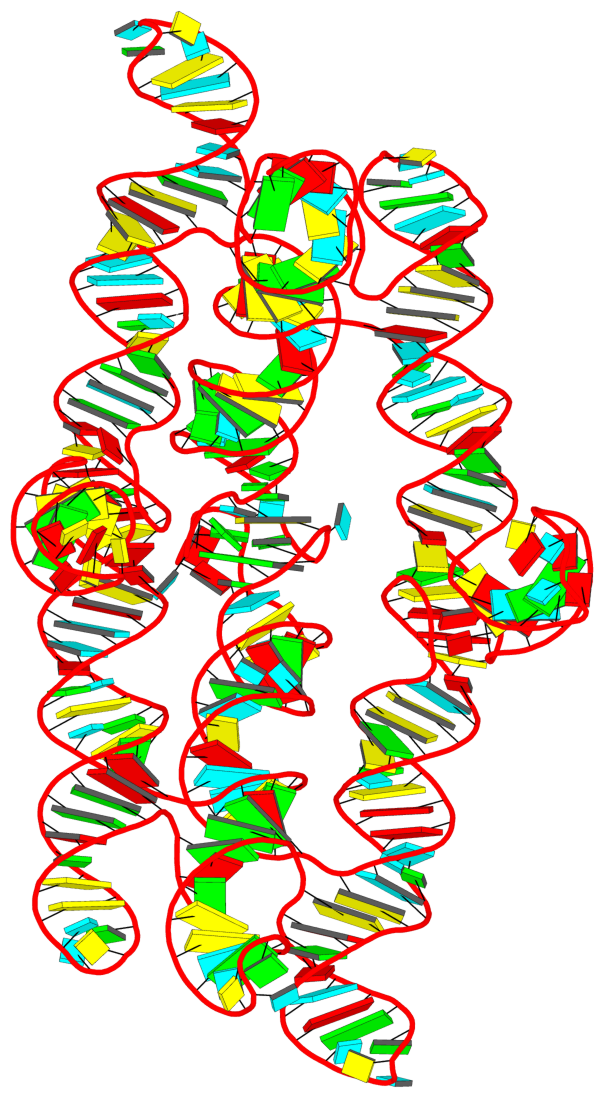
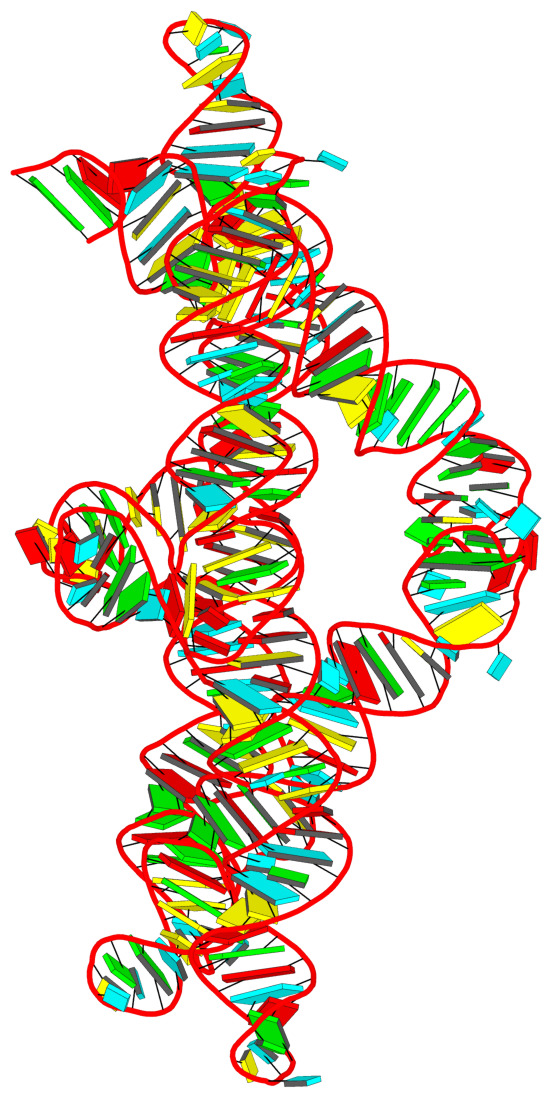
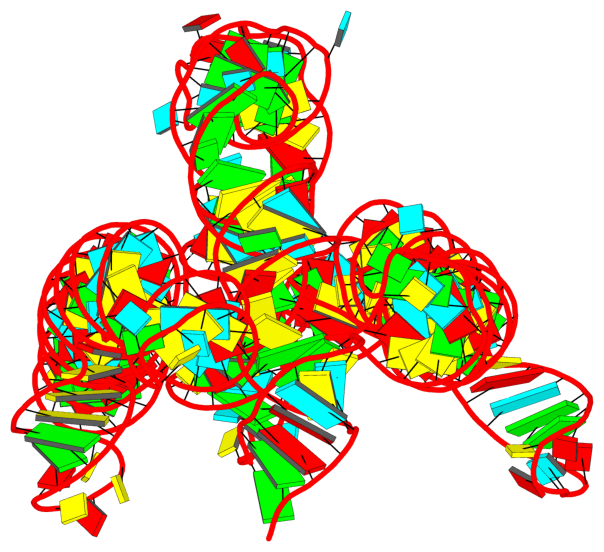
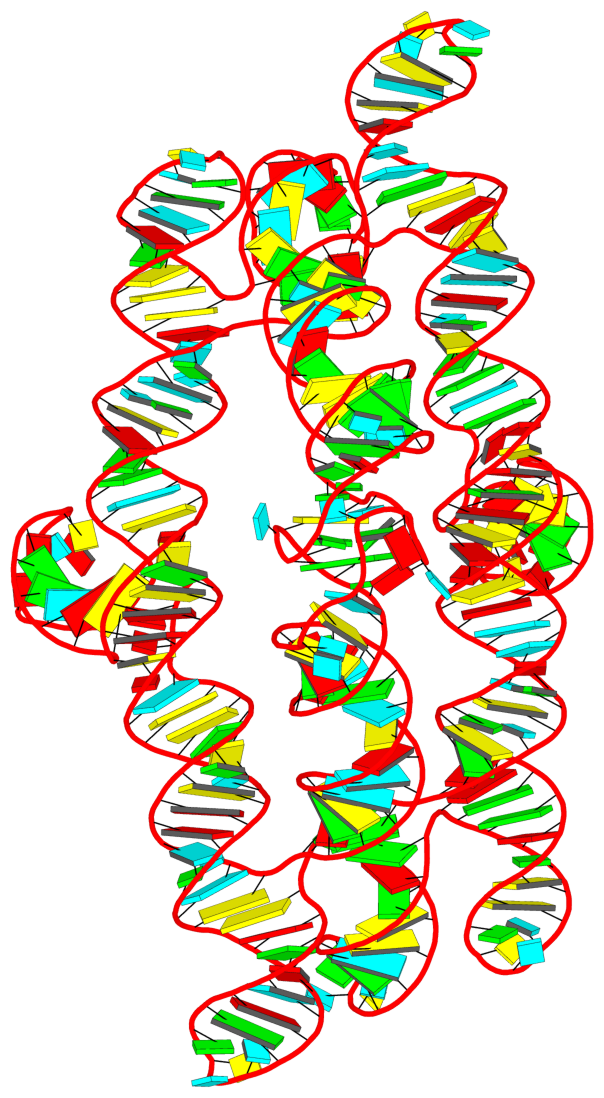
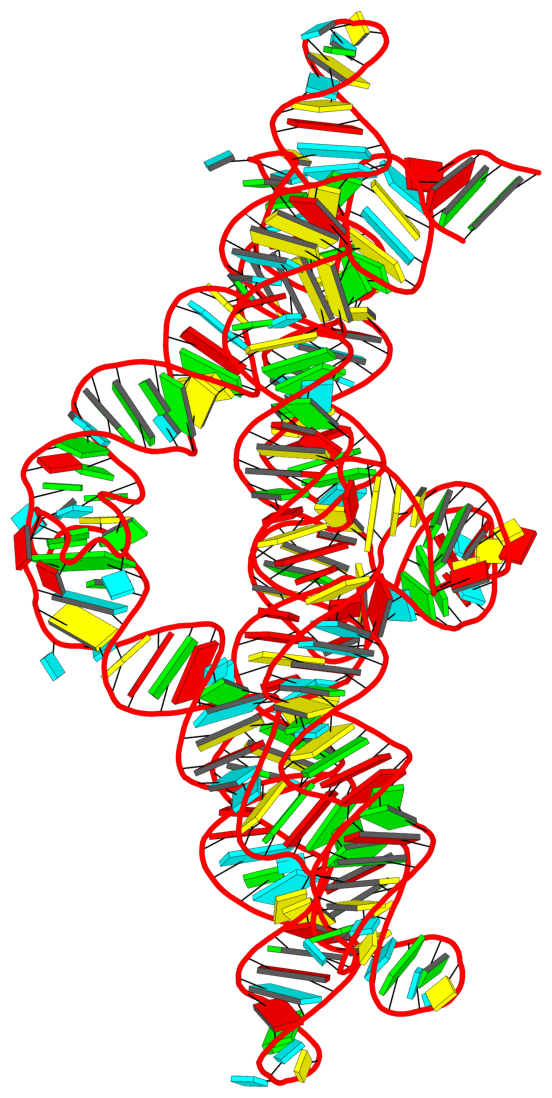
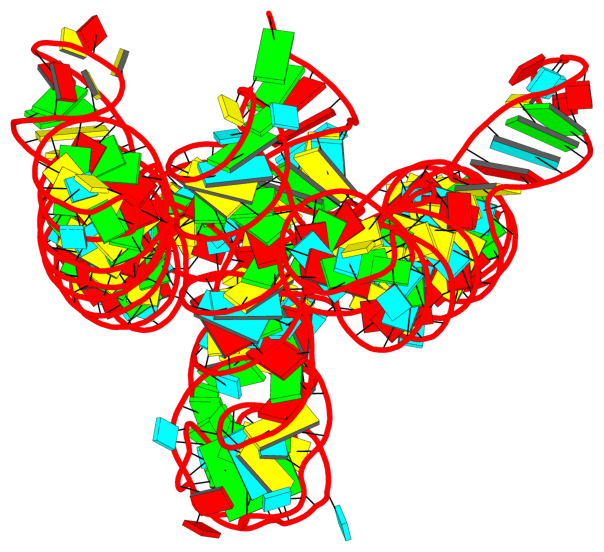
List of 2 G-tetrads
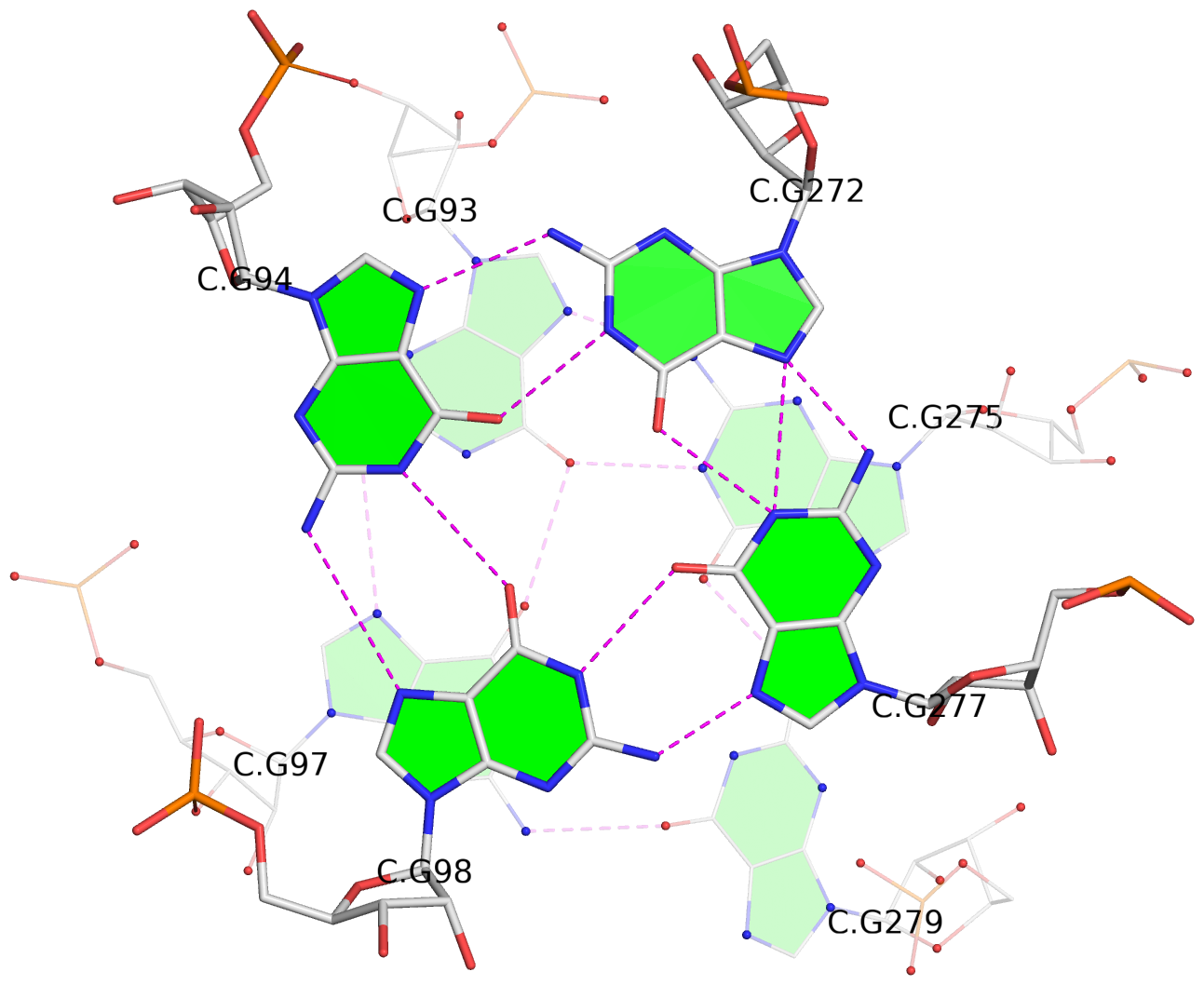
 1 glyco-bond=--s- sugar=-333 groove=-.n- planarity=0.572 type=other  -- nts=4 GGGG C.G93,C.G97,C.G279,C.G275
 2 glyco-bond=--ss sugar=-3-3 groove=-w-n planarity=0.426 type=other  N+ nts=4 GGGG C.G94,C.G98,C.G277,C.G272
List of 1 G4-helix
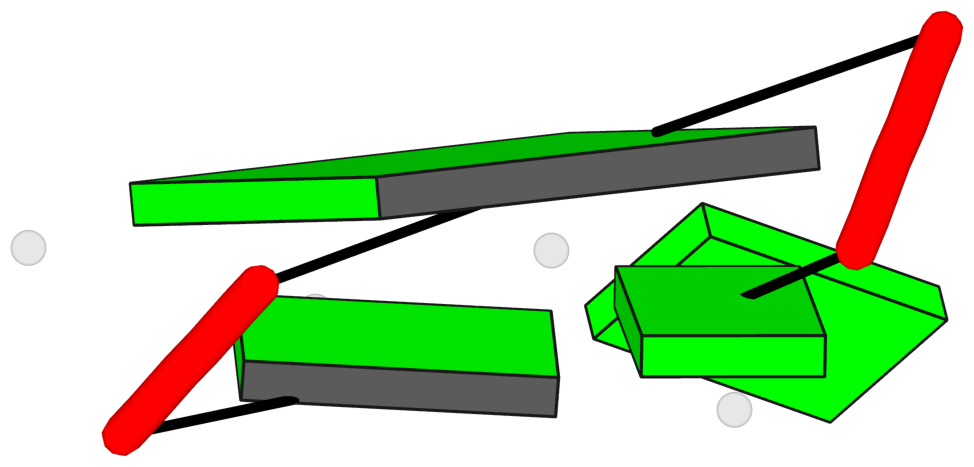
In DSSR, a G4-helix is defined by stacking interactions of G-tetrads, regardless of backbone connectivity, and may contain more than one G4-stem.
Helix#1, 2 G-tetrads, INTRA-molecular, with 1 stem
|
1 glyco-bond=--s- sugar=-333 groove=-.n- -- -- nts=4 GGGG C.G93,C.G97,C.G279,C.G275 2 glyco-bond=--ss sugar=-3-3 groove=-w-n WC-->Major N+ nts=4 GGGG C.G94,C.G98,C.G277,C.G272 step#1 pm(>>,forward) area=14.52 rise=3.33 twist=29.2 strand#1 RNA glyco-bond=-- sugar=-- nts=2 GG C.G93,C.G94 strand#2 RNA glyco-bond=-- sugar=33 nts=2 GG C.G97,C.G98 strand#3 RNA glyco-bond=ss sugar=3- nts=2 GG C.G279,C.G277 strand#4 RNA glyco-bond=-s sugar=33 nts=2 GG C.G275,C.G272 |
| 1 stacking diagram | |
|
1 glyco-bond=--s- sugar=-333 groove=-.n- -- -- nts=4 GGGG C.G93,C.G97,C.G279,C.G275 |
List of 1 G4-stem
In DSSR, a G4-stem is defined as a G4-helix with backbone connectivity. Bulges are also allowed along each of the four strands.
Stem#1, 2 G-tetrads, 2 loops, INTRA-molecular, UUDD, anti-parallel:basket2, 2+2, 2(-P+P)
|
1 glyco-bond=--s- sugar=-333 groove=-.n- -- -- nts=4 GGGG C.G93,C.G97,C.G279,C.G275 2 glyco-bond=--ss sugar=-3-3 groove=-w-n WC-->Major N+ nts=4 GGGG C.G94,C.G98,C.G277,C.G272 step#1 pm(>>,forward) area=14.52 rise=3.33 twist=29.2 strand#1 U RNA glyco-bond=-- sugar=-- nts=2 GG C.G93,C.G94 strand#2 U RNA glyco-bond=-- sugar=33 nts=2 GG C.G97,C.G98 strand#3* D RNA glyco-bond=ss sugar=3- nts=2 GG C.G279,C.G277 bulged-nts=1 U C.U278 strand#4* D RNA glyco-bond=-s sugar=33 nts=2 GG C.G275,C.G272 bulged-nts=2 AU C.A274,C.U273 loop#1 type=propeller strands=[#1,#2] nts=2 UC C.U95,C.C96 loop#2 type=propeller strands=[#4,#3] nts=1 A C.A276 |