DSSR-enabled G4 identification/annotation: PDB entry 9uk6
Summary information and primary citation
- PDB-id
- 9uk6
- Class
- DNA
- Method
- X-ray (1.94 Å)
- Summary
- Dimeric parallel g-quadruplex formed by d(g4c2)4
- Reference
- Geng Y, Liu C, Miao H, Suen MC, Xie Y, Zhang B, Han W, Wu C, Ren H, Chen X, Tai HC, Wang Z, Zhu G, Cai Q (2025): "Crystal structures of distinct parallel and antiparallel DNA G-quadruplexes reveal structural polymorphism in C9orf72 G4C2 repeats." Nucleic Acids Res., 53. doi: 10.1093/nar/gkaf879.
- Abstract
- The abnormal expansion of GGGGCC (G4C2) repeats in the noncoding region of the C9orf72 gene is a major genetic cause of two devastating neurodegenerative disorders, amyotrophic lateral sclerosis (ALS) and frontotemporal dementia (FTD). These G4C2 repeats are known to form G-quadruplex (G4) structures, which are hypothesized to contribute to disease pathogenesis. Here, we demonstrated that four DNA G4C2 repeats can fold into two structurally distinct G4 conformations: a parallel and an antiparallel topology. The high-resolution crystal structure of the parallel G4 reveals an eight-layered dimeric assembly, formed by two identical monomeric units. Each unit contains four stacked G-tetrads connected by three propeller CC loops and is stabilized through 5'-to-5' π-π interactions and coordination with a central K+ ion. Notably, the 3'-ending cytosines form a C·C+·C·C+ quadruple base pair stacking onto the adjacent G-tetrad layer. In contrast, the antiparallel G4 adopts a four-layered monomeric structure with three edgewise loops, where the C6 and C18 bases engage in stacking interaction with neighboring G-tetrad via a K+ ion. These structurally distinct G-quadruplexes provide mechanistic insights into C9orf72-associated neurodegeneration and offer potential targets for the development of structure-based therapeutic strategies for ALS and FTD.
- G4 notes
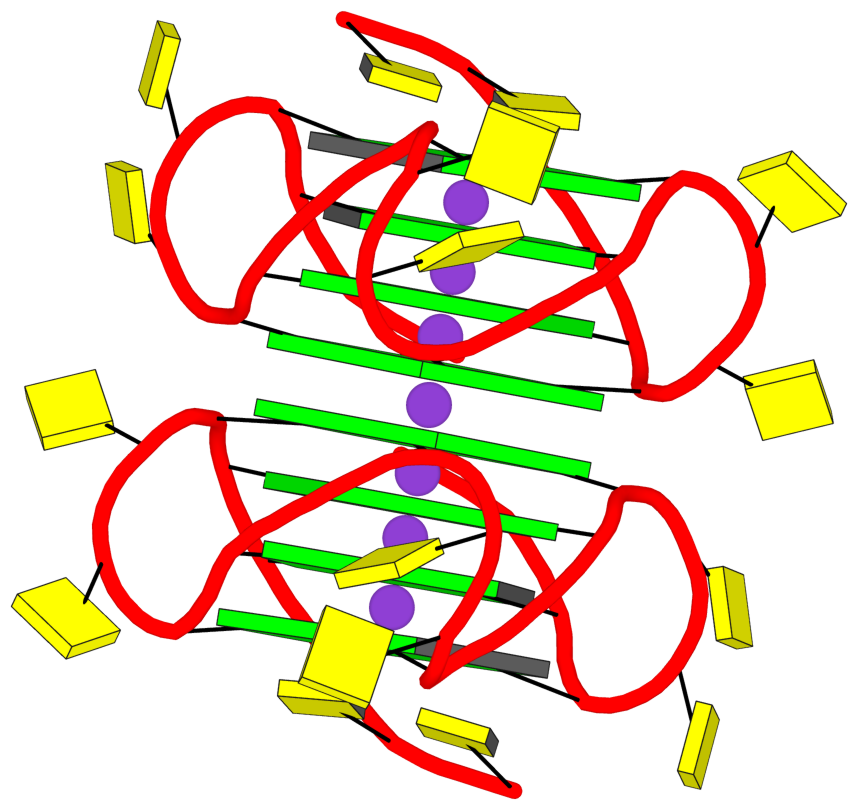
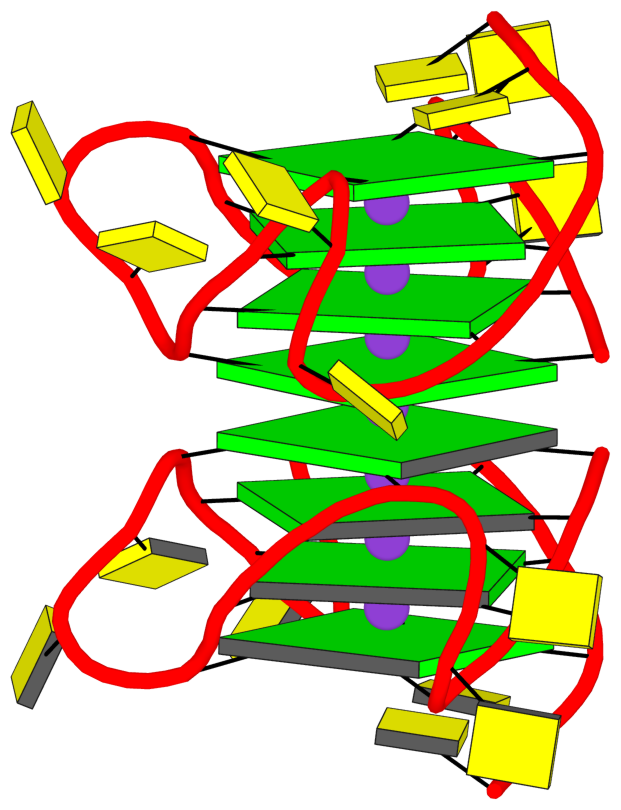
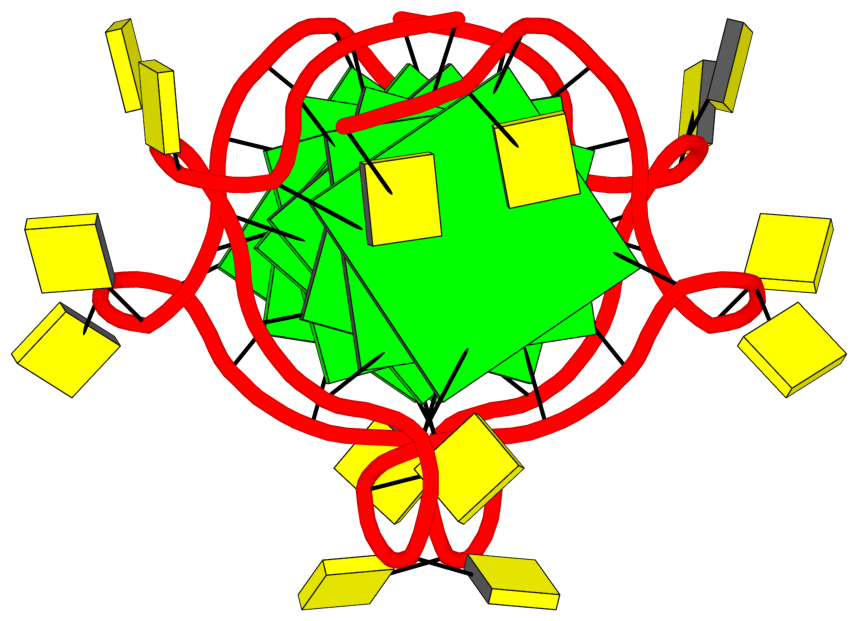
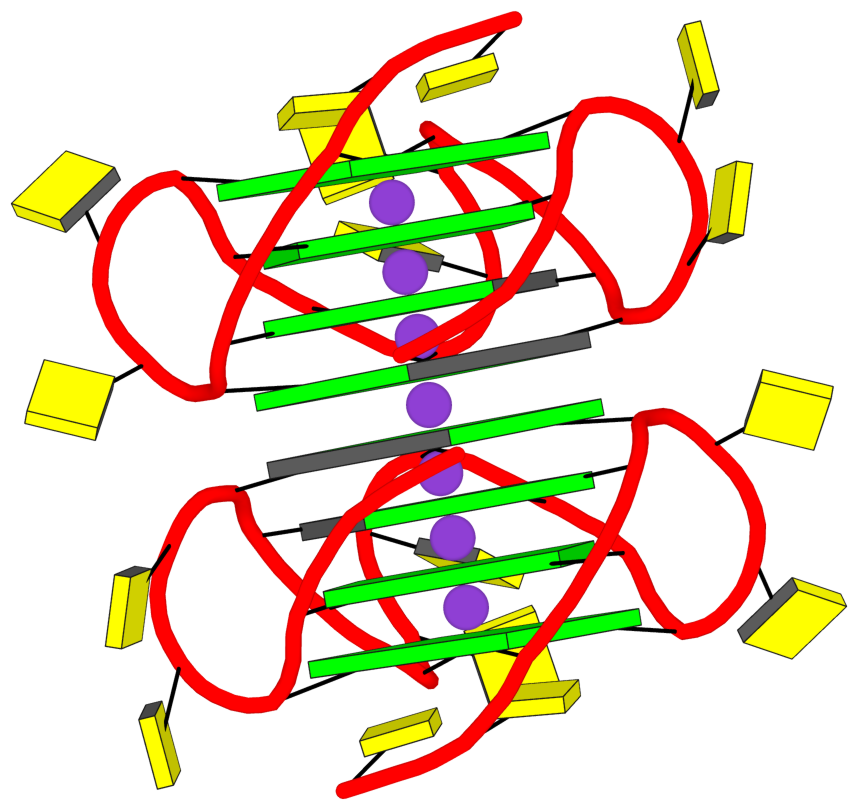
- 8 G-tetrads, 1 G4 helix, 2 G4 stems, 1 G4 coaxial stack, UUUU, parallel, 4+0, 4(-P-P-P), coaxial interfaces: 5'/5'
Cartoon-block schematics in six views (download the tarball)
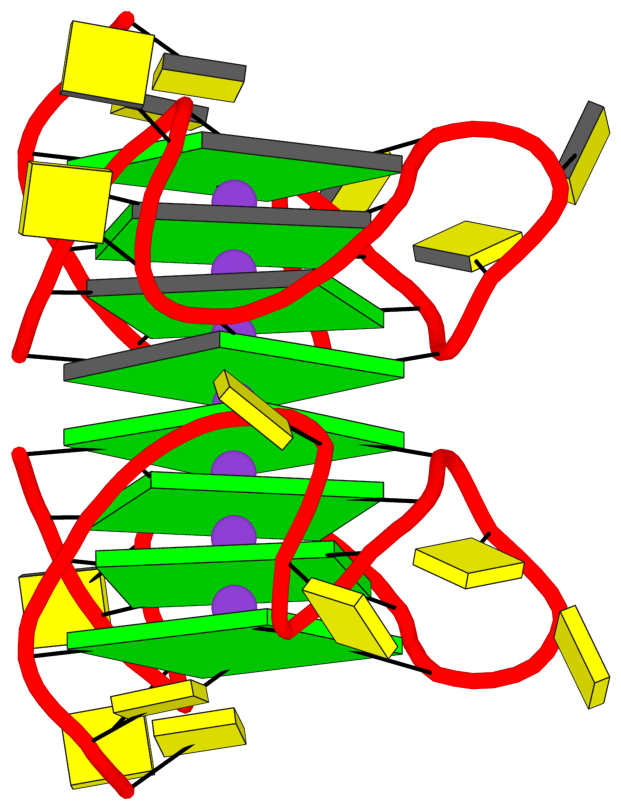
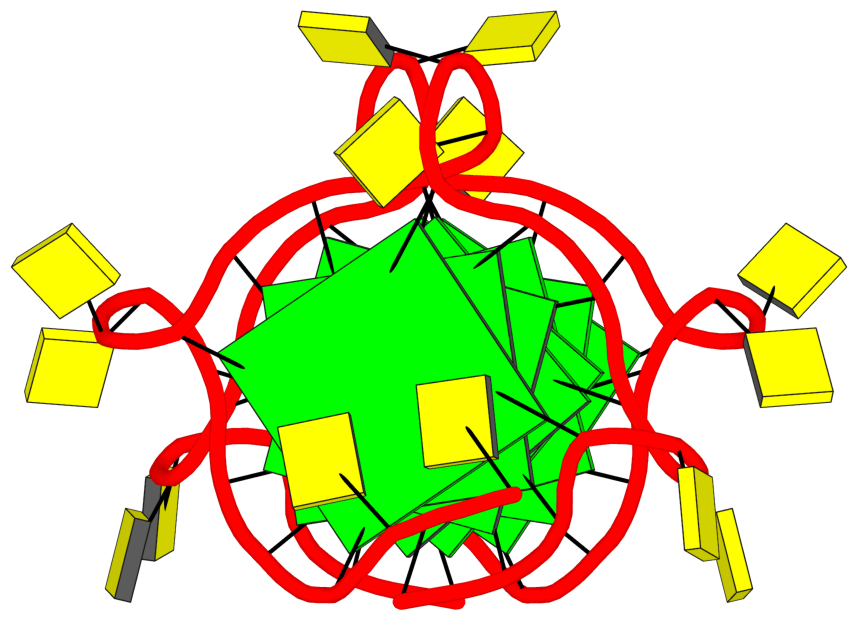
List of 8 G-tetrads
 1 glyco-bond=---- sugar=---- groove=---- planarity=0.046 type=planar O+ nts=4 GGGG 1:A.DG1,1:A.DG7,1:A.DG13,1:A.DG19
 2 glyco-bond=---- sugar=---- groove=---- planarity=0.040 type=planar O+ nts=4 GGGG 1:A.DG2,1:A.DG8,1:A.DG14,1:A.DG20
 3 glyco-bond=---- sugar=---- groove=---- planarity=0.065 type=planar O+ nts=4 GGGG 1:A.DG3,1:A.DG9,1:A.DG15,1:A.DG21
 4 glyco-bond=---- sugar=-.-- groove=---- planarity=0.213 type=bowl   O+ nts=4 GGGG 1:A.DG4,1:A.DG10,1:A.DG16,1:A.DG22
 5 glyco-bond=---- sugar=---- groove=---- planarity=0.046 type=planar O+ nts=4 GGGG 2:A.DG1,2:A.DG7,2:A.DG13,2:A.DG19
 6 glyco-bond=---- sugar=---- groove=---- planarity=0.040 type=planar O+ nts=4 GGGG 2:A.DG2,2:A.DG8,2:A.DG14,2:A.DG20
 7 glyco-bond=---- sugar=---- groove=---- planarity=0.065 type=planar O+ nts=4 GGGG 2:A.DG3,2:A.DG9,2:A.DG15,2:A.DG21
 8 glyco-bond=---- sugar=-.-- groove=---- planarity=0.213 type=bowl   O+ nts=4 GGGG 2:A.DG4,2:A.DG10,2:A.DG16,2:A.DG22
List of 1 G4-helix
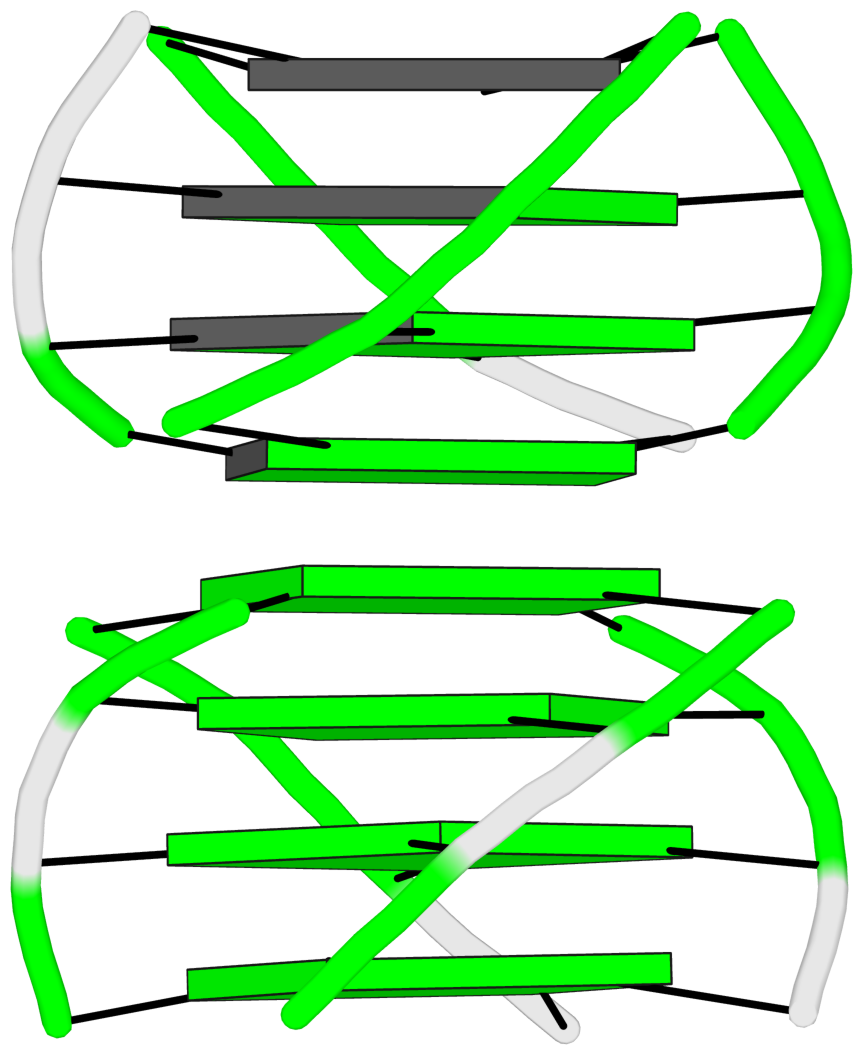
In DSSR, a G4-helix is defined by stacking interactions of G-tetrads, regardless of backbone connectivity, and may contain more than one G4-stem.
Helix#1, 8 G-tetrads, inter-molecular, with 2 stems
|
1 glyco-bond=---- sugar=-.-- groove=---- WC-->Major O+ nts=4 GGGG 1:A.DG4,1:A.DG10,1:A.DG16,1:A.DG22 2 glyco-bond=---- sugar=---- groove=---- WC-->Major O+ nts=4 GGGG 1:A.DG3,1:A.DG9,1:A.DG15,1:A.DG21 3 glyco-bond=---- sugar=---- groove=---- WC-->Major O+ nts=4 GGGG 1:A.DG2,1:A.DG8,1:A.DG14,1:A.DG20 4* glyco-bond=---- sugar=---- groove=---- WC-->Major O+ nts=4 GGGG 1:A.DG1,1:A.DG7,1:A.DG13,1:A.DG19 5 glyco-bond=---- sugar=---- groove=---- Major-->WC O+ nts=4 GGGG 2:A.DG1,2:A.DG19,2:A.DG13,2:A.DG7 6 glyco-bond=---- sugar=---- groove=---- Major-->WC O+ nts=4 GGGG 2:A.DG2,2:A.DG20,2:A.DG14,2:A.DG8 7 glyco-bond=---- sugar=---- groove=---- Major-->WC O+ nts=4 GGGG 2:A.DG3,2:A.DG21,2:A.DG15,2:A.DG9 8 glyco-bond=---- sugar=---. groove=---- Major-->WC O+ nts=4 GGGG 2:A.DG4,2:A.DG22,2:A.DG16,2:A.DG10 step#1 mp(<<,backward) area=13.60 rise=3.39 twist=25.3 step#2 mp(<<,backward) area=15.60 rise=3.34 twist=24.1 step#3 mp(<<,backward) area=8.88 rise=3.28 twist=34.4 step#4 mm(<>,outward) area=28.54 rise=3.33 twist=-9.6 step#5 pm(>>,forward) area=8.88 rise=3.28 twist=34.4 step#6 pm(>>,forward) area=15.60 rise=3.34 twist=24.1 step#7 pm(>>,forward) area=13.60 rise=3.39 twist=25.3 strand#1 DNA glyco-bond=-------- sugar=-------- nts=8 GGGGGGGG 1:A.DG4,1:A.DG3,1:A.DG2,1:A.DG1,2:A.DG1,2:A.DG2,2:A.DG3,2:A.DG4 strand#2 DNA glyco-bond=-------- sugar=.------- nts=8 GGGGGGGG 1:A.DG10,1:A.DG9,1:A.DG8,1:A.DG7,2:A.DG19,2:A.DG20,2:A.DG21,2:A.DG22 strand#3 DNA glyco-bond=-------- sugar=-------- nts=8 GGGGGGGG 1:A.DG16,1:A.DG15,1:A.DG14,1:A.DG13,2:A.DG13,2:A.DG14,2:A.DG15,2:A.DG16 strand#4 DNA glyco-bond=-------- sugar=-------. nts=8 GGGGGGGG 1:A.DG22,1:A.DG21,1:A.DG20,1:A.DG19,2:A.DG7,2:A.DG8,2:A.DG9,2:A.DG10 |
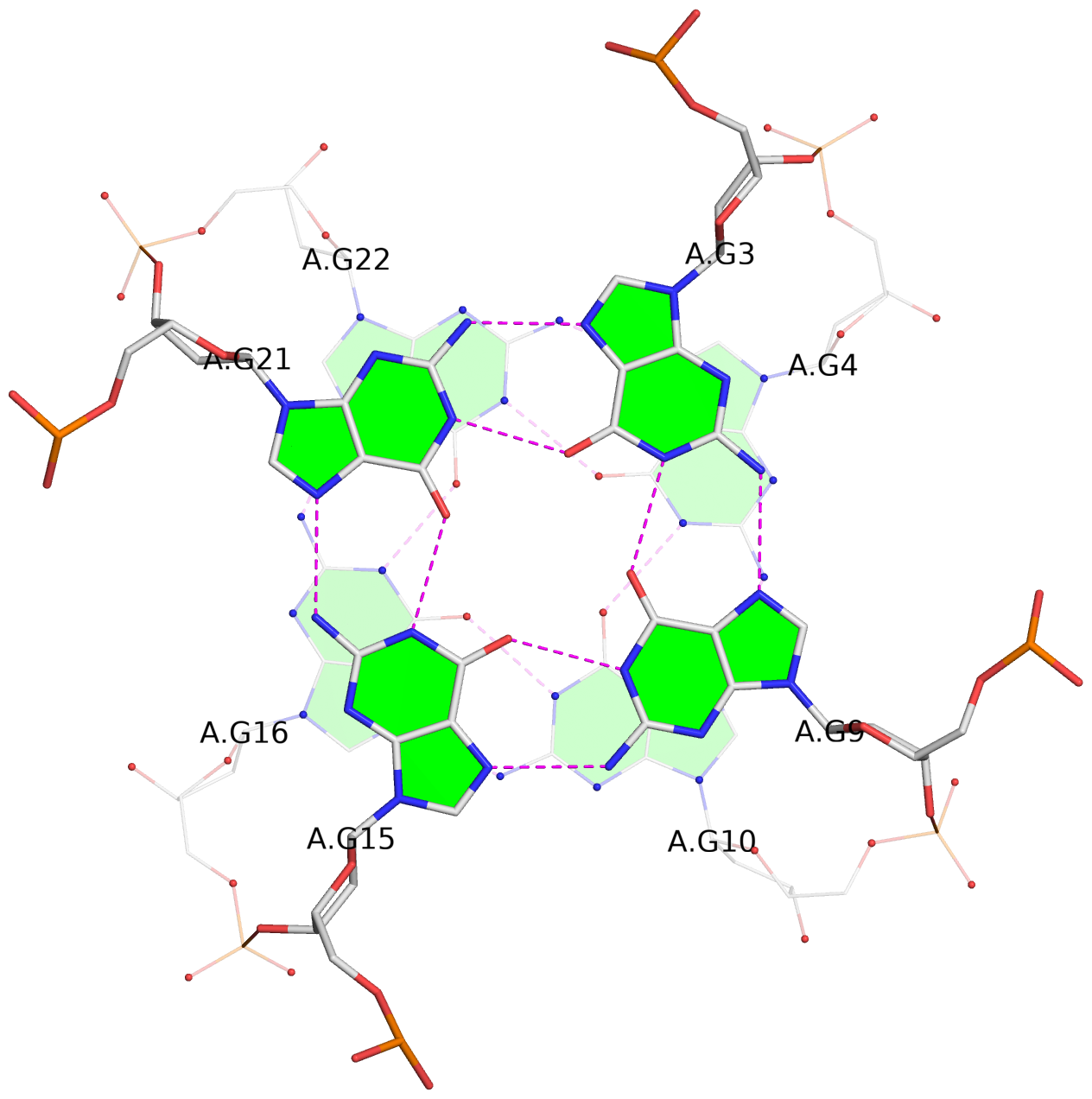
| 7 stacking diagrams | |
|
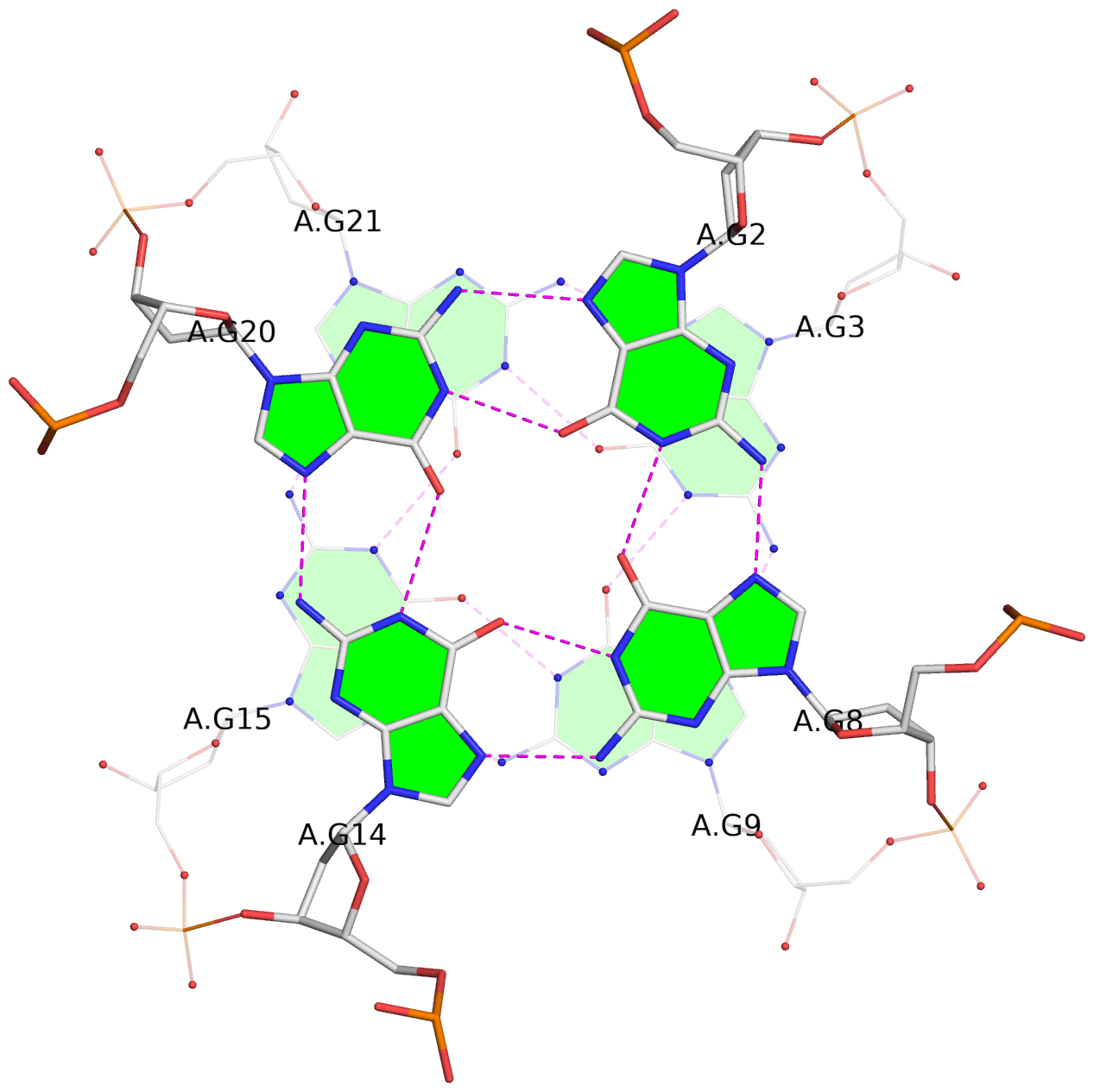
1 glyco-bond=---- sugar=-.-- groove=---- WC-->Major O+ nts=4 GGGG 1:A.DG4,1:A.DG10,1:A.DG16,1:A.DG22 |
|
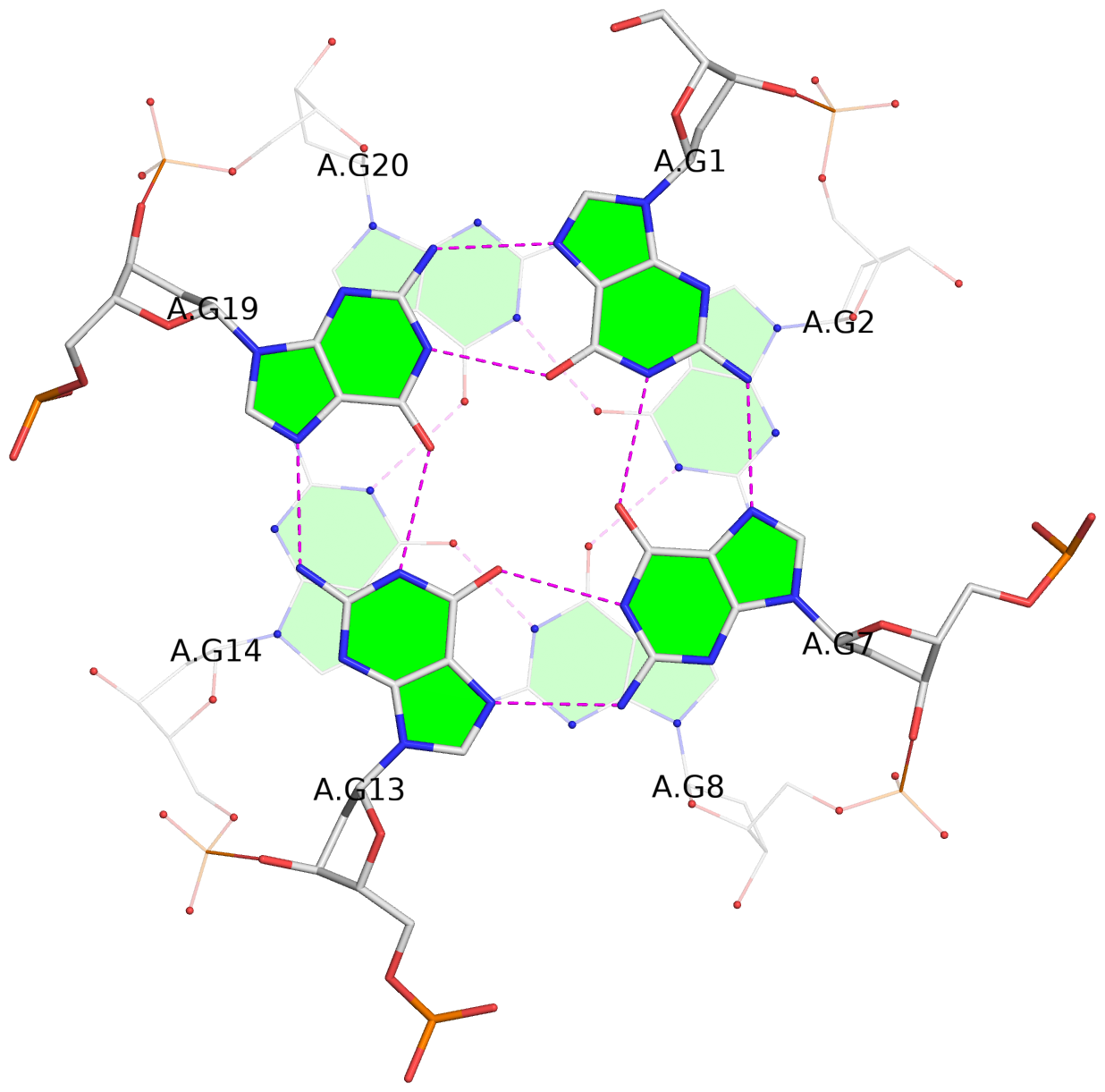
2 glyco-bond=---- sugar=---- groove=---- WC-->Major O+ nts=4 GGGG 1:A.DG3,1:A.DG9,1:A.DG15,1:A.DG21 |
|
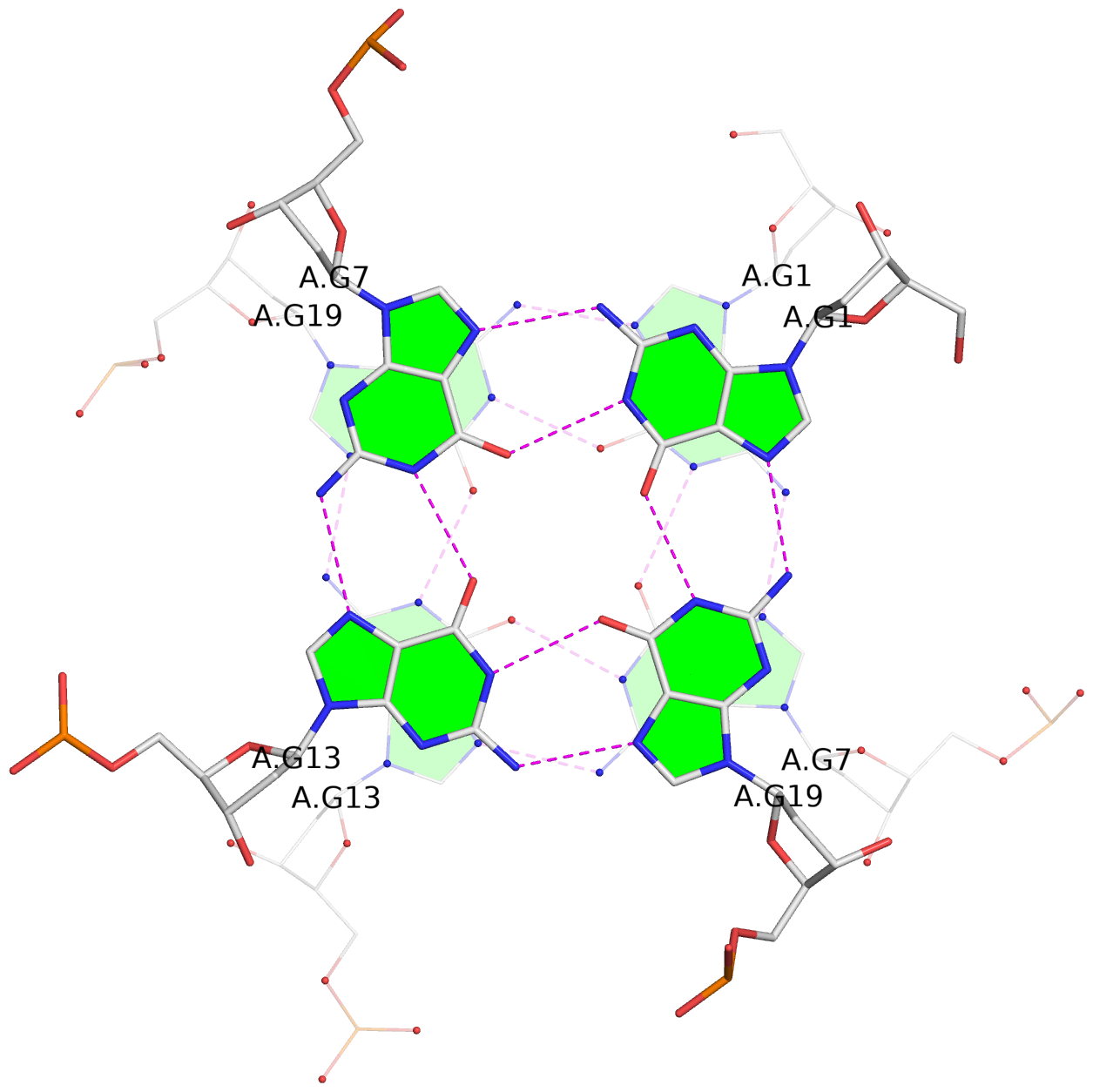
3 glyco-bond=---- sugar=---- groove=---- WC-->Major O+ nts=4 GGGG 1:A.DG2,1:A.DG8,1:A.DG14,1:A.DG20 |
|
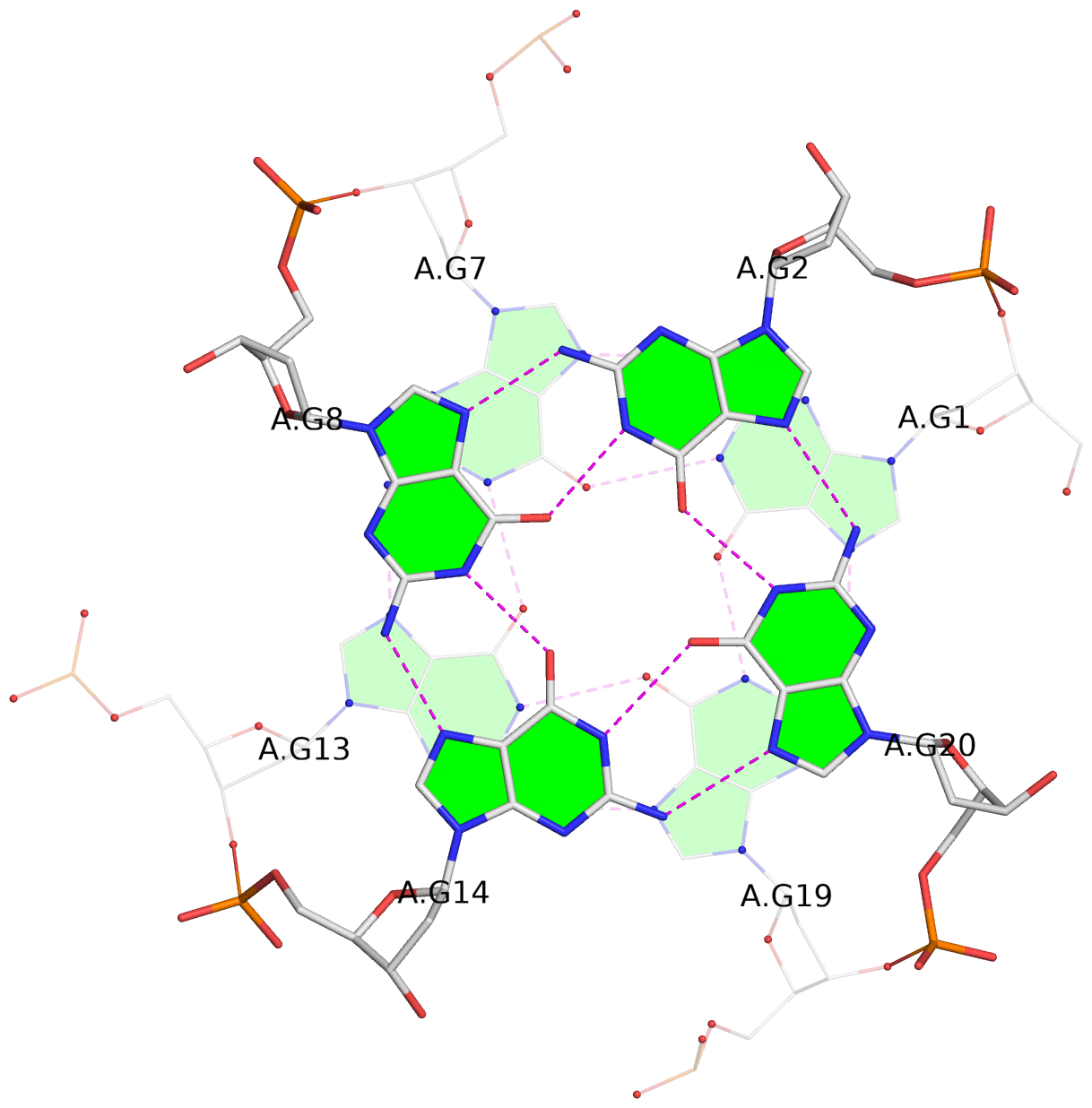
4* glyco-bond=---- sugar=---- groove=---- WC-->Major O+ nts=4 GGGG 1:A.DG1,1:A.DG7,1:A.DG13,1:A.DG19 |
|
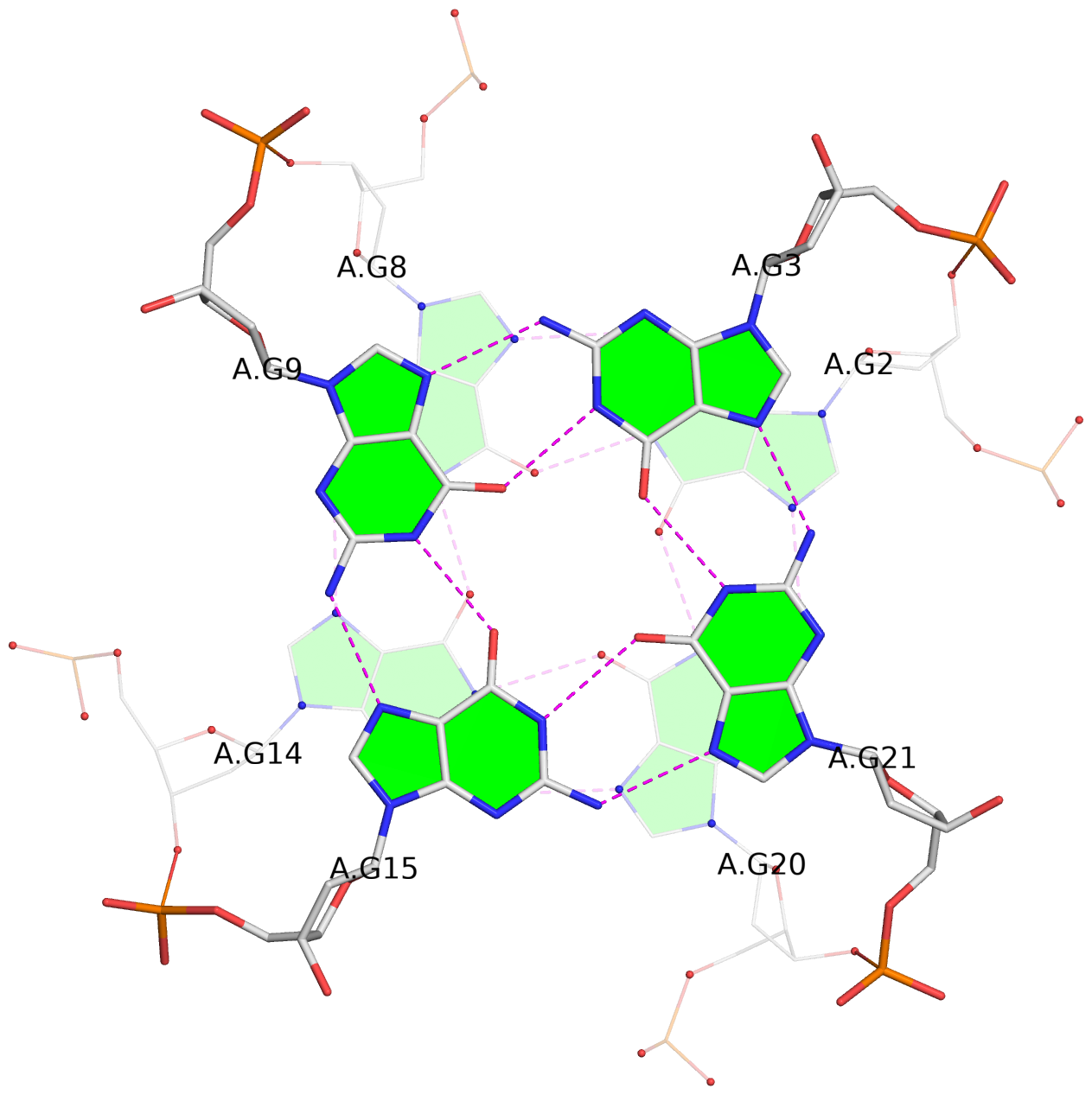
5 glyco-bond=---- sugar=---- groove=---- Major-->WC O+ nts=4 GGGG 2:A.DG1,2:A.DG19,2:A.DG13,2:A.DG7 |
|
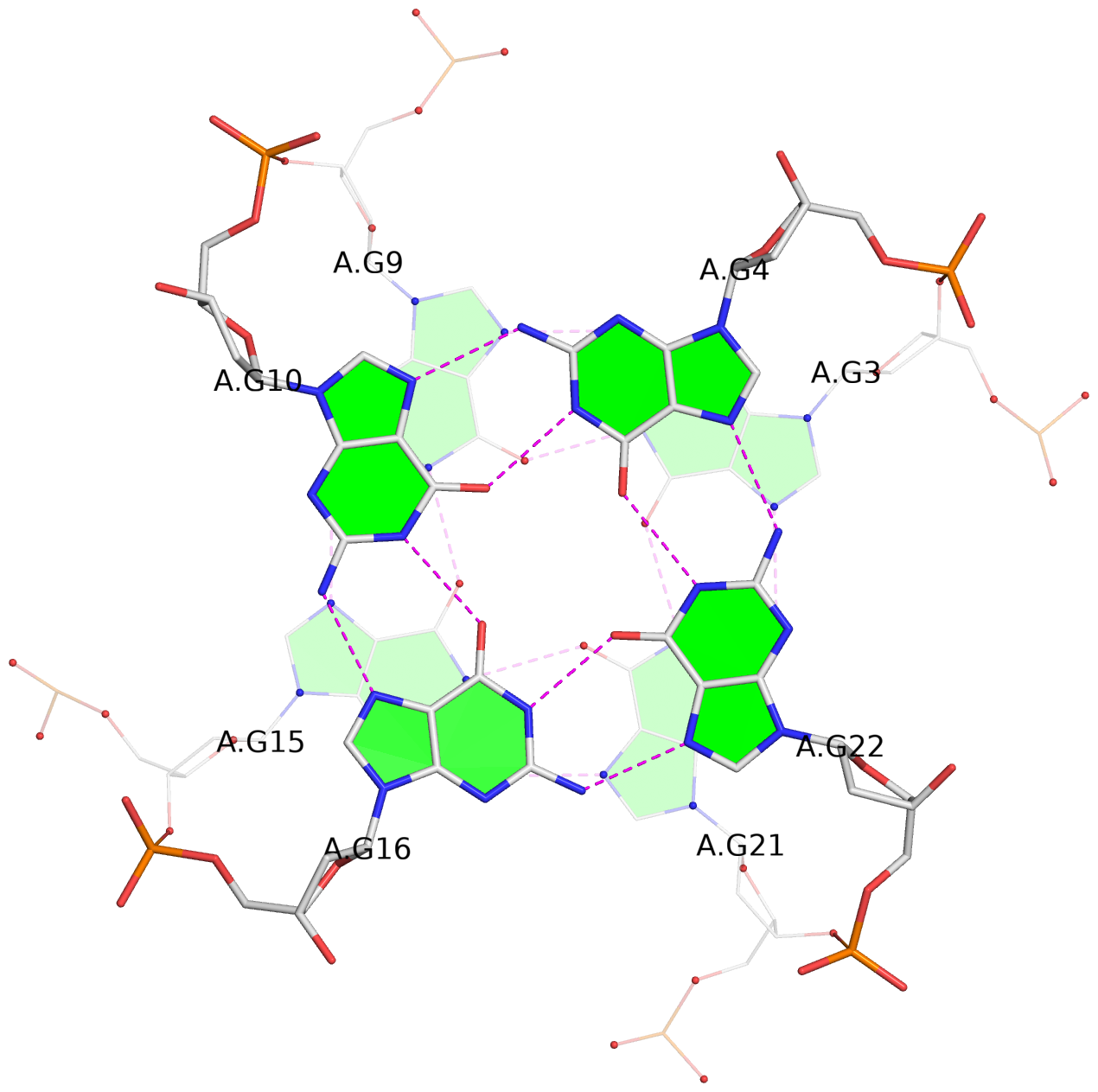
6 glyco-bond=---- sugar=---- groove=---- Major-->WC O+ nts=4 GGGG 2:A.DG2,2:A.DG20,2:A.DG14,2:A.DG8 |
|
7 glyco-bond=---- sugar=---- groove=---- Major-->WC O+ nts=4 GGGG 2:A.DG3,2:A.DG21,2:A.DG15,2:A.DG9 |
List of 2 G4-stems
In DSSR, a G4-stem is defined as a G4-helix with backbone connectivity. Bulges are also allowed along each of the four strands.
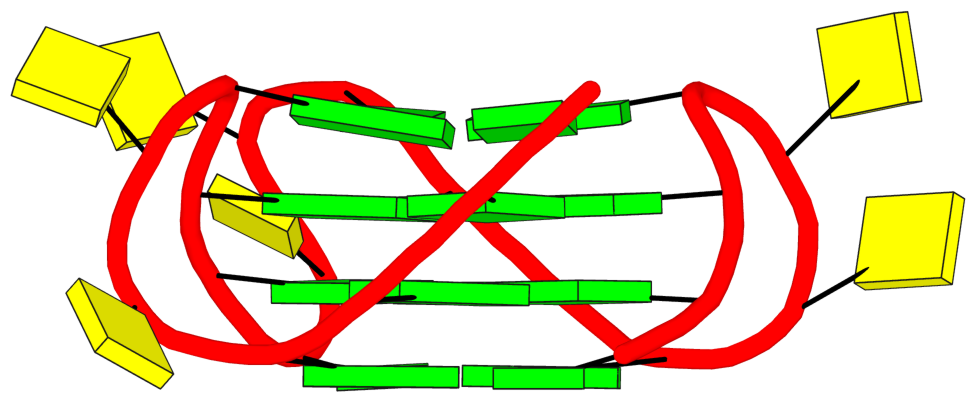
Stem#1, 4 G-tetrads, 3 loops, INTRA-molecular, UUUU, parallel, 4+0, 4(-P-P-P)
|
1 glyco-bond=---- sugar=---- groove=---- WC-->Major O+ nts=4 GGGG 1:A.DG1,1:A.DG7,1:A.DG13,1:A.DG19 2 glyco-bond=---- sugar=---- groove=---- WC-->Major O+ nts=4 GGGG 1:A.DG2,1:A.DG8,1:A.DG14,1:A.DG20 3 glyco-bond=---- sugar=---- groove=---- WC-->Major O+ nts=4 GGGG 1:A.DG3,1:A.DG9,1:A.DG15,1:A.DG21 4 glyco-bond=---- sugar=-.-- groove=---- WC-->Major O+ nts=4 GGGG 1:A.DG4,1:A.DG10,1:A.DG16,1:A.DG22 step#1 pm(>>,forward) area=8.88 rise=3.28 twist=34.4 step#2 pm(>>,forward) area=15.60 rise=3.34 twist=24.1 step#3 pm(>>,forward) area=13.60 rise=3.39 twist=25.3 strand#1 U DNA glyco-bond=---- sugar=---- nts=4 GGGG 1:A.DG1,1:A.DG2,1:A.DG3,1:A.DG4 strand#2 U DNA glyco-bond=---- sugar=---. nts=4 GGGG 1:A.DG7,1:A.DG8,1:A.DG9,1:A.DG10 strand#3 U DNA glyco-bond=---- sugar=---- nts=4 GGGG 1:A.DG13,1:A.DG14,1:A.DG15,1:A.DG16 strand#4 U DNA glyco-bond=---- sugar=---- nts=4 GGGG 1:A.DG19,1:A.DG20,1:A.DG21,1:A.DG22 loop#1 type=propeller strands=[#1,#2] nts=2 CC 1:A.DC5,1:A.DC6 loop#2 type=propeller strands=[#2,#3] nts=2 CC 1:A.DC11,1:A.DC12 loop#3 type=propeller strands=[#3,#4] nts=2 CC 1:A.DC17,1:A.DC18 |
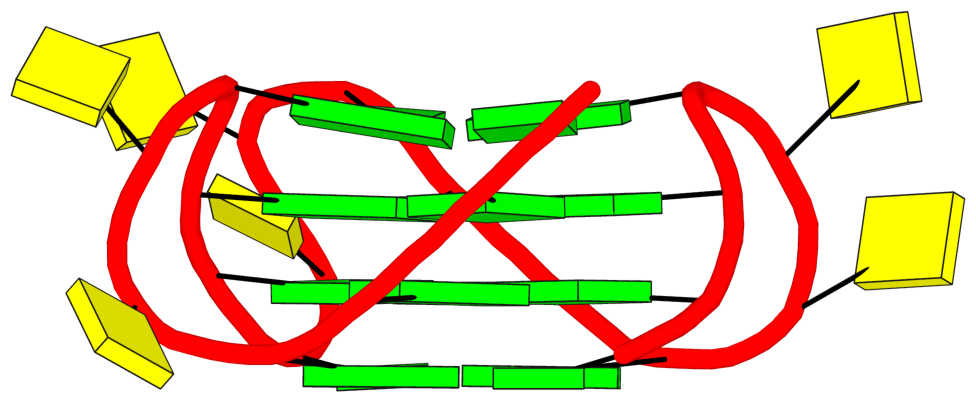
Stem#2, 4 G-tetrads, 3 loops, INTRA-molecular, UUUU, parallel, 4+0, 4(-P-P-P)
|
1 glyco-bond=---- sugar=---- groove=---- WC-->Major O+ nts=4 GGGG 2:A.DG1,2:A.DG7,2:A.DG13,2:A.DG19 2 glyco-bond=---- sugar=---- groove=---- WC-->Major O+ nts=4 GGGG 2:A.DG2,2:A.DG8,2:A.DG14,2:A.DG20 3 glyco-bond=---- sugar=---- groove=---- WC-->Major O+ nts=4 GGGG 2:A.DG3,2:A.DG9,2:A.DG15,2:A.DG21 4 glyco-bond=---- sugar=-.-- groove=---- WC-->Major O+ nts=4 GGGG 2:A.DG4,2:A.DG10,2:A.DG16,2:A.DG22 step#1 pm(>>,forward) area=8.88 rise=3.28 twist=34.4 step#2 pm(>>,forward) area=15.60 rise=3.34 twist=24.1 step#3 pm(>>,forward) area=13.60 rise=3.39 twist=25.3 strand#1 U DNA glyco-bond=---- sugar=---- nts=4 GGGG 2:A.DG1,2:A.DG2,2:A.DG3,2:A.DG4 strand#2 U DNA glyco-bond=---- sugar=---. nts=4 GGGG 2:A.DG7,2:A.DG8,2:A.DG9,2:A.DG10 strand#3 U DNA glyco-bond=---- sugar=---- nts=4 GGGG 2:A.DG13,2:A.DG14,2:A.DG15,2:A.DG16 strand#4 U DNA glyco-bond=---- sugar=---- nts=4 GGGG 2:A.DG19,2:A.DG20,2:A.DG21,2:A.DG22 loop#1 type=propeller strands=[#1,#2] nts=2 CC 2:A.DC5,2:A.DC6 loop#2 type=propeller strands=[#2,#3] nts=2 CC 2:A.DC11,2:A.DC12 loop#3 type=propeller strands=[#3,#4] nts=2 CC 2:A.DC17,2:A.DC18 |
List of 1 G4 coaxial stack
1 G4 helix#1 contains 2 G4 stems: [#1,#2] [5'/5']